- 16 June, 2026

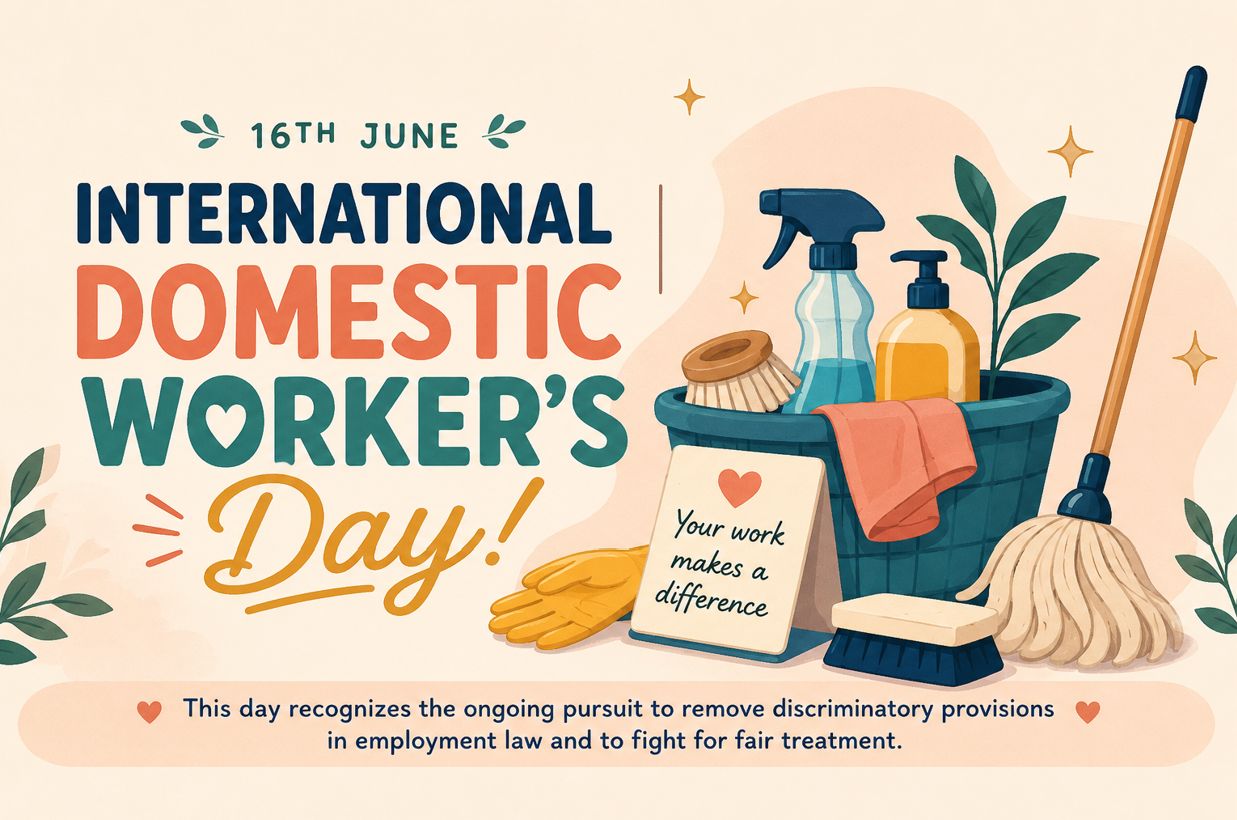
16 June 2026: Every year on June 16th, the world observes International Domestic Workers’ Day, a day dedicated to recognising the millions of people who clean homes, care for children, support elderly family members and perform essential household work that keeps societies functioning.


For generations, domestic work was often undervalued, invisible and excluded from many labour protections. The recognition of this day began after a historic moment in global labour rights: the adoption of the International Labour Organization (ILO) Convention No. 189 on Decent Work for Domestic Workers on June 16, 2011.
This landmark agreement changed the way the world viewed household labour by declaring that domestic work is “work like any other” and that domestic workers deserve dignity, fair wages, safe working conditions and social protection.
International Domestic Workers’ Day is therefore not only a celebration of their contribution but also a reminder that every form of honest labour carries equal dignity.


Domestic workers form one of the largest groups within the global care economy. According to labour organisations, more than 75 million people worldwide work as domestic workers, providing essential services to families and communities.
Yet many continue to face serious challenges.
More than 80% of domestic workers globally operate in informal employment, often without written contracts, healthcare benefits, pensions or legal protection. Many workers experience unfair wages, excessive working hours and vulnerability to exploitation.
Women make up a significant majority of domestic workers worldwide, making labour rights closely connected with issues of gender equality and social justice.
International Domestic Workers’ Day highlights a simple message: the person who cares for a home deserves the same respect and protection as any other worker.
The adoption of ILO Convention No. 189 created an international framework to improve the lives of domestic workers.
The convention encourages countries to provide:
Organisations such as the International Domestic Workers Federation (IDWF) continue to campaign worldwide for governments to strengthen protections and ratify international standards.
Through awareness campaigns, worker unions and advocacy programmes, domestic workers are increasingly gaining a stronger voice in discussions about labour rights.
The goal is not charity but justice — recognising domestic workers as professionals whose contribution is essential to society.
The Catholic Church has long emphasised that every form of honest work has dignity because human labour reflects the creativity and service of God.
A powerful example is Saint Zita of Lucca, recognised as the patron saint of domestic workers and servants.
Born in Italy in the 13th century, Saint Zita spent much of her life working as a domestic servant in the home of a wealthy family. Although her position was considered humble, she became known for her extraordinary kindness, faith and generosity.
According to tradition, Saint Zita treated her responsibilities with great love, serving others as an expression of her devotion to Christ. Stories of miracles connected with her life contributed to her reputation as a model of holiness among ordinary workers.
Her example reminds the world that holiness is not measured by social status or profession. A person serving faithfully in a household can reflect compassion, humility and love just as profoundly as anyone in a public position.
In India, domestic workers continue to represent a vital part of the workforce, particularly in urban areas. Many face challenges related to wages, safety, migration and access to support systems.
The Conference of Catholic Bishops of India (CCBI) works through various commissions connected with social action, human development and the protection of vulnerable communities.
The CCBI can be associated with concerns affecting workers, including the promotion of justice, dignity of labour and awareness of workers’ rights.
The Church’s social teaching continues to emphasise that workers should never be treated merely as economic resources but as human beings with dignity and rights.
International Domestic Workers’ Day carries a powerful message: no work that serves humanity should be considered insignificant.
The future of domestic workers depends on stronger laws, better awareness and societies that recognise the value of care and service.
The journey towards equality is not only about improving wages and protections; it is about changing attitudes. Domestic workers should not be seen as invisible helpers but as valued professionals who contribute daily to the wellbeing of families and communities.
Inspired by figures such as Saint Zita, the world is reminded that dignity comes from the love, commitment and humanity brought to every task.
On June 16th, the global community is called to honour domestic workers — not only with appreciation, but with justice, respect and equal rights.
By Catholic Connect Reporter
© 2026 CATHOLIC CONNECT POWERED BY ATCONLINE LLP