- 21 August, 2026

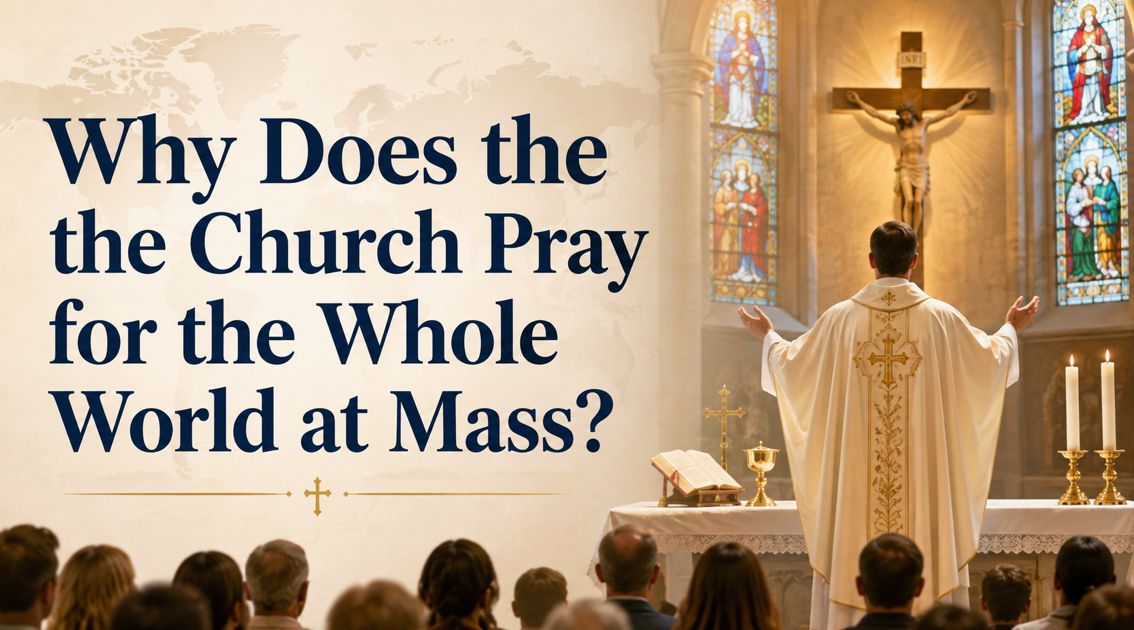
August 21, 2026: The Mass is celebrated in a particular church, with a particular congregation, yet its prayers reach far beyond those gathered there. Catholics pray for the Church, public authorities, those who suffer and the needs of people throughout the world. Why does the Church make this part of the Mass?


Near the end of the Liturgy of the Word, the Church prays the General Intercessions, also called the Prayer of the Faithful. At this moment, the needs of the Church and the whole human family are brought before God.
The petitions normally include prayers for the Church, those who govern, people experiencing suffering or hardship, and the needs of the local community. These intentions may be adapted according to the occasion, but their universal character remains important.


(Click Here to follow Catholic Connect for regular News & Content)
This is more than simply naming different intentions. The gathered assembly joins its prayer to Christ’s intercession and entrusts the needs of others to the Father.
This universal prayer reflects the example of Jesus Himself. In the Gospel of John, Christ offers His great priestly prayer for His disciples and for those who will come to believe through them.
The Church participates in Christ’s prayerful concern whenever she intercedes for others. The Catechism teaches that Christian intercession is an expression of the communion of saints and of a heart attentive to God’s mercy.
In other words, Catholics are not meant to pray only for themselves. At Mass, we are reminded that our faith connects us to the needs of the entire human family.
The General Intercessions are one visible expression of the Mass’s universal prayer. The Eucharistic Prayer also includes intercessions for the Church, the Pope, bishops, clergy, the faithful, the living and the dead, and the unity and salvation of all.
At the heart of the Eucharist is Christ’s one sacrifice. The Mass sacramentally makes present Christ’s one sacrifice, which He offered for the salvation of all humanity, and communicates its fruits to the Church. Through the Church’s intercession, those fruits are also sought for the salvation of the world according to God’s will.
Christ’s sacrifice is not repeated as a new sacrifice at every Mass. Rather, the Church is united to His one saving offering and prayer.
This changes the way we approach Mass. We may arrive carrying our own worries, but the liturgy teaches us to look beyond ourselves.
We pray for people affected by war, poverty and persecution. We pray for those who are sick, lonely or struggling. We pray for public leaders and for those who have lost their faith.
When the Church prays for the whole world at Mass, she participates in Christ’s own intercession for the human family. She does not stand before God as an independent mediator, but in Christ, through Christ and with Christ, entrusting every person to the Father’s mercy.
By Catholic Connect Reporter
Read More :
Why Do Catholics Say the Creed After the Homily?
Why Can’t We Skip the Homily at Sunday Mass?
Three Little Crosses Before the Gospel — But What Do They Mean?
Why Do Catholics Sit for the Readings but Stand for the Gospel?
Why Is There a Psalm Between the Readings?
Why Are There Usually Three Readings at Sunday Mass?
Why Does the Priest Say “The Lord Be with You” So Often at Mass?
Why Do We Keep Saying “Amen” at Mass? What Are We Really Saying?
The Prayer After “Let Us Pray” Changes at Mass—Do You Know Why?
Why Do Catholics Sing the Gloria—but Not at Every Mass?
Why Do We Confess Our Sins at the Start of Mass? The Deeper Meaning Explained
Why Does the Priest Kiss the Altar at Mass?
Why Does Mass Begin and End with the Sign of the Cross?
What Makes the Catholic Mass Different from Other Christian Worship Services?
If God Made the Seventh Day Holy, Why Do Catholics Worship on Sunday?
Four Parts, One Beautiful Story: Understanding the Flow of the Mass
Why Does the Mass Follow the Same Order Every Time? The Church's Timeless Wisdom
Why Do Catholics Call It the Mass? The Answer Begins with Three Latin Words
How the Mass Developed Over 2,000 Years: A Journey Through History and Worship
If God Made the Seventh Day Holy, Why Do Catholics Worship on Sunday?

© 2026 CATHOLIC CONNECT POWERED BY ATCONLINE LLP