- 21 August, 2026

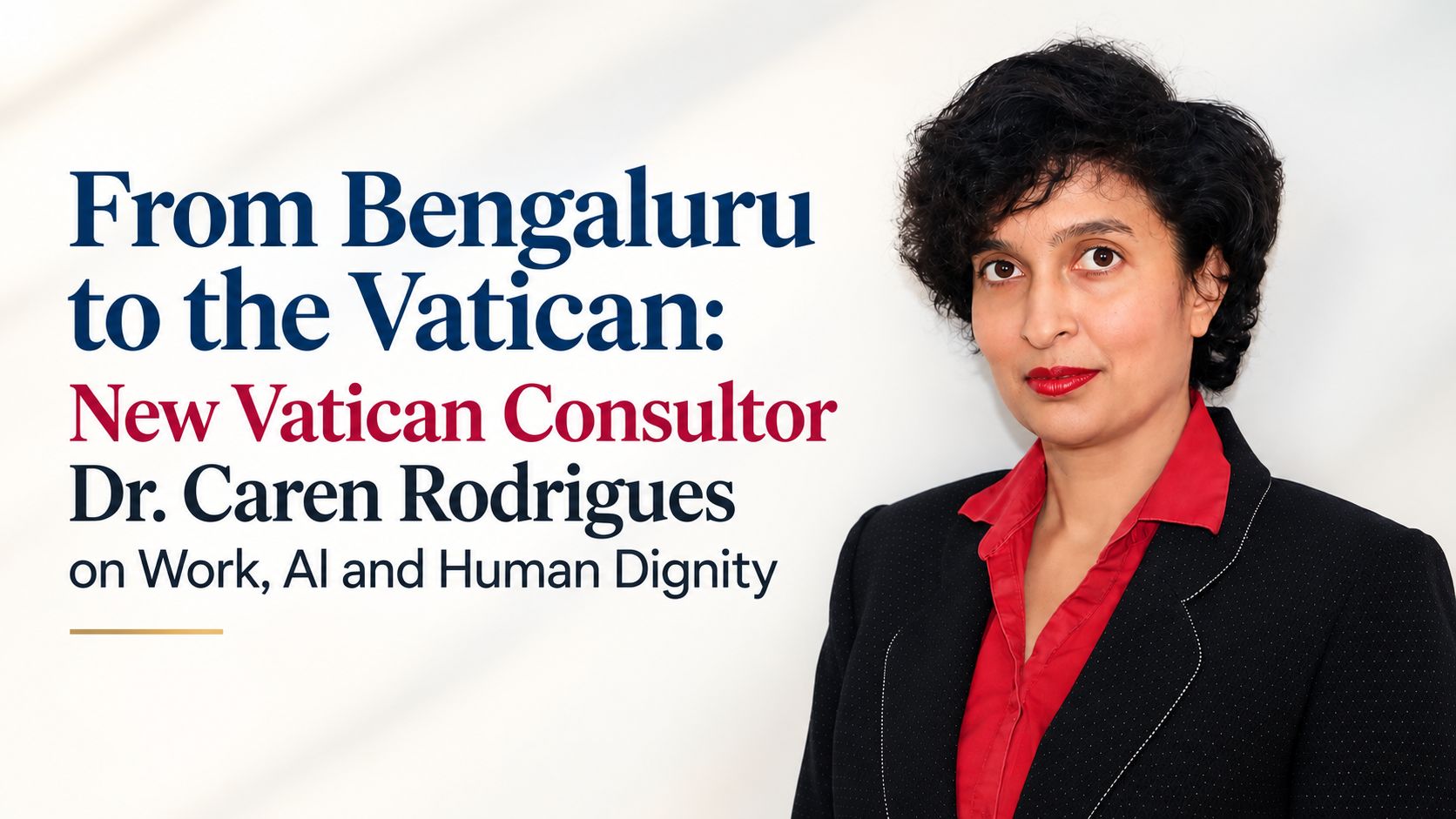
Bengaluru, August 21, 2026: A significant appointment for the Church in India has brought Indian management expertise to the Vatican. Dr. Caren Rodrigues, Associate Professor at St. Joseph’s Institute of Management, Bengaluru, has been appointed by Pope Leo XIV as a Consultor to the Vatican Dicastery for Promoting Integral Human Development.


The appointment brings her expertise in management and organisational behaviour to a Dicastery addressing issues such as work, economic justice, poverty, migration, human rights and care for creation. In an interview with Catholic Connect, Dr. Caren Rodrigues reflects on her appointment, the changing world of work, artificial intelligence, and the relevance of Catholic social teaching in a technology-driven economy.
1. Pope Leo XIV has appointed you as a Consultor to the Dicastery for Promoting Integral Human Development. What does this appointment mean to you personally?
It is an honour and a responsibility, and I will sincerely try to give my best in whatever I am called upon to do. I am grateful for the support and trust of my husband, my parents and family, friends, school teachers, my OB-HR faculty members at the Indian Institute of Management Bangalore (IIMB), the Economy of Francesco, my Directors and leadership at St. Joseph’s Institute of Management (SJIM) and the Bangalore Jesuit educational institutions, all of whom have played indispensable roles in my professional journey.


(Click Here to follow Catholic Connect for regular News & Content)
2. You come from a background in management, organisational behaviour and higher education. What particular perspectives or experiences do you hope to bring to the work of the Dicastery?
The Dicastery deals with matters related to the economy and work, and it is in this area that my background dovetails with the Dicastery’s. My work in management teaching and research deals with the social and environmental repercussions of organizational practices. My background in Organizational Behavior, whose central unit of analysis is the human employee, will, I hope, always keep me focused on the human person. And higher education is directly influenced by, and influences, the economy and the workplace –as educators, the future of our learners is the raison d'être for our work .
3. The Dicastery deals with issues such as work, economic justice, poverty, migration, human rights and care for creation. Which of these areas do you feel requires particularly urgent attention today, and why?
All of these require urgent attention of course. So, speaking only from my area of expertise, I feel that there are still many unresolved issues with regard to work and justice. In some ways, it is an old problem that keeps coming back, with every new phenomenon in human history. Some people benefit tremendously, often unfairly, to the detriment of the majority.
The rapid pace of recent technological developments, while having many obviously positive effects for the world, have hurled us into having to urgently consider how the human worker is being affected by it all. Which workers can benefit? Who is being excluded? How can work enable people to live meaningful and secure lives outside of work, at different stages of their lives? And how do we ensure that our ideas make sound and sustainable financial sense, while respecting human dignity and the environment? Last, but not least, as educators, what skills should we be facilitating our students to develop to succeed in the workplace?
4. How can the experiences and perspectives of India and the Global South contribute to the Church’s reflection on human development at the global level?
Let me speak as an Indian. I think that, as a culturally ancient and constitutionally young nation, we have a tremendous contribution to make to the global conversation on human development. Constitutionally, Indians have put disadvantaged groups at the center of our national project. Our fundamental rights form the basis of our constitutional morality, and over the last eighty years, have become entrenched in successive generations of Indians. Because of this, both our public and private sectors have innovated in different areas of human development, social upliftment and poverty alleviation, and have been successful where richer countries have failed. We also have frugality embedded within our research, development and production systems – like in our space programs – and I think the rest of the world is only now beginning to understand the value of restraint in the expenditure of resources.
5. The world of work is undergoing rapid transformation because of artificial intelligence, automation and the digital economy. What opportunities and risks do you see for workers, especially young people?
As an educator, this issue has been inescapable for several years now, and we still do not have good answers. As early as 2018, I had reflected in my essay for the Peter Drucker Challenge, that AI and automation are coming first for the very jobs that made it possible for millions of Indians to move into the middle class. It is very evident that this is the case now, and that our college graduates and post-graduates are struggling to be placed in a “livable” income job. Of course, the educational regulatory bodies and educational institutions have been trying very hard to meet this challenge. Additionally, we may have to look at sustainable entrepreneurship that is locally responsive, rather than be reliant on employment in private sector corporate jobs outsourced by multinationals seeking cost-cutting.
6. Catholic social teaching places the human person at the centre of economic and social development. How relevant do you think this vision is in today’s increasingly market-driven and technology-driven world?
From Pope Leo XIII’s Rerum Novarum to Pope Leo XIV’s Magnifica Humanitas, the Catholic Church has consistently responded to times of technological disruption by emphasizing the dignity and safeguarding of the human person. As we saw in the response to Magnifica Humanitas, Catholic Social Teaching has become one of the most powerful and trusted voices for those marginalized by market and technological disruptions. It also enables ecumenical dialogue, beyond religion, beyond nationality, emphasizing that different peoples of the world have more in common than we have differences.
7. What message would you like to share with young professionals and students who want to contribute to building a more just, humane and sustainable society?
I would like to say that we need their ideas and we need their 'joie de vivre' (joy of living). The future has challenges, but we have more than enough reason and ability to hope, and work towards building a more just, humane and sustainable society.
We have just celebrated our 80th Independence Day in India, and so I’d like to leave our young people with those perpetually motivating words spoken at our tryst with destiny on that midnight in 1947: “The ambition of the greatest man of our generation has been to wipe every tear from every eye. That may be beyond us, but as long as there are tears and suffering, so long our work will not be over.”
About Dr. Caren Rodrigues
Dr. Caren Rodrigues is a distinguished researcher and management thinker. In 2012, she won the Wings of Excellence Award, called the “Oscar for Young Academics”, at the St. Gallen Symposium in Switzerland. In the 2018 Peter Drucker Challenge, she was ranked sixth in the world for her “innovative contribution to management thought on a contemporary topic of concern”.
Her work has been accepted in outlets including the International Journal of Human Resource Management and European Management Review, as well as at the Academy of Management and its affiliates. She has co-authored a Harvard Business School Case and received the Junior Faculty Award at the 2016 Midwest Academy of Management Conference in the United States.
Dr. Caren earned her doctorate in management from IIMB, where she received the Director’s Merit Award for doctoral coursework. At SJIM, she teaches Organisational Behaviour, Strategic Human Resource Management and Corporate Social Responsibility. She has conducted leadership and professional development workshops for Indian audiences ranging from college professors to the Indian Air Force, as well as research-related workshops for international audiences at the Academy of Management in the United States and its affiliates.
By Catholic Connect Reporter



© 2026 CATHOLIC CONNECT POWERED BY ATCONLINE LLP