- 28 September, 2026

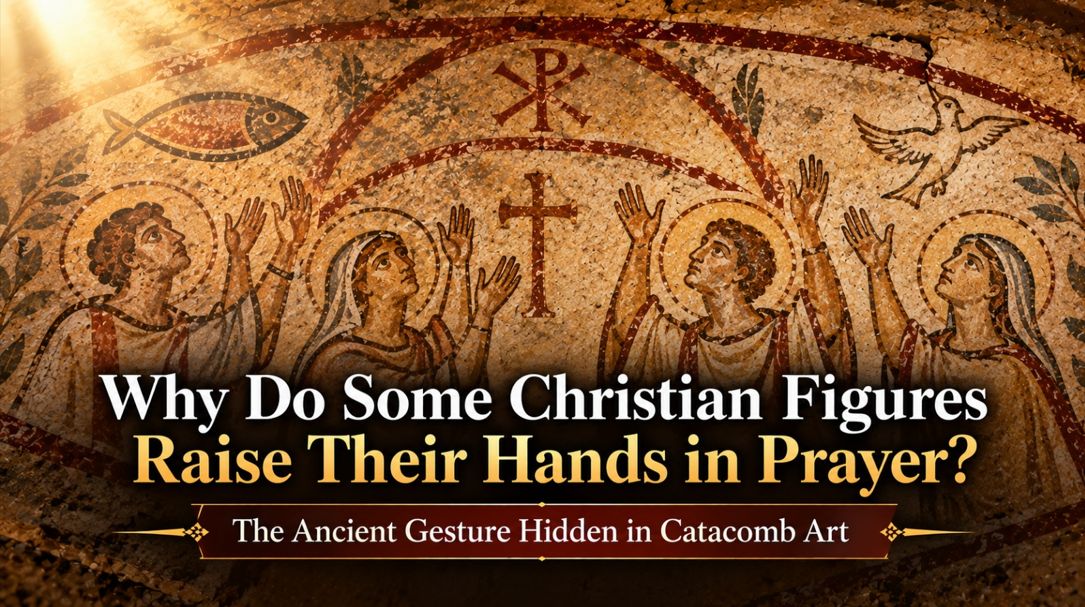
September 28, 2026: Walk through the ancient Christian catacombs of Rome and one gesture appears again and again: a figure standing upright, arms raised, elbows slightly bent and palms open towards heaven. This is the orans posture, one of Christianity's oldest visual expressions of prayer, hope and trust in God. But what did those raised hands actually mean to the first Christians?

The Latin word orans means “praying” or “one who prays”. The posture shows a person standing with the arms raised and the palms open, generally facing upwards or forwards. The gesture was not originally Christian. Similar forms of prayer existed in the ancient Jewish and Greco-Roman worlds. Christianity, however, gave the gesture a distinctive theological meaning.
Its biblical roots are strong. Scripture speaks of “lifting up holy hands” in prayer (1 Timothy 2:8), while Moses raises his hands during Israel's battle in Exodus 17. The Psalms likewise describe stretching out one's hands towards God. The gesture therefore naturally expressed dependence, supplication and trust.
(CLICK HERE to follow Catholic Connect and to stay updated with Catholic News & Content)
The orans became especially significant in early Christian funerary art, particularly in Rome's catacombs from the second and third centuries onwards. These burial places were filled with images expressing Christian hope in the face of death.
An orans figure could represent the soul of the deceased standing before God. Rather than merely showing an individual caught in the act of prayer, the image could communicate peace, salvation and confident hope of eternal life. The raised hands suggested that the person belonged to God and remained oriented towards Him.
The posture also appears in biblical scenes involving divine deliverance. Figures such as Daniel in the lions' den were shown with raised hands to emphasise prayer, trust and God's saving power. For Christians contemplating death, such images proclaimed that suffering and mortality did not have the final word.
The gesture formed a kind of visual shorthand. Open hands could signify supplication, as the believer asks for God's mercy; trust, as the person places themselves entirely in God's hands; and praise, as the soul turns towards its Creator.
The open palms also suggested surrender. Nothing is concealed or grasped: the person stands before God with a posture of receptivity and dependence.
Early Christian interpretation could also connect the outstretched arms with the Cross of Christ. The praying figure's body subtly recalls Christ's crucified form, transforming prayer into a visual reminder of the Passion and the salvation won through it.
The orans posture did not remain confined to ancient art. It continued into Christian iconography, particularly images of the Virgin Mary and saints, and remains recognisable in Catholic worship.
In the Roman Rite, the priest uses the orans posture at various points of the liturgy, especially in prayers addressed to God on behalf of the assembled Church. The gesture expresses the Church's prayer and intercession.
From the catacombs to the altar, therefore, raised hands carry a remarkably enduring message: the Christian turns towards God in prayer, entrusts life and death to Him, and hopes in His promise of salvation.
By Catholic Connect Reporter
Read more:
1) Why Is the Pelican a Symbol of Christ? The Christian Meaning Explained
2) Why Are the Four Gospels Represented by a Man, Lion, Ox and Eagle?
3) Why Is the Rooster a Symbol in Christian Art?
4) Why Do Peacocks Appear in Early Christian Tombs?
5) Why Does a Phoenix Appear in Christian Art?
6) Why Does a Pomegranate Appear in Christian Art?
7) A.M., AM or M? What Do These Mysterious Marian Letters Mean?
8) Why Is Mary Sometimes Shown With a Star?
9) What Does an Anchor Have to Do with Christianity?
10) Why Is a Ship One of Christianity’s Oldest Symbols?
11) Why Does the Grapevine Appear in Christian Art? Its Meaning Explained
12) Why Do Palm Branches Appear in Christian Art?
13) Why Do the Letters “IHS” Appear in Catholic Churches?
14) What is the Chi-Rho (ΧΡ)? The Ancient Symbol for Christ Explained
15) When Mary Looked to Heaven: The Curious Meaning Behind the Virgin’s Upward Gaze
16) Why Do Alpha and Omega Appear in Christian Art?
17) What Does the Eye Inside a Triangle Mean in Christian Art?
18) The Strange ‘Weapons’ of Christ: Why the Instruments of His Passion Appear Together
19) Why Does a Unicorn Appear in Medieval Christian Art?
20) The Mystery Behind Mary’s Enclosed Garden
21) Why Does a Scroll Appear in So Many Christian Images?
22) Why Does Jacob’s Ladder Appear in Christian Art? The Heavenly Stairway That Points to Christ
22) Why Does an Olive Branch Appear in Christian Art? The Biblical Symbol of Peace and Hope


© 2026 CATHOLIC CONNECT POWERED BY ATCONLINE LLP