- 12 May, 2026

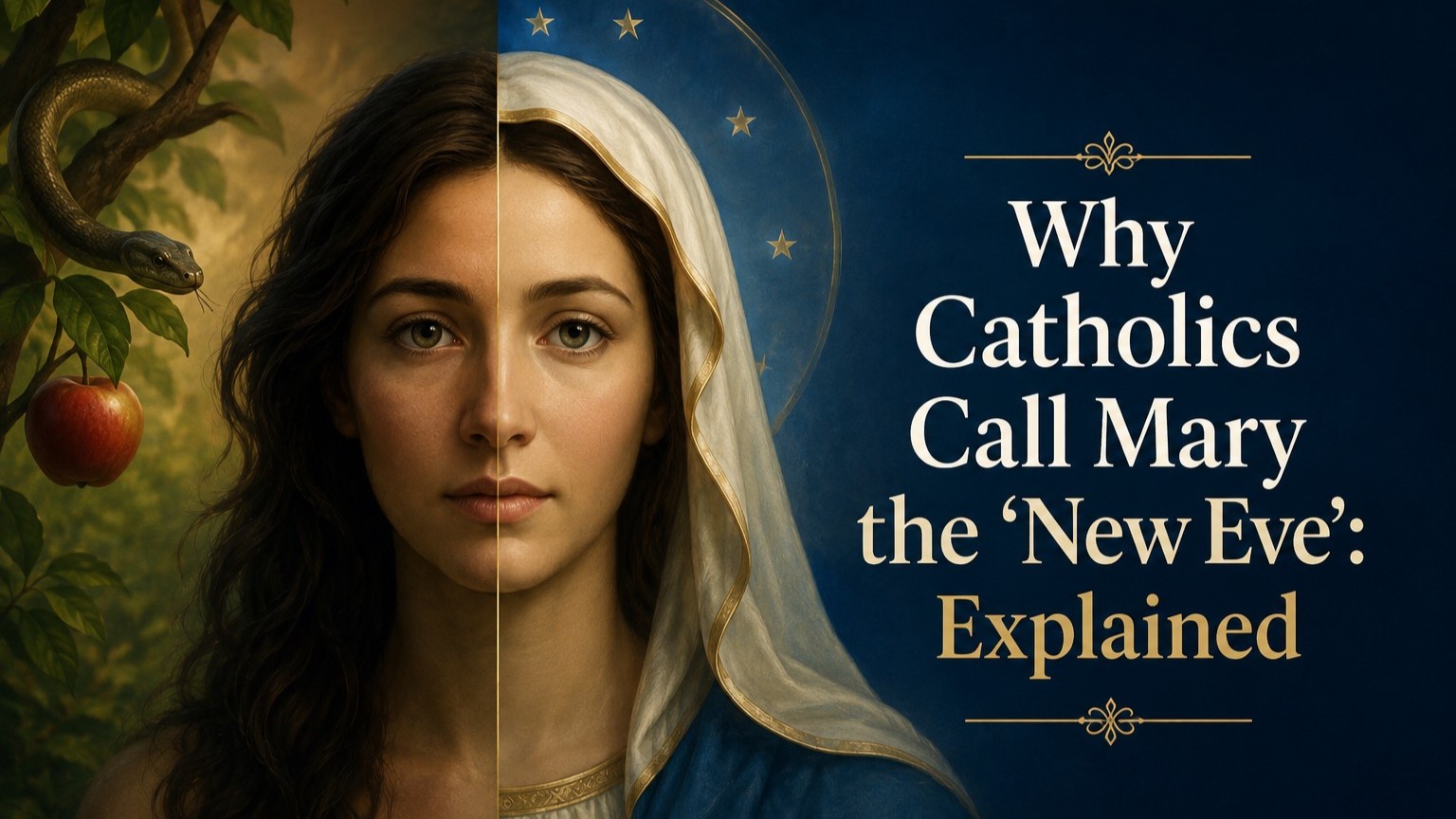
May 12, 2026: Among the many titles given to the Blessed Virgin Mary, one of the most profound and ancient is “the New Eve.” Long before Marian apparitions, feast days, or devotions became widespread, early Christians reflected on how Mary’s role in salvation history mirrored—and reversed—the role of Eve in the Garden of Eden. While Eve’s disobedience contributed to humanity’s fall, Mary’s obedience opened the way for humanity’s redemption through Jesus Christ.


The idea is deeply rooted in Scripture and was developed by some of the earliest Church Fathers. It reveals how God works through human cooperation and how Mary’s humble “yes” became part of the divine plan to restore what had been broken since the beginning.
Eve and the Fall of Humanity
In the Book of Genesis, Eve listened to the serpent and chose to distrust God’s command. Together with Adam, she participated in the first act of disobedience, bringing sin, suffering, and death into the world. Humanity’s relationship with God was fractured, and the consequences of that fall echoed throughout history.


Eve was not evil; she was created good. Yet her decision became symbolic of humanity’s tendency to turn away from God’s will.
Mary and the Beginning of Redemption
Centuries later, another woman entered salvation history in a dramatically different way.
When the angel Gabriel announced that she would become the mother of the Saviour, Mary responded with faith and surrender: “Let it be done to me according to your word” (Luke 1:38). Unlike Eve, who doubted God’s word, Mary trusted it completely.
The early Church saw a striking parallel between the two women:
Genesis 3:15 and the Promise of a New Woman
One of the strongest Biblical foundations for understanding Mary as the New Eve comes from Genesis 3:15, often called the Protoevangelium or “First Gospel.” After Adam and Eve fell into sin, God told the serpent: “I will put enmity between you and the woman, and between your offspring and hers; he will crush your head, and you will strike his heel.”
Catholics have traditionally understood this verse as pointing forward to Jesus and Mary. Jesus is seen as the offspring who defeats evil and sin, while “the woman” is viewed as a prophetic image of Mary, who stands in complete opposition to the serpent through her obedience to God.
Where Eve cooperated with temptation, Mary cooperated with grace.
Jesus Calling Mary “Woman”
Another significant connection appears in the Gospel of John. Jesus refers to Mary as “Woman” at both the wedding at Cana (John 2:4) and at the foot of the Cross (John 19:26). Many Biblical scholars believe this was intentional symbolism. Just as Eve was called “woman” at the beginning of creation, Mary appears as the “woman” at the beginning of the new creation brought through Christ.
At Cana, Mary’s intercession precedes Jesus’ first public miracle. At Calvary, she stands beside the Cross as Jesus completes the work of redemption. These moments further reinforce her unique role in salvation history.
The Early Church Fathers and the “New Eve”
The title “New Eve” is not a modern invention. As early as the second century, Christian writers began drawing this comparison.
St. Justin Martyr and St. Irenaeus of Lyons both explained that just as humanity fell through the disobedience of a virgin, Eve, salvation began through the obedience of another virgin, Mary.
St. Irenaeus famously wrote that “the knot of Eve’s disobedience was untied by Mary’s obedience.” In other words, what Eve helped bind through distrust, Mary helped loosen through faith.
This comparison also highlights Jesus as the “New Adam.” Just as Adam and Eve were central to humanity’s fall, Jesus and Mary became central figures in humanity’s redemption.
Mary’s Role Always Leads to Christ
The Church does not teach that Mary replaces Christ or saves humanity by her own power. Rather, her role is entirely connected to Jesus.
Mary’s greatness lies in her willingness to cooperate with God’s plan. Through her faith, Christ took flesh and entered the world. Every Marian title—including “New Eve”—ultimately points back to Jesus and His saving mission.
Catholics honour Mary not because she is divine, but because of the unique role God entrusted to her in salvation history.
(CLICK HERE to follow Catholic Connect and to stay connected with the Church)
Why This Title Matters Today
The title “New Eve” reminds Christians that God brings restoration where humanity experiences brokenness. It also shows that obedience, humility, and trust in God can transform history.
In a world often marked by confusion and self-reliance, Mary stands as a model of faithful surrender. Her response to God was simple yet courageous, and through it, hope entered the world anew.
For many believers, reflecting on Mary as the New Eve is not merely a theological idea—it is an invitation to imitate her trust in God, especially during uncertainty and struggle.
As Eve once stood at the beginning of humanity’s fall, Mary stood at the beginning of humanity’s redemption, pointing always to Christ, the source of new life.
By Catholic Connect Reporter
Also Read:
© 2026 CATHOLIC CONNECT POWERED BY ATCONLINE LLP