- 05 October, 2026

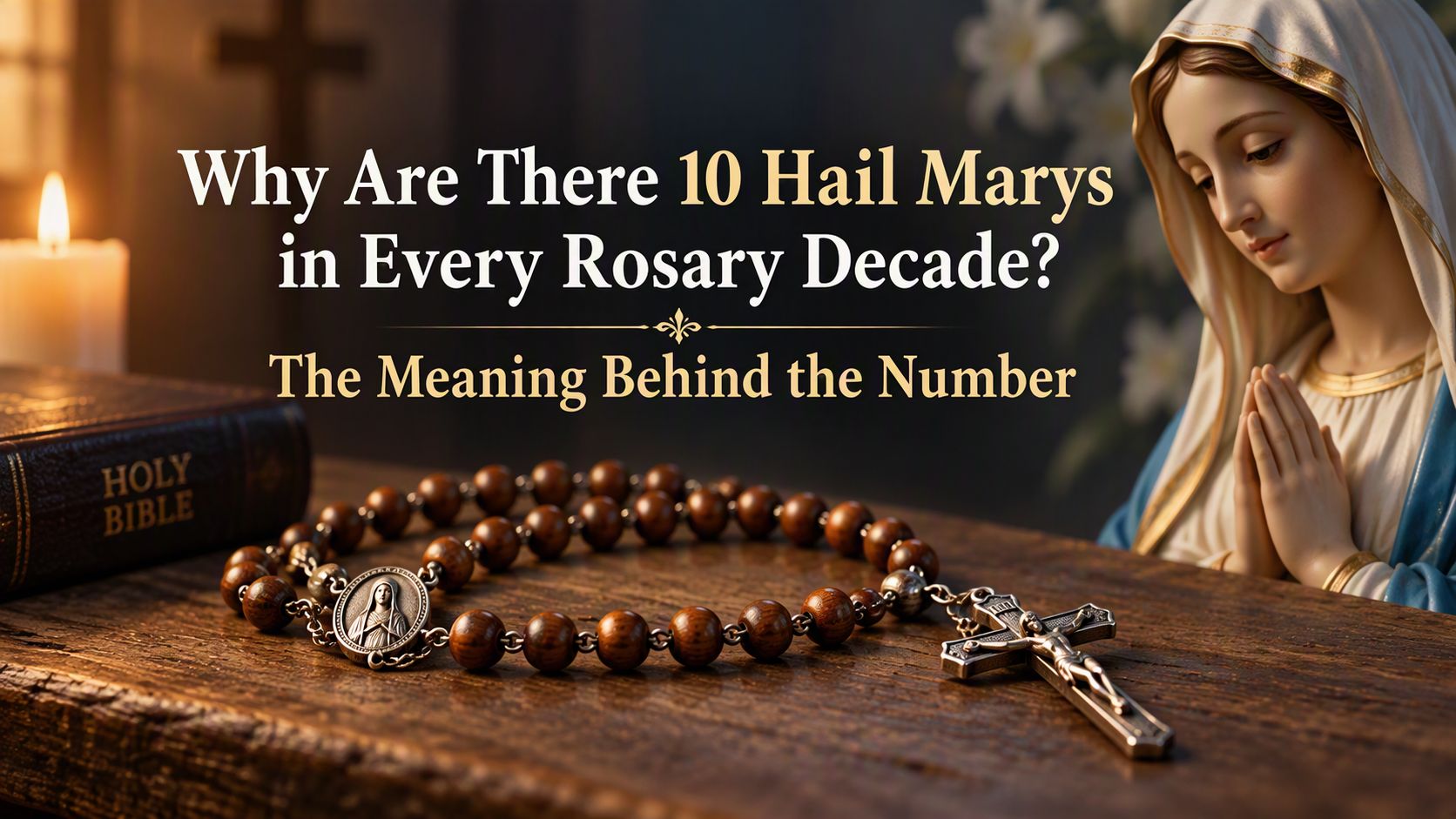
October 5, 2026: The Rosary has a distinctive rhythm: one Our Father, followed by ten Hail Marys, and then a Glory Be. But why exactly ten Hail Marys? Is the number found in Scripture, or did it develop through the history of Christian prayer? The answer reveals something important about how the Rosary combines vocal prayer with meditation on the life of Christ.


A decade simply means a group of ten. In the Rosary, each decade begins with the announcement of one mystery, followed by the Our Father, ten Hail Marys, and the Glory Be. The Fatima Prayer is also commonly added after the Glory Be, although it is not an essential part of the traditional structure.
The five decades of a standard Rosary therefore contain fifty Hail Marys. They are arranged around five mysteries drawn from the life of Jesus and, closely connected with Him, the life of the Blessed Virgin Mary.
There is no biblical command requiring ten Hail Marys. The number developed through the historical growth of the Rosary.
During the Middle Ages, monks regularly prayed the 150 Psalms of the Psalter. Christians who could not read or did not have access to a Psalter sought simpler ways of participating in this tradition of prayer. Repeated prayers, including the Our Father and eventually the Hail Mary, became increasingly common.
The 150 Hail Marys of the developing Marian Psalter were eventually organised into groups of ten. These groups became known as decades. Over time, the Rosary developed into the familiar structure in which each decade provides a period for contemplating a particular mystery of salvation.
Thus, ten is principally a historical and devotional structure, not a number possessing a special doctrinal status.
The ten prayers provide a steady rhythm for contemplation. The Rosary is not intended simply to count prayers. As Pope St. John Paul II explained in Rosarium Virginis Mariae, it is fundamentally a prayer for contemplating Christ with Mary.
For example, while praying the First Joyful Mystery, the Annunciation, the Christian reflects upon the angel's message, Mary's faith, her “yes” to God and, above all, the mystery of the Incarnation. The repeated Hail Marys provide time for the mind to remain with this Gospel scene rather than rushing immediately to the next mystery.
The order itself is deeply theological. The Our Father is the prayer taught by Jesus Himself (Matthew 6:9–13), so each decade begins by turning towards God the Father.
The Hail Mary then repeatedly directs attention to Christ: “Blessed is the fruit of thy womb, Jesus.” Its biblical words come principally from the Gospel accounts of the Annunciation and Visitation.
The decade therefore has a Trinitarian movement: prayer is addressed to the Father, Christ remains at the centre of meditation, and the decade concludes with the Glory Be to the Father, Son and Holy Spirit.
The ten Hail Marys are therefore not ten isolated prayers. They form a spiritual framework for meditation. Their repetition quietens distraction and gives the mind time to enter more deeply into the mystery being contemplated.
The Rosary's structure ultimately serves its central purpose: to contemplate Christ, remember the mysteries of salvation, and draw closer to Him with Mary as a guide in prayer.
By Catholic Connect Reporter
Know more about the rosary:
1) Why Does October Belong to the Rosary? The Story Behind the Church’s Marian Month
2) Why Are There 59 Beads on a Rosary? The Story Behind Its Traditional Structure




© 2026 CATHOLIC CONNECT POWERED BY ATCONLINE LLP