- 02 September, 2026

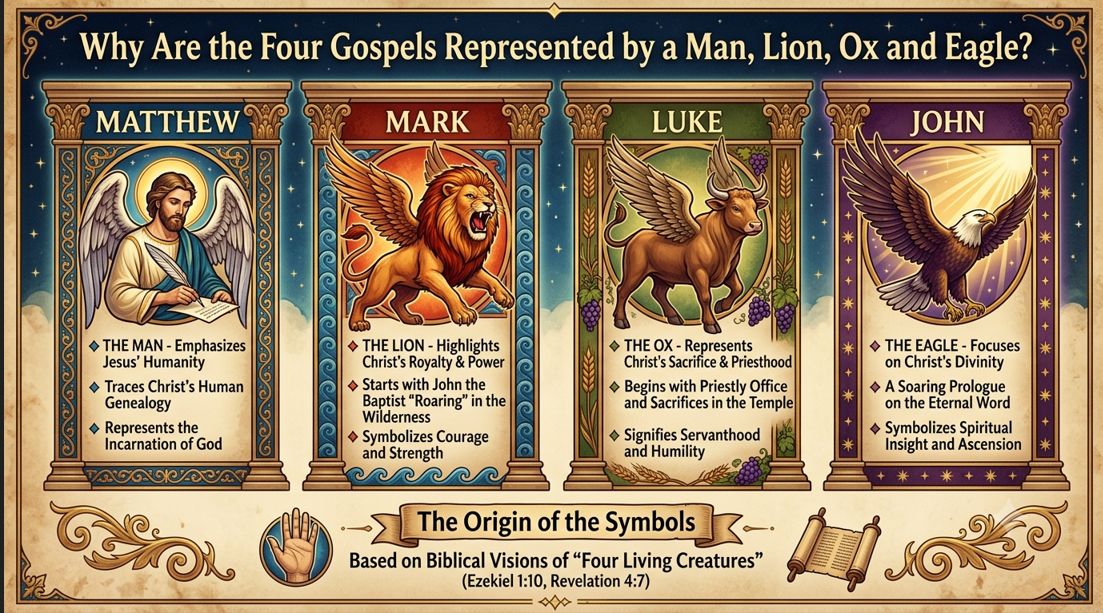
September 2, 2026: In Christian art, the four Gospels are traditionally represented by a winged man, a lion, an ox and an eagle. Known as the tetramorph, meaning “fourfold form,” these symbols are associated with the four Evangelists: Matthew, Mark, Luke and John.


The symbolism has its biblical roots in the visions of Ezekiel and the Book of Revelation. Scripture, however, does not explicitly identify these four creatures with the four Gospel writers. Rather, the Church gradually came to interpret them as fitting symbols of the four Evangelists.
Different arrangements existed among early Christian writers, but the association that became customary in the West is Matthew with the man, Mark with the lion, Luke with the ox, and John with the eagle.


In Ezekiel 1:5–10, the prophet sees four mysterious living creatures associated with God's heavenly glory. Each has four faces: a human being, a lion, an ox and an eagle. The imagery appears again in Ezekiel 10, where the creatures are associated with the cherubim.
The vision is echoed in Revelation 4:6–8, where St. John sees four living creatures surrounding God's throne. One resembles a lion, another an ox, another has a human appearance, and the fourth is like a flying eagle. They continually worship God, proclaiming His holiness.
These passages provide the biblical foundation for the later Christian symbolism.
Matthew is represented by a winged man or angel because his Gospel begins with Christ's human genealogy, tracing His ancestry through Abraham and David. The symbol therefore recalls the humanity of Christ and the mystery of the Incarnation.
Mark is represented by a winged lion because his Gospel opens with John the Baptist proclaiming in the wilderness: “The voice of one crying in the wilderness.” This powerful proclamation became the primary Western explanation for Mark's lion.
The lion can also suggest strength, majesty and, in some Christian interpretations, Christ's victory and Resurrection. These are additional traditional associations rather than the principal explanation for Mark's symbol.
Luke is represented by a winged ox because his Gospel soon introduces Zechariah, a priest serving in the Temple. The ox was a traditional sacrificial animal and therefore recalls sacrifice, priesthood and Christ's saving Passion.
The biblical text of Revelation is sometimes translated “ox” and sometimes “calf,” so both terms are found in Christian tradition.
John is represented by an eagle because his Gospel soars immediately into the mystery of Christ's divinity: “In the beginning was the Word.” The eagle, traditionally associated with height and heavenly vision, therefore represents John's profound contemplation of Christ as the eternal Word.
The tetramorph became an important feature of Christian art, appearing in Gospel manuscripts, mosaics, sculptures, stained-glass windows and church architecture. The symbols are often shown around Christ in Majesty, recalling the heavenly throne room of Revelation.
The four symbols are a venerable Christian tradition rather than an explicit biblical identification. Early writers such as St. Irenaeus and St. Augustine proposed different arrangements before the Western tradition settled on the familiar association of Matthew with the man, Mark with the lion, Luke with the ox and John with the eagle.
The symbols ultimately remind the Church that the four canonical Gospels are distinct witnesses, yet united in proclaiming the one Jesus Christ, true God and true man, and the one Gospel of salvation.
Four Evangelists. Four witnesses. One Christ. One Gospel of salvation.
By Catholic Connect Reporter
Read More:
Sep 1st : Why Is the Pelican a Symbol of Christ? The Christian Meaning Explained





© 2026 CATHOLIC CONNECT POWERED BY ATCONLINE LLP