- 02 September, 2026

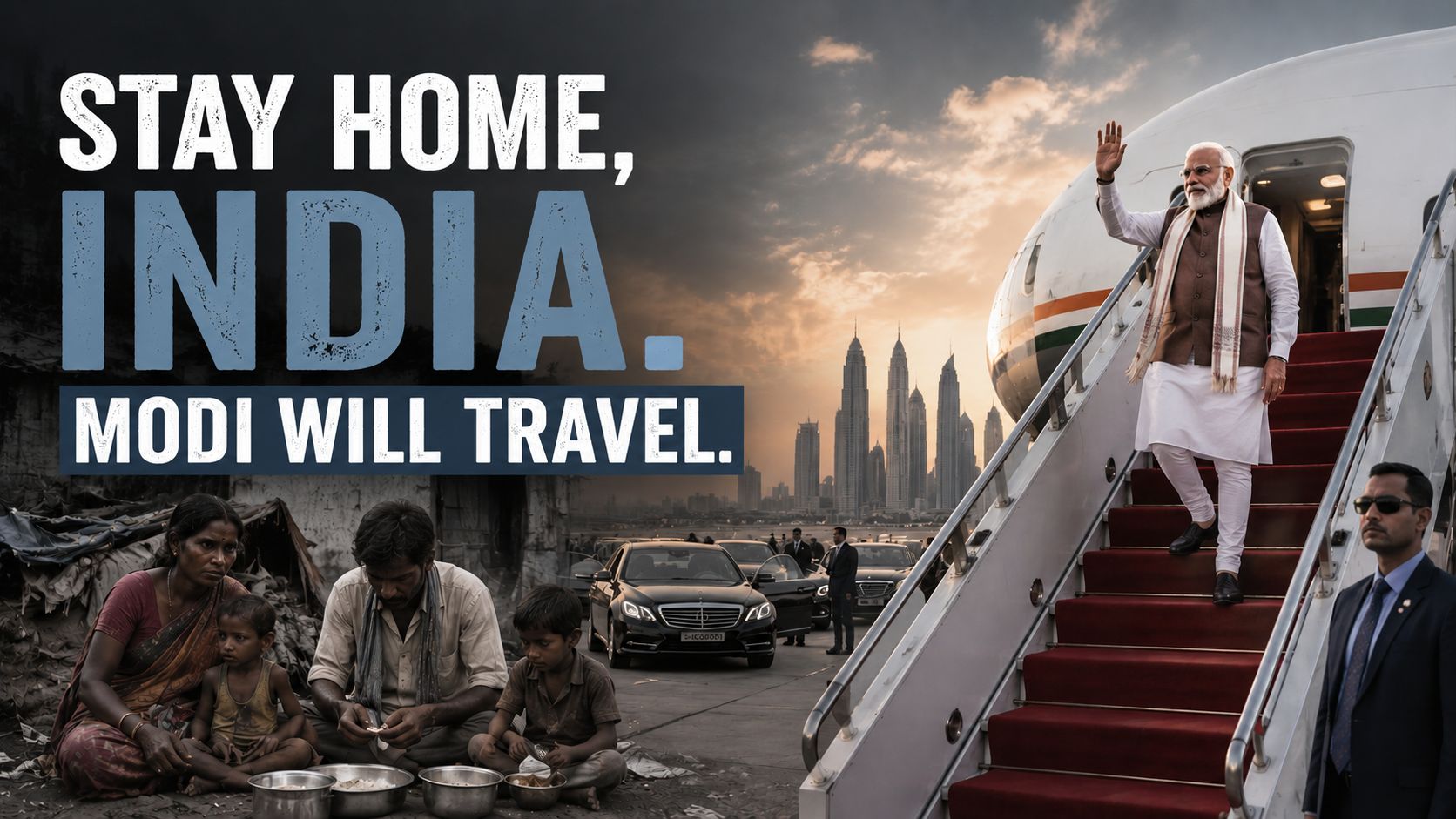
Sep 2, 2026: No foreign trips. No gold. No overseas weddings—but where is the promise of a life free from poverty?


Prime Minister Narendra Modi, speaking while on a foreign tour, has delivered a three-fold message to Indians: do not travel abroad unnecessarily, do not buy gold unless it is essential, and do not hold weddings in foreign destinations. He has urged citizens to keep their spending within India in the name of Swadeshi and economic self-reliance.
The irony is difficult to miss. A Prime Minister touring the world is telling Indians to stay home; a government celebrating India's economic rise is asking citizens to spend less; and a political leadership boasting of India's global stature is cautioning its people against looking beyond India's borders.


Modi's foreign travel is justified by diplomacy and national interest. But ordinary Indians also have the right to decide how they spend their legitimately earned money. A foreign holiday, a gold purchase or a wedding abroad is not, by itself, an act of economic disloyalty.
More importantly, India's poor do not need lectures on restraint from a Prime Minister abroad. For millions struggling with food, employment, healthcare, education and housing, foreign holidays and destination weddings are not even possibilities.
They have already been practising austerity—not by choice, but by necessity.
Modi's message comes amid repeated celebrations of India's economic growth and the government's projection of India as a rising global power marching towards Viksit Bharat.
But development cannot be reduced to GDP figures.
India has made progress in reducing poverty, but millions still face insecure employment, inadequate healthcare, poor nutrition and limited access to quality education. At the same time, the concentration of wealth among a small section of society remains a serious concern.
For India's poorest citizens, advice about foreign holidays and destination weddings borders on irrelevance.
A daily-wage worker does not need to be told to cancel a holiday abroad. A farm labourer does not need a lecture about buying gold. A migrant worker does not need advice on reducing foreign expenditure when migration itself is driven by the search for employment.
The poor do not need lessons in sacrifice. They need an end to deprivation.
India's poor have practised austerity for generations. They have cut meals, postponed medical treatment, borrowed for education and sold possessions during emergencies. They do not need Narendra Modi to teach them thrift.
They need decent wages, secure employment, affordable healthcare, quality education and social security.
There is nothing wrong with encouraging Indians to support domestic businesses. A strong domestic economy benefits from local production and consumption.
But patriotism cannot be reduced to a list of consumer instructions:
If citizens have earned their money honestly, they should be free to decide how to spend it. Travelling abroad, holding a wedding overseas or purchasing gold is not an act of disloyalty.
The government's responsibility is not to dictate how citizens demonstrate patriotism. It is to create an economy in which citizens can live with security, freedom and dignity.
If Indians are being asked to sacrifice for the nation, the obvious question is: who is expected to sacrifice?
Will billionaires reduce conspicuous consumption? Will corporations surrender some of their privileges? Will governments curb extravagant spending? Will economic policies seriously tackle the concentration of wealth?
Or will sacrifice once again be demanded mainly from ordinary citizens?
When the economy is under pressure, the poor are told to tighten their belts. When the economy grows, however, the benefits do not necessarily reach them with equal speed.
That cannot be the meaning of Viksit Bharat.
If the government wants Indians to conserve their money, it should first ask why so many families are forced to spend their savings on private healthcare, education and basic necessities because public systems remain inadequate.
If the government is genuinely concerned about Indians spending money abroad, it should address why Indians seek foreign destinations and services in the first place.
Why do affluent Indians spend heavily on overseas education and medical treatment? Why do businesses and investors move capital abroad? Why do Indian consumers often prefer foreign brands?
These questions cannot be answered by telling citizens to stay home.
They require better universities, world-class healthcare, competitive industries, stronger institutions and greater economic security.
A confident India does not fear its citizens seeing the world. It gives them reasons to return.
Atmanirbhar Bharat, Swadeshi and Viksit Bharat are powerful political slogans. But slogans cannot feed hungry children, create secure employment or provide affordable healthcare.
The real measure of India's progress is not how often its economic growth is celebrated. It is whether the poorest citizen can live with dignity.
Instead of telling Indians where to travel, where to marry or what to buy, the Prime Minister should tell the farmer that his livelihood will be protected, the worker that his wages will rise, the unemployed graduate that education will lead to employment and the poor family that illness will not wipe out its savings.
That would be leadership.
Modi has every right to travel abroad when diplomacy and national interest demand it. Ordinary Indians who can afford it have the same right to decide where they travel, where they marry and how they spend their money.
The Prime Minister may fly across continents representing India. But millions of Indians still struggle to travel beyond the boundaries imposed by poverty.
That is the contradiction India must confront. India does not need moral lectures from foreign soil. It needs economic justice at home.
The poor have sacrificed enough. Now let the powerful deliver.
By Fr. Suresh Mathew Pallivathukal




© 2026 CATHOLIC CONNECT POWERED BY ATCONLINE LLP