- 26 November, 2026
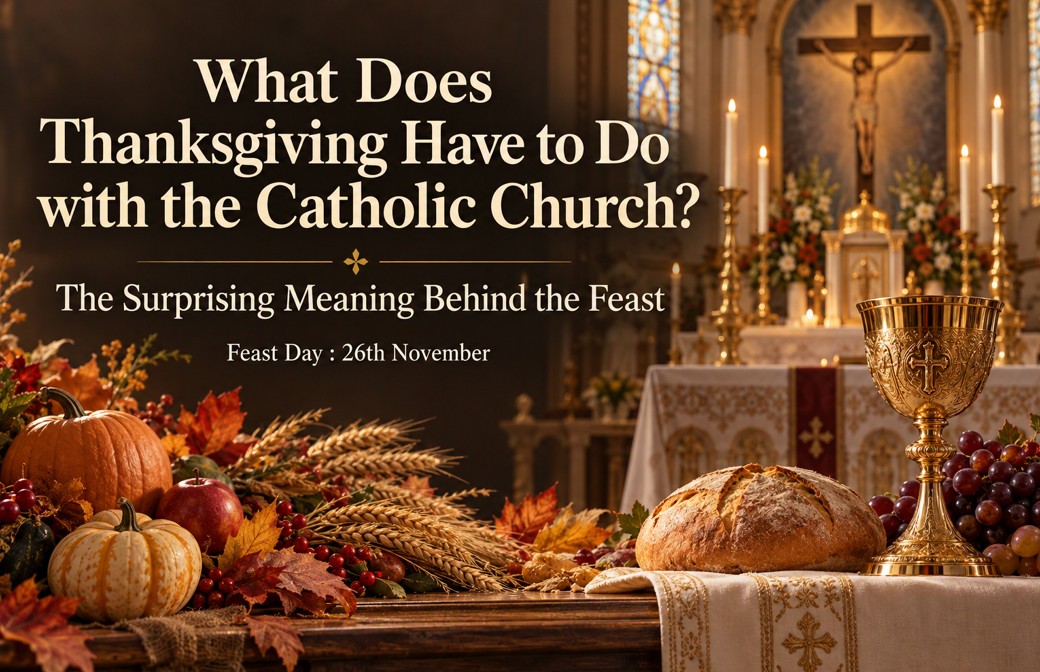
November 26, 2026: Every November, millions of Americans gather around family tables to celebrate Thanksgiving. They share food, remember their blessings and express gratitude. But is there a connection between this national holiday and the Catholic Church? Surprisingly, the connection reaches beyond a shared spirit of thankfulness to the heart of Catholic worship, history and theology.

1. The Eucharist is itself an act of thanksgiving
One of the strongest connections lies in the word Eucharist. It comes from the Greek word eucharistia, meaning “thanksgiving”.
For Catholics, the Holy Mass is the Church's supreme act of thanksgiving to God through Jesus Christ. In the Eucharist, the Church gives thanks to the Father for all His blessings and for everything He has accomplished through creation, redemption and sanctification. This includes the gift of salvation through Christ's life, death and Resurrection.
The Catechism of the Catholic Church explains: “The Eucharist is a sacrifice of thanksgiving to the Father” (CCC 1359–1361).
This means that thanksgiving is not simply an occasional expression of gratitude in Catholic life. It is at the very heart of Christian worship. Through the Eucharist, the faithful share in the thanksgiving of Christ, their Head, and recognise God as the source of every good gift.
2. Thanksgiving has a biblical foundation
Scripture repeatedly calls believers to recognise God's goodness and respond with grateful hearts.
St. Paul writes: “Give thanks in all circumstances” (1 Thessalonians 5:18). Psalm 100:4 also invites the faithful to enter God's presence “with thanksgiving”.
Catholic teaching understands gratitude as more than good manners or a passing emotion. It is a virtue that recognises God as the source of every good gift. Christians are called to remain grateful and trust in God's providence even amid suffering and uncertainty.
This does not mean that suffering or evil should be considered good or that people must feel thankful for painful experiences. Rather, it means maintaining faith in God's goodness and remaining open to His grace, even during difficult times.
Thanksgiving, therefore, becomes an expression of trust in God and an acknowledgement that His love remains present throughout life's joys and challenges.
3. An early Catholic connection with North American thanksgiving
The familiar 1621 Plymouth harvest gathering is often associated with the origins of the American Thanksgiving tradition. However, earlier European religious celebrations also took place in North America.
In 1565, Spanish settlers in what is now St. Augustine, Florida, participated in a solemn Catholic Mass celebrated by their chaplain, Father Francisco López de Mendoza Grajales. The Mass commemorated the Nativity of the Blessed Virgin Mary and was celebrated at a location later known as Nombre de Dios.
This Mass represents an important early Catholic liturgical event in what is now the United States.
Some historical accounts also associate the Spanish settlement with a meal involving local Indigenous people, including the Timucua. However, the precise details of this gathering and its relationship to the later American Thanksgiving tradition require careful historical qualification. The documented celebration of Mass should not automatically be described as a formally designated Thanksgiving celebration.
It is also important to remember that the history of Spanish settlement in Florida involved conflict and violence, making it necessary to approach accounts of early encounters between European settlers and Indigenous communities with historical care.
Although the 1565 event and the 1621 Plymouth gathering belong to different historical traditions, both form part of the broader story of early European settlement in North America.
4. Is Thanksgiving a Catholic feast day?
No. Thanksgiving is a United States civil holiday, not a universal Catholic solemnity or Holy Day of Obligation.
Nevertheless, some American Catholic parishes mark the occasion with special Masses, prayers of thanksgiving or other liturgical observances. Practices may vary from parish to parish.
For Catholics, the holiday provides a valuable opportunity to reflect on God's blessings, bring families together in prayer and place gratitude at the centre of community life.
Although Thanksgiving is not a universal feast in the Catholic calendar, its underlying message is closely connected to the Christian understanding of gratitude.
5. Gratitude must lead to charity
Catholic thanksgiving should not end with a prayer before a plentiful meal. It should inspire practical love and generosity towards others.
When Christians recognise God's generosity in their own lives, they are called to share those blessings. This means remembering the hungry, assisting the poor, welcoming the lonely and caring for those experiencing hardship.
The Eucharist itself reminds Catholics that receiving God's gifts also brings a responsibility to live according to Christ's example.
Gratitude becomes authentic when it produces generosity. A thankful heart should be reflected in acts of compassion, forgiveness, service and love.
In this way, Thanksgiving can become more than a family celebration. It can serve as a reminder of the Christian responsibility to care for others, particularly those who may have little to celebrate.
A celebration that points towards God
Thanksgiving and the Catholic Church share a profound conviction: life's blessings should never be taken for granted. Yet Catholic faith gives gratitude an even deeper meaning through the Eucharist.
Thanksgiving may come once a year on the American calendar, but every celebration of Mass reminds Catholics to give thanks to God for His goodness, mercy and saving love.
Ultimately, the greatest expression of gratitude is not simply saying “thank you”, but allowing a grateful heart to become a generous life.
And that is perhaps the most beautiful connection between Thanksgiving and the Catholic faith: every blessing we receive from God becomes an invitation to give thanks, share generously and love others as Christ has loved us.
By Catholic Connect Reporter
© 2026 CATHOLIC CONNECT POWERED BY ATCONLINE LLP