- 18 August, 2026

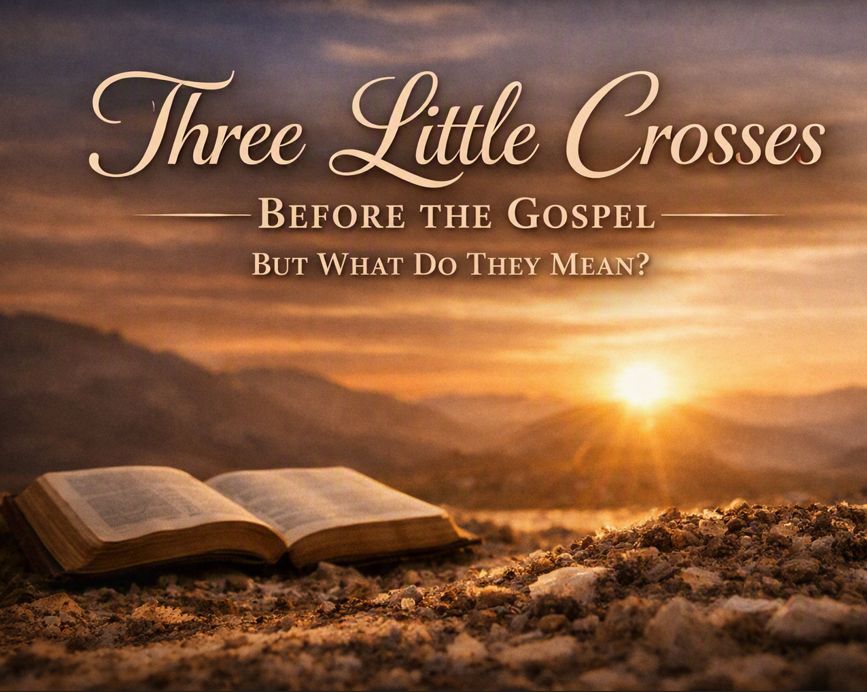
August 18, 2026: At the announcement of the Gospel at Mass, Catholics make three small crosses with their thumb: one on the forehead, one on the lips and one on the breast. The priest or deacon who proclaims the Gospel makes these signs on the Gospel book and on himself, and the faithful do likewise.


It is such a familiar gesture that we can easily make it without thinking about its meaning. Yet these three little crosses express a beautiful prayer of faith and readiness. They are an outward sign of reverence for the Gospel and for Christ, who speaks to His Church through its liturgical proclamation.
The Gospel holds a special place in the Liturgy of the Word. It is the high point of the Liturgy of the Word, and Catholics stand to hear it and respond with acclamations because Christ is acknowledged as present and speaking to His people through its proclamation.


The three small crosses help us prepare to listen attentively.
The gesture is commonly understood as a prayer that God's Word may enlighten our minds, guide our speech and take root in our hearts.
The first small cross is made on the forehead. Traditionally, this is understood as a prayer that we may receive the Gospel with our minds.
We ask God to help us understand His Word, recognise its truth and allow it to shape the way we think. The Gospel is not merely information about Jesus; it is the proclamation of Christ and an invitation to conversion and deeper communion with Him.
(CLICK HERE to follow Catholic Connect and to stay updated with Catholic News & Content)
The second cross is made on the lips. This can be understood as a prayer that we may faithfully speak and proclaim God's Word.
The Gospel is not meant to remain something we hear only at Mass. As Christians, we are called to bear witness to Christ in daily life through our words, charity, holiness and actions, speaking the truth with love and courage.
The third cross is made on the breast. Often interpreted devotionally as referring to the heart, this gesture expresses our desire to welcome God's Word into the deepest part of our lives.
It reminds us that hearing the Gospel should lead to more than understanding. God's Word should influence our choices, desires and actions, helping us to live more faithfully as disciples of Christ.
The three crosses are not a magical formula. They are a bodily expression of attentive faith and reverence.
So the next time you make those three small crosses, pause for a moment: May God's Word enlighten my mind, guide my speech, take root in my heart and bear fruit in my life.
A simple gesture can become a powerful reminder that at Mass, we are not merely hearing words about Christ; through the proclamation of the Gospel, we are listening to Christ speak to His people.
By Catholic Connect Reporter
Read More :
Why Do Catholics Sit for the Readings but Stand for the Gospel?
Why Is There a Psalm Between the Readings?
Why Are There Usually Three Readings at Sunday Mass?
Why Does the Priest Say “The Lord Be with You” So Often at Mass?
Why Do We Keep Saying “Amen” at Mass? What Are We Really Saying?
The Prayer After “Let Us Pray” Changes at Mass—Do You Know Why?
Why Do Catholics Sing the Gloria—but Not at Every Mass?
Why Do We Confess Our Sins at the Start of Mass? The Deeper Meaning Explained
Why Does the Priest Kiss the Altar at Mass?
Why Does Mass Begin and End with the Sign of the Cross?
What Makes the Catholic Mass Different from Other Christian Worship Services?
If God Made the Seventh Day Holy, Why Do Catholics Worship on Sunday?
Four Parts, One Beautiful Story: Understanding the Flow of the Mass
Why Does the Mass Follow the Same Order Every Time? The Church's Timeless Wisdom
Why Do Catholics Call It the Mass? The Answer Begins with Three Latin Words
How the Mass Developed Over 2,000 Years: A Journey Through History and Worship
If God Made the Seventh Day Holy, Why Do Catholics Worship on Sunday?

© 2026 CATHOLIC CONNECT POWERED BY ATCONLINE LLP