- 29 May, 2026
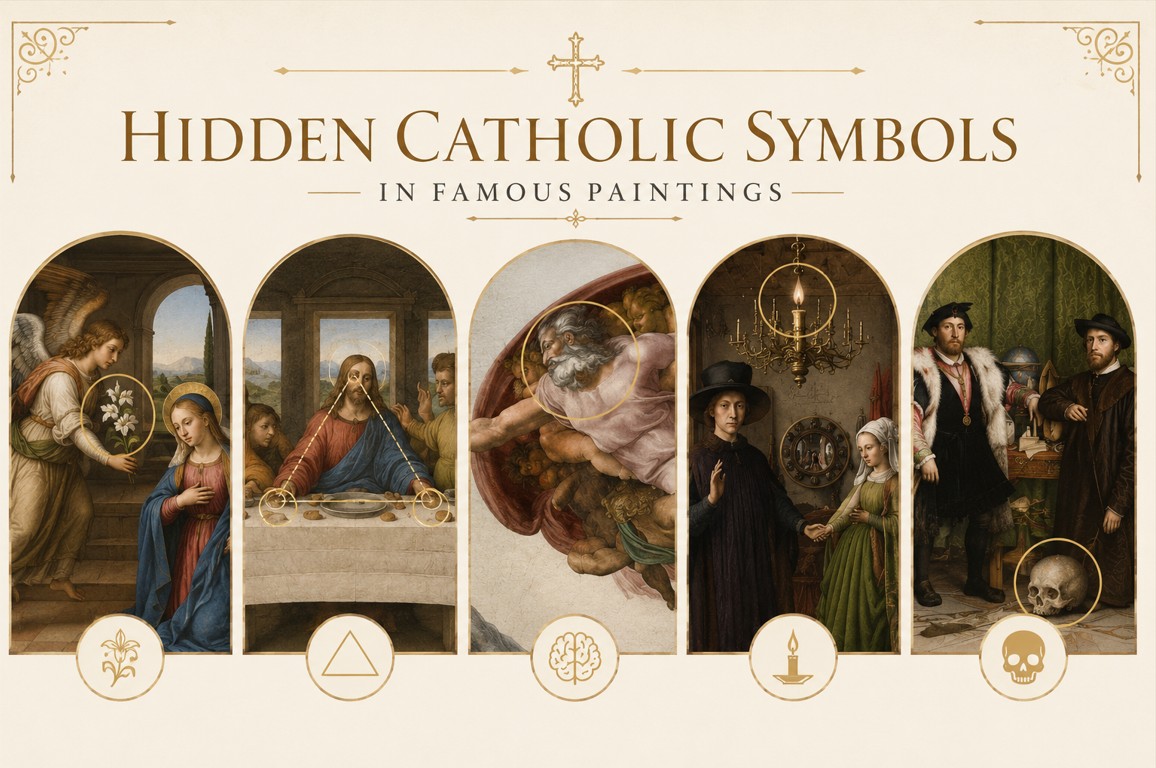
May 29, 2026: For centuries, some of the world’s greatest artists painted more than beautiful images. Hidden beneath layers of colour, light, and geometry were powerful Catholic messages designed to teach faith, morality, and salvation.


To modern viewers, Renaissance masterpieces may appear to be simple portraits or biblical scenes. But to people of the time, these paintings were visual sermons — rich with symbols that revealed deep theological truths.
From secret references to the Eucharist to hidden reminders of death and eternity, these masterpieces continue to speak a spiritual language many no longer recognise.
During the Renaissance and Baroque periods, much of Europe was illiterate. Paintings became powerful teaching tools for the Catholic Church, helping ordinary people understand Scripture and theology through imagery.
Artists such as Leonardo da Vinci, Michelangelo, Jan van Eyck, and Hans Holbein embedded layers of meaning into their works. Every object — a candle, flower, mirror, or hand gesture — carried significance.

These paintings were never meant to be viewed casually. They were meant to be studied, contemplated, and spiritually experienced.
Jan van Eyck’s famous Arnolfini Portrait appears at first to show a wealthy couple standing in their home. Yet hidden details transform the scene into something profoundly spiritual.
Above the couple burns a single candle in daylight — a classic Catholic symbol of Christ as the “Light of the World” and the ever-present gaze of God.
Behind them hangs a convex mirror reflecting two unseen figures entering the room. Around the mirror are tiny scenes from the Passion of Christ, quietly reminding viewers that human love exists beneath divine redemption.
What looks like an ordinary portrait becomes a sacred meditation on covenant and marriage.
Leonardo da Vinci’s Last Supper is filled with carefully arranged symbolism.
The apostles are grouped in sets of three, while Christ forms a perfect triangle at the centre of the composition. In Catholic symbolism, the number three represents the Holy Trinity, while the triangle signifies divine perfection.
Even the three windows behind Christ reinforce this theological message.
The bread and wine are also placed deliberately, drawing attention to the institution of the Eucharist — the centre of Catholic worship.
Leonardo was not merely painting a historical event. He was creating theology through mathematics and design.
(CLICK HERE to follow Catholic Connect and to stay updated with Catholic News & Content)
Few works are more recognisable than Michelangelo’s Creation of Adam on the ceiling of the Sistine Chapel.
Yet scholars have long noted that the red cloak surrounding God strikingly resembles the human brain.
Many believe Michelangelo intentionally included this image to symbolise that God gave humanity not only life, but intellect, creativity, and consciousness.
The fresco becomes more than a depiction of creation. It becomes a reflection on the divine gift of human reason itself.
Hans Holbein’s The Ambassadors appears to celebrate wealth, knowledge, and success. But stretched across the bottom of the painting is a distorted object visible only from a certain angle.
Viewed correctly, it becomes a human skull.
This hidden symbol reflects the Catholic concept of memento mori — “remember that you must die.”
No matter how powerful or successful someone becomes, earthly glory fades. The soul alone is eternal.
For Renaissance artists, beauty and belief were inseparable. Their paintings were not simply decorations for palaces and churches. They were invitations to prayer, reflection, and spiritual awakening.
Modern audiences often admire these masterpieces for their technique without realising they contain entire layers of hidden Catholic theology.
What appears to be a flower may symbolise purity. A candle may represent Christ. A geometric shape may point toward the Trinity.
These artists understood something timeless: true art does not merely entertain the eyes — it speaks to the soul.
And centuries later, their silent messages are still waiting to be discovered.
By Catholic Connect Reporter

© 2026 CATHOLIC CONNECT POWERED BY ATCONLINE LLP