- 29 May, 2026
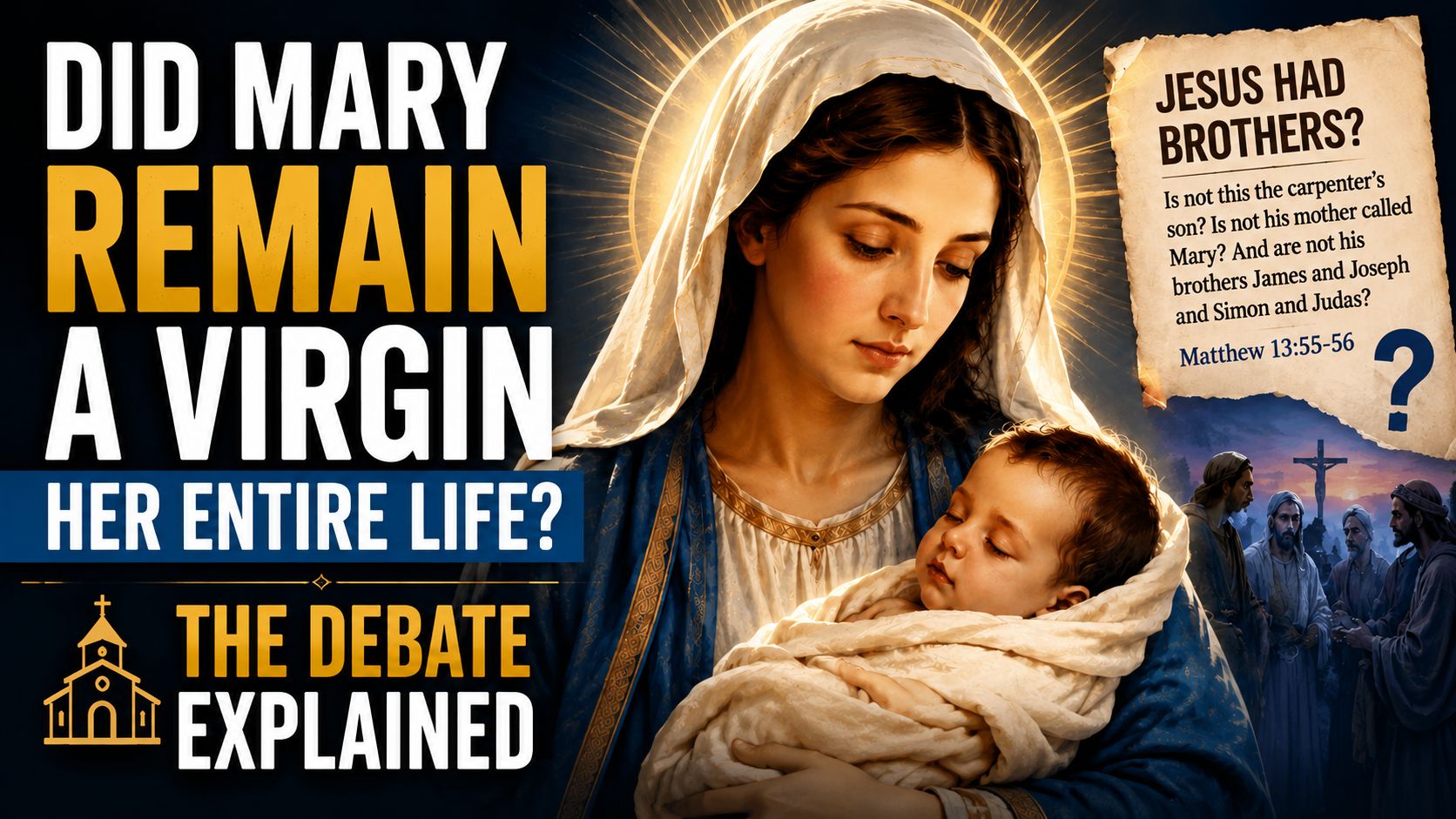
May 29, 2026: Did Mary remain a virgin her entire life? For many Christians, the answer is an unquestionable yes. For others, it remains one of the most debated teachings in Christianity.


The doctrine of Mary's perpetual virginity teaches that Mary was a virgin before, during, and after the birth of Jesus Christ. In other words, Jesus was her only child, and Mary never entered into ordinary marital relations with Joseph.
But why does this teaching generate so much discussion? More importantly, what evidence supports it? And when did the confusion begin? Let's explore the biblical, historical, and theological foundations of one of Christianity's oldest Marian beliefs.


Why Is It Debated?
The debate largely stems from a few biblical passages that appear, at first glance, to suggest that Jesus had brothers and sisters.
For example, in Matthew 13:55-56, people ask: "Is not this the carpenter's son? Is not his mother called Mary? And are not his brothers James and Joseph and Simon and Judas?" Many modern readers assume these "brothers" were biological siblings of Jesus.
Another commonly cited verse is Matthew 1:25, which says Joseph "knew her not until she had borne a son." Some interpret the word "until" as implying that Mary and Joseph later had marital relations. These passages have led some Christians to reject Mary's perpetual virginity. However, the question is whether these verses necessarily mean what modern readers assume they mean.
What Does the Bible Actually Say?
Interestingly, the Bible never explicitly states that Mary had other children. In the Jewish culture of Jesus' time, the term "brother" was often used broadly to describe relatives, cousins, or close kin. The Hebrew and Aramaic languages lacked a specific word for cousin in many contexts.
We see similar usage throughout the Old Testament. Abraham and Lot are called brothers, even though Lot was Abraham's nephew. Likewise, the "brothers" of Jesus may have been relatives rather than children of Mary.
The verse about Joseph not knowing Mary "until" Jesus was born also deserves closer attention. In Scripture, the word "until" does not always imply a change afterward.
Consider 2 Samuel 6:23: "Michal, the daughter of Saul, had no child until the day of her death." Obviously, she did not have children after her death. The verse simply emphasizes what was true up to that point without commenting on what followed.
Another intriguing clue comes from the Crucifixion. As Jesus hung on the Cross, He entrusted His mother to the beloved disciple John (John 19:26-27). If Mary had other biological sons, Jewish custom would have expected them to care for her. Jesus' action makes far more sense if He was Mary's only child.
What Did the Early Christians Believe?
One of the strongest arguments for Mary's perpetual virginity comes from Christian history. Long before modern debates emerged, the early Church consistently taught this belief.
Around the second century, the ancient Christian writing known as the Protoevangelium of James describes Mary as a consecrated virgin and Joseph as her guardian rather than a husband in the ordinary sense.
Several influential Church Fathers defended Mary's perpetual virginity:
St. Athanasius referred to Mary as "ever-virgin."
St. Jerome wrote an extensive defense against those who claimed Mary had other children.
St. Augustine taught that Mary remained a virgin before, during, and after Christ's birth.
St. Ambrose upheld the same belief.
What is remarkable is that this teaching was widely accepted across the Christian world centuries before major divisions arose among Christians.
When did the Confusion Begin?
The confusion surrounding Mary's perpetual virginity did not begin in the apostolic era. For the first few centuries of Christianity, the belief was widely accepted and rarely challenged. The major controversy emerged in the late 4th century, primarily because some Christians began interpreting certain biblical passages more literally and through a cultural lens different from that of the ancient Jewish world.
The First Major Challenge: Helvidius (c. AD 380)
A Christian writer named Helvidius argued that the "brothers" of Jesus mentioned in the Gospels were Mary's biological children and that Mary and Joseph had normal marital relations after Jesus' birth.
His arguments were based mainly on:
His views were significant because they represented one of the earliest known direct attacks on Mary's perpetual virginity.
St. Jerome's Response
The challenge was taken so seriously that St. Jerome wrote an entire work, Against Helvidius, defending the traditional Christian belief.
Jerome argued that:
Importantly, Jerome did not present the doctrine as a new idea. He defended it as the belief Christians had already inherited.
Why Did the Confusion Grow Later?
The debate intensified during the 16th-century Protestant Reformation.
Interestingly, many of the first Protestant Reformers still believed in Mary's perpetual virginity:
The shift came later among some Protestant groups that adopted the principle of reading Scripture without relying heavily on Church tradition. As a result: The word "brothers" was increasingly understood as biological siblings. Ancient Jewish linguistic customs became less familiar. The testimony of the early Church Fathers was often given less weight. The doctrine was viewed as unnecessary because it was not explicitly stated in a single verse.
The Cultural Factor
Another reason for confusion is that modern readers often approach the Bible with modern assumptions. Today, if someone says "my brother," we almost always mean a biological sibling.
In the ancient Near East, family terminology was much broader. The same word could refer to cousins, nephews, clan members, or close relatives. Modern readers can unintentionally impose contemporary meanings onto ancient texts.
An Interesting Historical Fact
What's striking is that the earliest critics of Mary's perpetual virginity were the exception rather than the norm.
When Helvidius challenged the doctrine in the 4th century, major Christian leaders reacted as though he was contradicting a belief already held throughout the Church. Had the doctrine been a recent invention, there would likely have been evidence of earlier debates—but history records very little controversy before Helvidius.
Why Does It Matter?
Mary's perpetual virginity points to the uniqueness of Jesus Christ. His birth was not merely another human birth but the entrance of God into human history. The doctrine also highlights Mary's total dedication to God's plan. Just as certain people in Scripture were set apart for sacred purposes, Mary was uniquely consecrated as the Mother of God.
The teaching is ultimately Christ-centered. It emphasises who Jesus is rather than simply focusing on Mary herself.
A Question for Reflection
Imagine discovering that Christians living just one or two generations after the Apostles already believed Mary remained ever-virgin. Would that make you reconsider the common assumption that this doctrine was a later invention?
Whether one ultimately accepts the teaching or not, the evidence reveals that Mary's perpetual virginity is not a medieval legend or a recent Catholic idea. It is a belief deeply rooted in Scripture, supported by early Christian testimony, and consistently upheld throughout much of Christian history.
For Catholics, it remains a beautiful reminder that Mary belonged entirely to God and that the child she bore was no ordinary son, but Jesus Christ, the Son of God.
By Catholic Connect Reporter
© 2026 CATHOLIC CONNECT POWERED BY ATCONLINE LLP