- 19 June, 2026

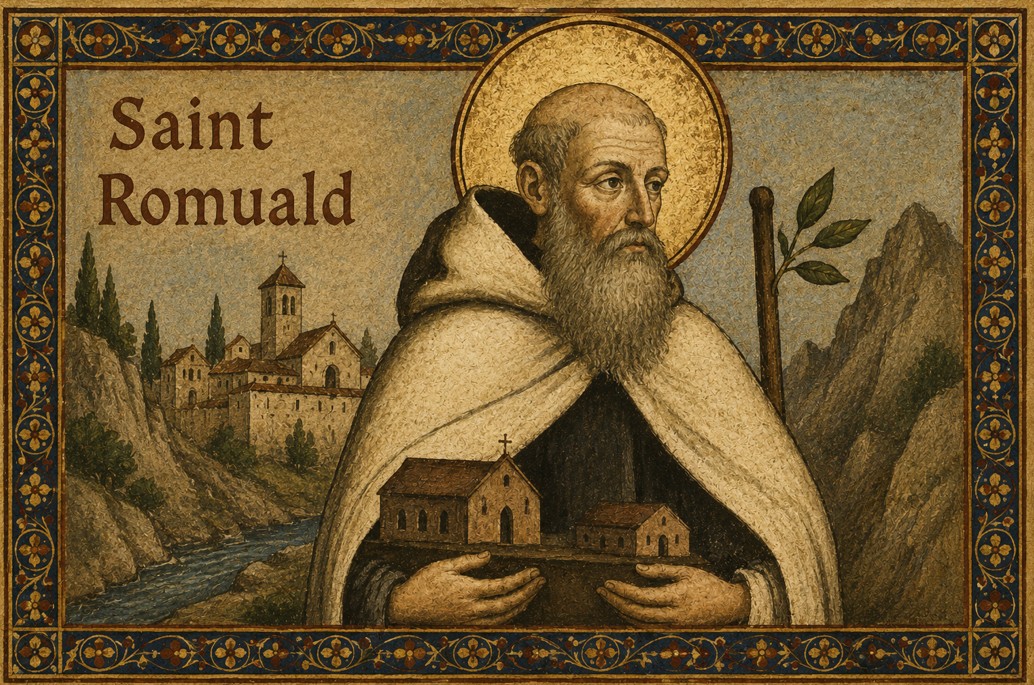
Italy, June 19, 2026: Why is Saint Romuald remembered as one of the greatest reformers of Christian monasticism? Discover the extraordinary story of the Italian monk who left behind a life of wealth and comfort, embraced solitude and prayer, founded the Camaldolese Benedictine order, and inspired generations of seekers through his passion for holiness.


Feast Day: 19 June
Born: Around 951, Ravenna, Italy
Died: 19 June 1027, Val di Castro, Italy
Canonized: 1595 by Pope Clement VIII


Patron of: Hermits, monks, and those seeking spiritual renewal
Known For: Founding the Camaldolese Order, reforming monastic life, promoting solitude, prayer, and deep conversion
Title: Father of the Camaldolese Monks
Few saints represent the search for God through prayer and solitude as deeply as Saint Romuald.
Born into a noble family in medieval Italy, Romuald experienced the emptiness of worldly pleasures and dedicated his entire life to seeking God. Through years of prayer, discipline, and spiritual struggle, he became one of the greatest figures in the renewal of monastic life.
He was not satisfied with simply following traditions. He desired a deeper devotion, calling monks back to the original spirit of Saint Benedict: prayer, simplicity, work, and complete surrender to God.
His vision eventually led to the foundation of the Camaldolese Order, a community that united the life of hermits with the stability of Benedictine monasticism.
Saint Romuald was born around the year 951 in Ravenna, Italy, into a wealthy and influential family.
As a young man, he enjoyed the privileges of his noble background. However, despite having access to comfort and worldly success, he felt a deep spiritual emptiness.
A life-changing moment came when Romuald witnessed a tragic event involving his father, Sergius, who killed a relative during a dispute over property.
Deeply disturbed by this act, Romuald experienced a profound conversion. He entered the monastery of Sant'Apollinare in Classe to seek forgiveness, prayer, and a closer relationship with God.
This experience marked the beginning of his lifelong journey toward holiness.
(CLICK HERE to follow Catholic Connect for regular News and Content)
Although Romuald respected traditional monastic life, he felt called to a stricter and more prayerful way of living.
He sought guidance from holy men and eventually followed the example of hermits who lived in solitude, dedicating themselves entirely to contemplation and prayer.
Romuald travelled throughout Italy, establishing small communities of monks and encouraging deeper spiritual discipline.
His goal was not fame or influence but the transformation of souls.
Saint Romuald believed that silence created space for people to encounter God.
He encouraged monks to spend time in prayer, meditation, and reflection while also maintaining the discipline of community life.
His spirituality combined two important traditions:
This balance became the foundation of his future religious order.
Around the year 1012, Saint Romuald founded the monastery of Camaldoli Monastery.
This became the centre of the Camaldolese Benedictines, a reform movement within the Benedictine tradition.
The name Camaldoli came from the land donated for the monastery, and the community developed a unique way of life that included both communal worship and individual hermit cells.
The monks followed a strict discipline of prayer, fasting, silence, and contemplation.
Romuald’s foundation became one of the most important expressions of medieval monastic renewal.
Saint Romuald was not only a founder but also a spiritual guide.
Many people came to him seeking wisdom and direction. He trained monks, encouraged bishops, advised rulers, and helped people return to a deeper faith.
His teachings emphasised humility, repentance, and complete trust in God.
One of his most important messages was that external religious practices must lead to inner conversion.
For Romuald, holiness was not about appearances—it was about a heart completely transformed by God.
Although Saint Romuald valued solitude, he also had a strong desire to spread the Gospel.
He encouraged missionary activity and hoped to bring Christianity to distant lands.
His vision showed that true contemplation does not separate people from the world but prepares them to serve God’s mission.
His monks carried forward this spirit through prayer, study, and missionary work.
After decades of reforming monastic life, Saint Romuald continued seeking deeper solitude.
In his final years, he lived a simple life of prayer and penance.
He died on 19 June 1027 at the monastery of Val di Castro in Italy.
After his death, his reputation for holiness continued to spread, and many Christians looked to him as a model of spiritual dedication.
Saint Romuald was canonized in 1595 by Pope Clement VIII.
Today, he is honoured as the founder of the Camaldolese Order and one of the great fathers of Western monastic renewal.
His influence continues through communities of monks and hermits who follow his spiritual tradition.
His life remains a reminder that silence, prayer, and surrender to God can transform both individuals and the Church.
His greatest contribution was his call for authentic conversion.
At a time when some aspects of religious life had become weakened, he encouraged monks to return to simplicity, discipline, and prayer.
His reform teaches that renewal begins within the human heart.
By seeking God with complete dedication, Romuald helped restore spiritual vitality to Christian communities.
The life of Saint Romuald offers many lessons for modern believers:
Saint Romuald reminds Christians that holiness begins when the heart seeks God above everything else.
In a world filled with noise, distractions, and constant activity, Saint Romuald’s message remains especially meaningful.
He was a nobleman who abandoned privilege, a monk who embraced simplicity, and a reformer who renewed the Church through prayer.
From the forests of medieval Italy to monasteries around the world today, his legacy continues to inspire those searching for a deeper spiritual life.
Saint Romuald teaches a timeless truth: when a person truly seeks God, silence becomes a place of encounter, and a single faithful life can transform generations.
To know about more saints please visit the spiritual section.
By Catholic Connect Reporter
Saint Romuald, Saint Romuald feast day, Camaldolese Order, Benedictine saints, Catholic hermit saints, Italian saints, monastic reformers, saints of June, Christian monks, founders of religious orders, contemplative saints, Catholic spirituality


© 2026 CATHOLIC CONNECT POWERED BY ATCONLINE LLP