- 03 September, 2026

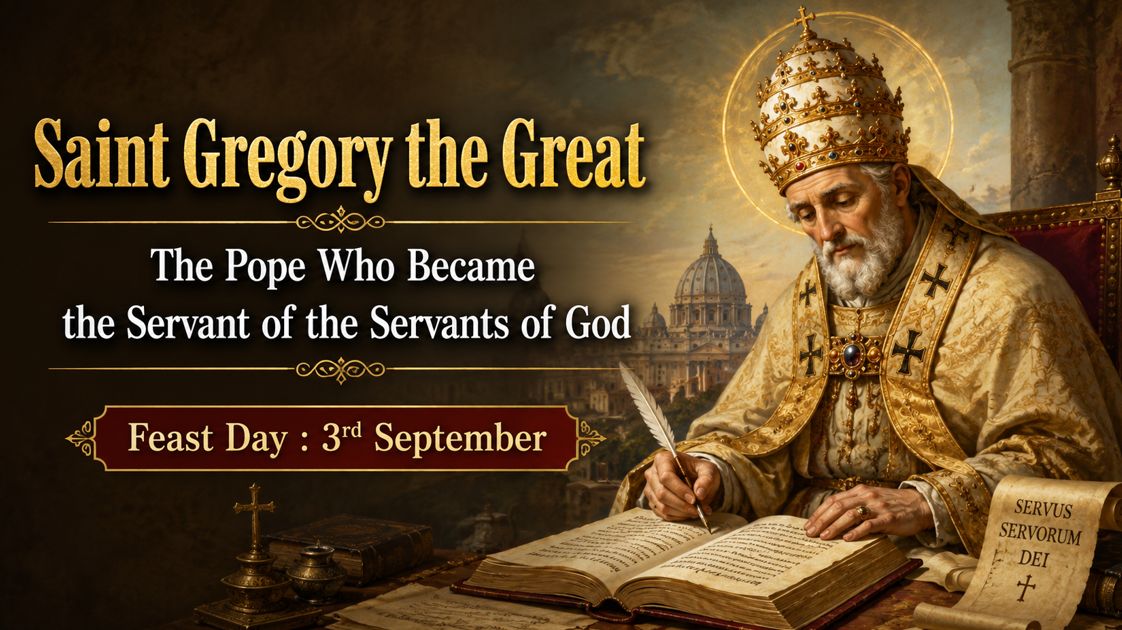
September 3, 2026: Why is Saint Gregory remembered as one of the greatest popes in the history of the Catholic Church? Discover the remarkable life of the Roman administrator who gave up wealth and power to become a monk, and later guided the Church through famine, plague and political turmoil with humility, wisdom and compassion.


Feast Day: 3 September
Born: c. 540, Rome, Italy
Died: 12 March 604, Rome, Italy
Papal Name: Gregory I


Pope: 590–604
Known For: Church reform, missionary work, care for the poor, pastoral writings and liturgical development
Title: Pope and Doctor of the Church
Also Known As: Gregory the Great
Famous Title: Servant of the Servants of God
Saint Gregory the Great was born around 540 into a noble Roman family.
(CLICK HERE to follow Catholic Connect and to stay updated with Catholic News & Content)
He received an excellent education and became an outstanding public administrator. At about the age of thirty, Gregory became Prefect of Rome, one of the highest civil positions in the city.
Yet worldly success did not satisfy his deepest desire.
Gregory eventually gave up his public office, transformed his family home into a monastery and embraced a life of prayer, poverty and contemplation. He desired a hidden life centred completely on God.
Gregory's peaceful monastic life did not last.
Because of his abilities, he was called to serve the Church and was eventually sent to Constantinople as a papal representative. After returning to Rome, he continued to serve Pope Pelagius II.
When the Pope died during a time of plague and suffering, Gregory was elected Bishop of Rome in 590.
Although he had not desired the position, Gregory accepted the responsibility and became Pope on 3 September 590.
Rome faced enormous difficulties during Gregory's pontificate.
Famine, disease and the threat of invasion brought suffering to the people. Gregory responded not only as a spiritual leader but also as a compassionate servant.
He organised assistance for the poor and ensured that food from Church lands was distributed to those in need. He was especially sensitive to people who suffered quietly and did not wish to ask publicly for help.
For Gregory, the resources of the Church were meant to serve those in need.
Gregory also looked beyond Rome.
He sent missionaries to England, including Saint Augustine of Canterbury, to bring the Gospel to the Anglo-Saxon people.
His missionary vision helped shape the future of Christianity in England and strengthened the Church's presence throughout Europe.
Gregory believed that leadership in the Church was a form of service.
He described himself as the “Servant of the Servants of God”, a title later associated with the papacy.
He also wrote extensively about the responsibilities of bishops and priests. His Pastoral Rule became one of the most influential guides for Church leaders during the Middle Ages.
Saint Gregory teaches that true leadership is rooted in humility and service.
The powerful Roman official who became a monk eventually became Pope, yet he continued to see himself as a servant.
His message remains deeply relevant: Use authority to serve, care for those who suffer, remain faithful in prayer, and lead others with humility and love.
To know about more saints please visit the spiritual section.
By Catholic Connect Reporter
Saint Gregory the Great, Saint Gregory I, Pope Gregory the Great, Saint Gregory feast day, September 3 feast day, Doctors of the Church, Catholic popes, Catholic saints, Gregory the Great biography, Servant of the Servants of God, Saint Augustine of Canterbury, Catholic missionaries, Church reform, Pastoral Rule, Gregorian tradition, saints of Rome, Catholic feast days.


© 2026 CATHOLIC CONNECT POWERED BY ATCONLINE LLP