- 02 August, 2026
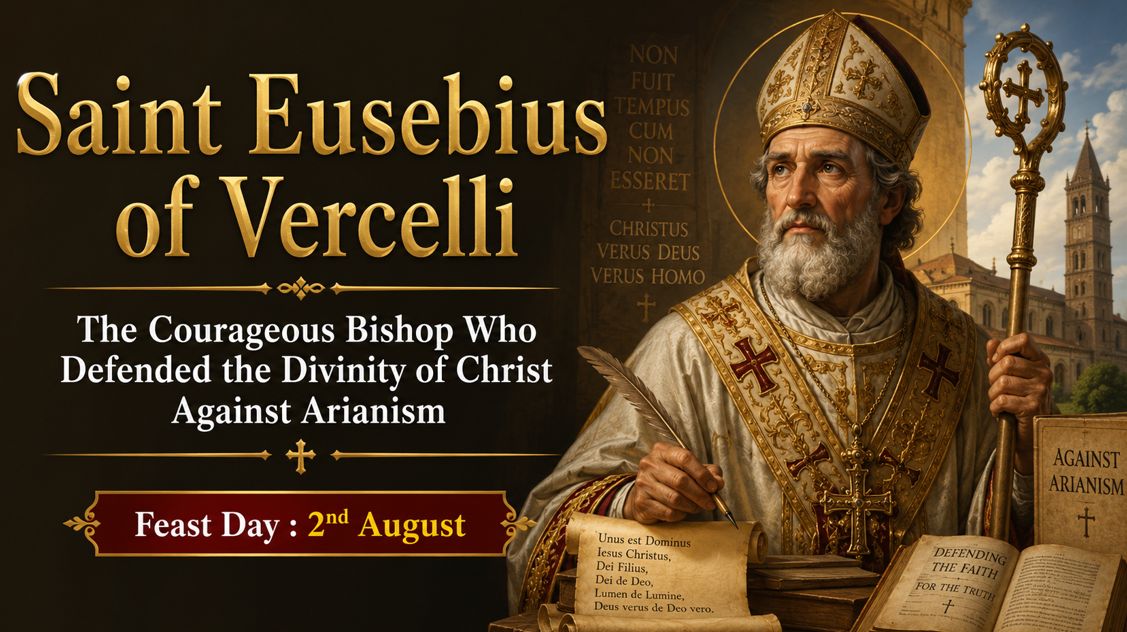
Italy, August 2, 2026: Why is Saint Eusebius of Vercelli remembered as one of the Church's great defenders of the Catholic faith? Discover the inspiring story of the fearless fourth-century bishop who endured exile, persecution, and hardship rather than deny the divinity of Jesus Christ. His steadfast witness helped preserve orthodox Christian teaching during one of the Church's greatest theological crises.


Feast Day: 2 August
Born: c. 283, Sardinia (Roman Empire)
Died: 1 August 371, Vercelli, Italy
Canonized: Recognized as a saint by early Christian tradition


Patron of: Vercelli, Piedmont, and bishops
Known For: Defending the Nicene faith against Arianism, enduring exile for refusing to condemn Saint Athanasius, and establishing communities of clergy living a common life
Title: Bishop, Confessor
Throughout Christian history, many saints have defended the faith with remarkable courage. Among them stands Saint Eusebius of Vercelli, whose unwavering commitment to the divinity of Christ made him one of the greatest champions of the Nicene faith during the fourth century.
When political pressure and theological controversy threatened to divide the Church, Eusebius refused to abandon the truth proclaimed by the Council of Nicaea. Though his fidelity led to imprisonment, exile, and years of suffering, his witness strengthened the Church and inspired generations of Christians.
Eusebius was born around 283 AD on the island of Sardinia. After the death of his father, his family moved to Rome, where he received a solid Christian education and prepared for ministry.
Ordained as a lector, he became known for his holiness, wisdom, and deep knowledge of Sacred Scripture. His exemplary life led to his election as the first Bishop of Vercelli, in northern Italy, around 345 AD.
As bishop, Eusebius introduced a unique form of communal life in which priests lived together in prayer, simplicity, and mutual support, combining the discipline of monastic life with the responsibilities of pastoral ministry. This model later influenced many other dioceses throughout the Church.
During Eusebius' lifetime, the Church faced one of its greatest theological battles: the spread of Arianism, a heresy that denied the full divinity of Jesus Christ.
Although the Council of Nicaea in 325 had proclaimed that Christ is truly God, equal to the Father, many influential political and religious leaders continued to support Arian beliefs.
Saint Eusebius stood firmly alongside Saint Athanasius of Alexandria, one of the Church's greatest defenders of Nicene orthodoxy.
When Emperor Constantius II attempted to force bishops to condemn Athanasius, Eusebius courageously refused.
In 355 AD, Emperor Constantius II summoned bishops to the Council of Milan, hoping to secure support for Arianism.
Eusebius insisted that the bishops first reaffirm the Nicene Creed before discussing any other matters. His refusal to compromise angered the emperor.
As punishment, he was arrested and sent into exile.
For several years he endured harsh treatment in Scythopolis (modern-day Israel), then in Cappadocia, and later in the Egyptian city of Thebaid. Historical accounts describe imprisonment, physical abuse, and severe hardships intended to break his resolve.
Yet throughout his exile, Eusebius remained faithful, encouraging Christians through letters and constant prayer.
After Emperor Constantius died in 361 AD, the new emperor, Julian the Apostate, permitted exiled bishops to return to their dioceses.
Saint Eusebius returned triumphantly to Vercelli, where he resumed his pastoral ministry with renewed zeal.
Rather than seeking revenge against those who had opposed him, he focused on healing divisions, strengthening the clergy, and restoring unity within the Church.
Working closely with Saint Athanasius and other orthodox bishops, he helped reaffirm the Nicene faith throughout northern Italy and beyond.
Saint Eusebius continued serving the Church until his death on 1 August 371.
He was widely honored as a confessor of the faith—a title given to those who suffered persecution for Christ without being martyred.
His influence extended far beyond his own diocese. His example of combining monastic discipline with pastoral ministry inspired later bishops, while his steadfast defense of Christ's divinity helped preserve one of Christianity's most fundamental beliefs.
Today, he is remembered as one of the great champions of Catholic orthodoxy during the fourth century.
Saint Eusebius teaches that truth must never be sacrificed for popularity or political convenience.
His willingness to endure exile rather than deny the teachings of the Church remains a powerful example for Christians facing opposition or misunderstanding.
His life also demonstrates that authentic leadership requires humility, prayer, and unwavering trust in God, especially during times of crisis.
The life of Saint Eusebius offers lasting lessons for every believer:
His witness reminds Christians that fidelity to Christ often requires courage, but God's grace always sustains those who remain steadfast.
More than sixteen centuries after his death, Saint Eusebius continues to inspire Catholics through his fearless defense of the faith.
He demonstrated that bishops are called not only to govern the Church but also to protect the truth of the Gospel, regardless of personal cost.
From the councils of the early Church to the Diocese of Vercelli, his legacy proclaims an enduring message: Christ is truly God, and no earthly power can overcome the truth revealed by Him.
His life remains a powerful testimony that unwavering faith, humble leadership, and courageous perseverance can strengthen the Church even in its darkest moments.
To know about more saints please visit the spiritual section.
By Catholic Connect Reporter
Saint Eusebius of Vercelli, Saint Eusebius feast day, Bishop of Vercelli, Arianism, Council of Nicaea, Nicene Creed, Saint Athanasius, Catholic saints, fourth-century saints, defenders of the faith, Christian persecution, August feast days, Catholic Church history, Saint Eusebius biography



© 2026 CATHOLIC CONNECT POWERED BY ATCONLINE LLP