- 02 August, 2026
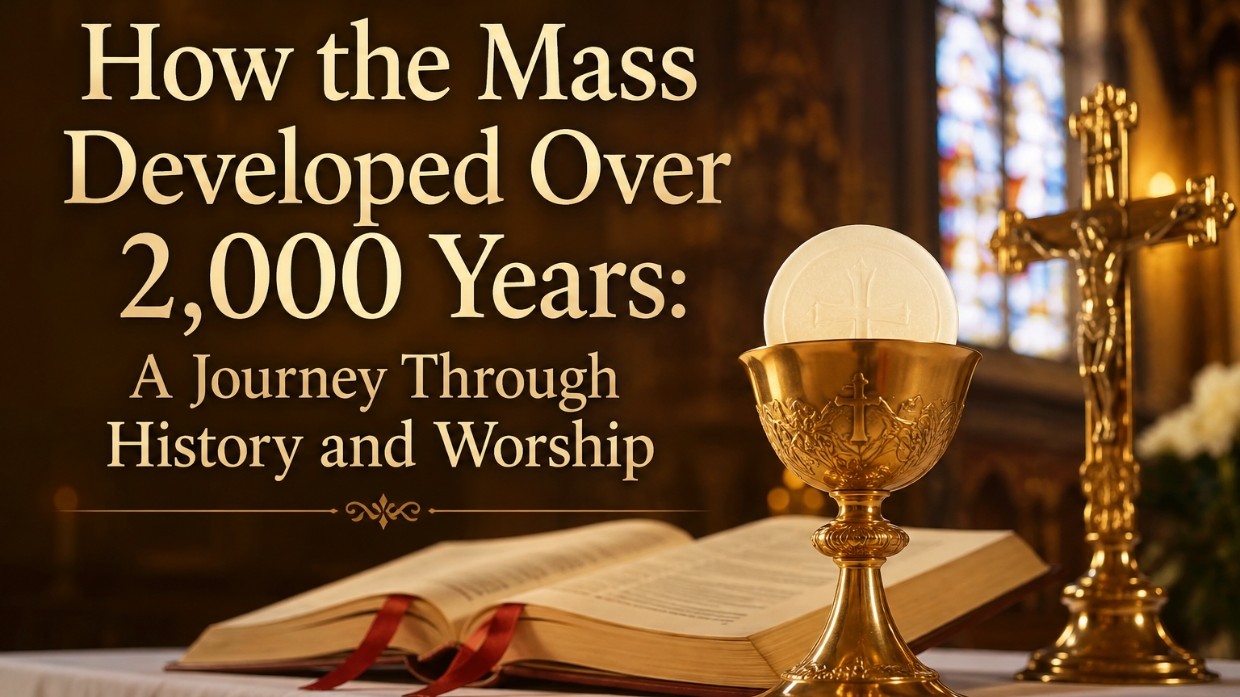
August 2, 2026: The Catholic Mass did not emerge fully formed in a single moment. Rather, it grew organically over time while preserving its essential structure—the Church’s faithful transmission of the worship Christ instituted. From the beginning, Christian worship is ordered to the Eucharist, in which the Church offers God the sacrifice of Christ and gives the faithful communion in the fruits of that sacrifice.

The Mass’s continuity from Christ to the Apostles
Catholics understand the Eucharist as rooted in Christ’s command to celebrate “in remembrance of” His saving suffering. St. Justin Martyr testifies that Christians understood the Eucharist as the bread and cup offered in accordance with the Lord’s institution, celebrated in remembrance of Christ’s suffering.
The early liturgy: One essential nucleus, two-part worship


In the earliest centuries, there was already a recognizable “nucleus” of Eucharistic worship: bread and wine are brought, set on the altar (the place of sacrifice), thanksgiving is given, the words of institution are spoken, and the consecrated gifts are distributed to those who are in communion.
Just as importantly, the Eucharist was not celebrated in isolation. It was preceded by a service of readings, psalms, prayers, and preaching/homily, continuing the ancient pattern of Jewish worship adapted to the new covenant—so that the Eucharist followed a liturgy of the word and teaching, and was then offered for the baptized.
Growth and diversity: Unity in essentials, development in expression
As Christianity spread, liturgical expression diversified across regions and communities. In the Latin West especially, medieval centuries saw “numerous local varieties” of the Roman Mass, understood as ornate developments and expansions of the older Roman rite, as well as particular customs in religious orders.
Even within the Roman rite itself, some parts of the Mass—including elements of the celebrant’s preparation and the way the rite frames its beginning and end—developed over time and were later stabilized in more uniform form. The Catholic Encyclopedia notes that the Mass’s “modern rule” for certain preparatory elements was established under Pius V, and that what follows “Ite missa est” relates to the Mass’s thanksgiving rather than to an earlier uniform ending.
Trent and liturgical reform in the Catholic response
The Council of Trent (1545–1563), in the Church’s definitive response to the Protestant Reformation, also addressed the need for reform and clarity in worship and practice, including liturgical matters. In this period, Pius V promulgated a standardized Roman Missal (1570), strengthening uniformity while preserving lawful tradition.
Vatican II: participation and the mystery of the liturgy
The Second Vatican Council taught that the Church earnestly desires the faithful to be led into fully conscious and active participation in liturgical celebrations, grounded in the nature of the liturgy and flowing from baptism as a “right and duty.”
However, the Council’s teaching must be read correctly: “participation” does not mean only external activity during the celebration. The Church insists it must be understood in more substantial terms, with greater awareness of the mystery being celebrated and its relationship to daily life, so that the faithful are not “strangers or silent spectators” but participants “in the sacred action,” actively and devoutly.
Vatican II also encouraged participation through acclamations, responses, psalmody, antiphons, songs, and bodily gestures and attitudes, with reverent silence at appropriate times.
Today: One sacrifice of Christ, expressed in many cultures
Today Catholics worldwide celebrate the same Eucharistic sacrifice in communion with the universal Church, even as languages, musical styles, and certain ceremonial customs vary by culture and legitimate tradition. What makes the Mass the Mass is not uniform entertainment or identical wording, but the faithful celebration of Christ’s Eucharistic mystery: the true and proper sacrifice offered to God, joined to communion with Him through the gifts consecrated by the Church’s liturgy.
The Mass thus remains what it has always been: the Church’s worship centered on Christ, handed on from the Apostles through living tradition, continually purified and developed in its outward forms while holding fast to its essential reality.
Read more from our Holy Mass series: Click here
By Catholic Connect Reporter
Continue Reading on Catholic Connect App
Get access to exclusive news articles & more.
© 2026 CATHOLIC CONNECT POWERED BY ATCONLINE LLP