- 02 October, 2026
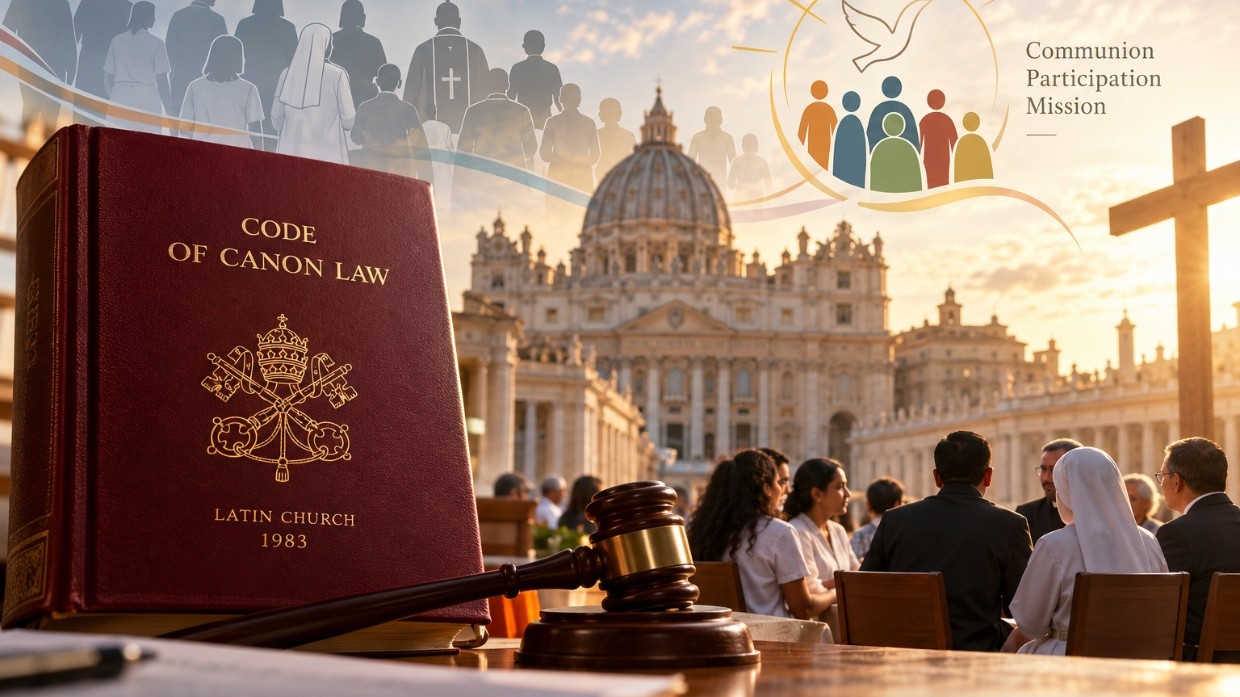
October 2, 2026: In the wake of the 2023 and 2024 General Assemblies of the Synod of Bishops on Synodality, the Canonical Commission for a Synodal Church established by the Synod Secretariat in Rome issued its landmark Final Report. Established to translate synodal discernment into concrete canonical norms, the Commission has proposed modifications to the Latin Church’s Code of Canon Law promulgated in 1983. These are only proposals, not amendments to the Code of Canon Law. Guided by the core theme, Communion, Participation, Mission, these reforms aim to entrench equality, broaden lay participation in governance, establish mandatory accountability, and revitalise participatory bodies through ecclesial discernment, decision-making processes, and removing the “only” (tantum) in consultative votes.



Below is an overview of the key proposed amendments in the Canon Law across the three central areas addressed in the report.
Part One: The Lay Faithful And Co-responsibility
The first major section translates the equal baptismal dignity of all Christian faithful into juridical structures. Recognising that lay men and women are co-responsible for the Church's life and mission, the Commission proposes amendments to enable greater lay participation in governance, judicial procedures, and pastoral ministry.
A. Communal Discernment in Governance (Cann. 127, 208, 212, 275):
i. When there is a need to seek counsel or consent from the participatory bodies, the authority seeking it should provide necessary information, ample time and freedom to express their opinion. (Canon 127 §4)
ii. Competent authority must recognise and promote the common mission of all the faithful, recognising their charism and ministries in the process of communal discernment. Canon 208 §2
iii. Introduces an explicit duty for pastors to listen to the opinions of the faithful regarding the good of the Church by employing "methods of communal discernment". (Canon 212 §4)
iv. Directs clerics to encourage communal discernment to entrust ecclesiastical offices and functions to suitable members of the faithful based on pastoral needs and spiritual gifts. (Canon 275 §3)
B. Expansion of Judicial Roles (Cann. 1421, 1425):
i. Formally permits diocesan Bishops to directly appoint both clerics and laypersons as diocesan judges without requiring prior permission from the Episcopal Conference. (Canon 1421 §1)
ii. Allows a single judge, whether a cleric or layperson, man or woman, to be assigned to adjudicate first-instance trials when a three-judge collegiate tribunal cannot be formed. Therefore, a Bishop appointing one no longer requires the permission of the episcopal conference. (Canon 1425 §4)
C. Diocesan Leadership & Curial Offices (Can. 476):
i. Authorises diocesan Bishops to appoint one or more suitable lay persons as “episcopal delegates” who exercise delegated authority over specific areas, pastoral matters, or groups. (Canon 476 §2)
ii. In the episcopal council, the episcopal delegate (layperson) also can be included. (Canon 473 §4)
iii. The need for the canonical provision that, in cases in which the reputation of a priest can be called into question, the notary must be a priest, is abrogated. (Canon 483 §2)
D. Stabilisation of Lay Ministries (Cann. 230, 1112):
i. Expands the formally instituted stable ministries conferred by liturgical rite to explicitly include the ministry of catechist alongside lector and acolyte. (Canon 230 §1)
ii. Formally recognises the ability of laypersons to assist at marriages alongside other ministerial duties when needed. (Canon 230 §3)
iii. Streamlines the delegation of laypersons (men and women) to assist at marriages by replacing the requirement of Holy See permission with a requirement that the Bishop consult the presbyteral council. Here, the canon more explicitly emphasises both men and women. Moreover, it no longer requires permission from the Holy See. But the presbyteral council needs to be consulted. (Canon 1112 §1)
E. The Sensus Fidei (Can. 749):
Reaffirms infallibility by introducing an opening paragraph highlighting that the entire body of the faithful cannot err in matters of faith when manifesting universal consent from the Bishops down to the last lay faithful.
Part Two: Episcopal Conferences, Particular Councils, And Bishops
Part Two addresses the revitalisation of regional synodal structures. It places special emphasis on renewing particular (provincial and plenary) councils and providing greater autonomy to local episcopates.
A. Mandatory Frequency for Provincial Councils (Can. 440 §1):
Establishes that a provincial council must be celebrated at least once every ten years.
B. Expanded Voting and Voice in Councils (Can. 443):
i. Replaces the restrictive phrase "merely consultative vote" (tantum consultivum) across council norms, framing participation as a consultative vote integral to the communal discernment process before decisin-taking.
ii. Increases the proportion of laypersons and presbyters who can be invited to particular councils, allowing their numbers to match the total count of ex officio members.
C. Presumption of Validity / Holy See Review (Can. 446):
Introduces two proposals for reviewing particular council decrees sent to the Apostolic See, including two options: Proposal A: The Apostolic See needs to fulfil this duty of reviewing within a year; Proposal B: Establishing that if the Holy See does not respond within one year, the decrees can be promulgated locally (tacit consent), following the principle, “qui tacet, consentire videtur”.
D. Clarification of Episcopal Roles (Cann. 403, 450):
i. Clarifies criteria for appointing auxiliary Bishops based on diocese size, a large number of Christ’s faithful, or particular complexity. (Canon 403 §1)
ii. Authorises Bishops Emeriti to be appointed to commissions within Episcopal Conferences to draw upon their experience. (Canon 450 §3)
Part Three: Participatory Bodies and Mandatory Accountability
The final section focuses on the institutional mediation of synodality at the diocesan and parish levels. The report asserts that synodal life cannot be credible without structural mechanisms enforcing transparency and regular evaluation.
A. Mandatory Creation and Regular Meetings of Councils:
i. Diocesan Synod: Mandates that a diocesan synod be celebrated at least once every ten years to review and formulate pastoral plans. Therefore, the condition “when circumstances suggest” its need is proposed to be abrogated. (Can. 461 §1)
ii. Parish Pastoral Council: Makes parish pastoral councils mandatory in every parish (removing the clause where a Bishop judges it "opportune"). Moreover, a decision made without consultation is invalid; however, the parish priest is not bound by the consulted opinion if he has an overriding reason. (Can. 536 §1)
iii. Diocesan Pastoral Council: Makes diocesan pastoral councils mandatory in every diocese, requiring them to convene at least three times a year. It also opens council participation to delegates from other Christian denominations without full communion as non-voting participants. (Cann. 511, 512, 514)
iv. Lay Majority in Synods: Requires that lay members selected by pastoral councils constitute the majority of members in a diocesan synod. (Can. 463)
v. Expansion of Presbyteral Council Consent: Replaces the "only consultative" wording and explicitly requires the diocesan Bishop to obtain the consent of the presbyteral council on key matters, such as erecting or suppressing parishes/seminaries, reducing churches to profane use, incardinating presbyters, or selling cultural goods and those of artistic value (can. 1292). The presbyteral council will promote the implementation of the diocesan pastoral plan. (Can. 500 §2)
B. Standardising Transparency and Financial Audits (Cann. 391, 493, 537):
i. Directs the diocesan Bishop to establish clear norms for synodal accountability and evaluation for all entities under his jurisdiction. Canon 391 §3 (New)
ii. Mandate that both diocesan and parish finance councils publish annual financial reports certified, where possible, by independent auditors. The diocesan finance committee will do so before the diocesan pastoral council and presbyteral council. (Canons 493 & 537)
C. Reporting and Ad Limina Revisions:
i. Requires diocesan Bishops to share a summary of their quinquennial (five-year) report on the state of the diocese with the faithful, specifically through the presbyteral and pastoral councils, before sending it to the Holy See. (Can. 399 §2)
Moving Forward
The Canonical Commission established by the Synod Secretariat in Rome emphasises that its proposals for prospective amendments to canon law reflect a short-to-medium-term response to the Synod on Synodality. While long-term efforts will eventually require a comprehensive revision of the Code of Canon Law, these proposals for immediate amendments offer a practical framework to foster co-responsibility, increase lay involvement in decision-making (communal discernment), and embed a culture of accountability throughout the local and universal Church.
By: Fr. Merlin Rengith Ambrose
Director, Centre of Canon Law, St Peter’s Pontifical Institute, Bangalore
Continue Reading on Catholic Connect App
Get access to exclusive news articles & more.





© 2026 CATHOLIC CONNECT POWERED BY ATCONLINE LLP