- 22 November, 2026
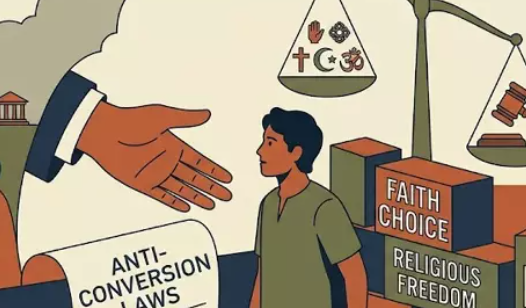
KOLKATA, November 22, 2026: A roundtable discussion in Kolkata has brought renewed attention to the relationship between religious conversion, socio-economic deprivation and the responsibilities of the state, with civil society representatives and members of the Christian community offering differing perspectives on the issue.


Titled ‘Religious Conversion in Secular India’, the discussion was held at Bharatiya Bhasa Parishad on Shakespeare Sarani on Friday. Participants examined whether religious conversions in disadvantaged communities were connected to the lack of access to essential services, including education and healthcare, and discussed the constitutional rights of religious minorities.
Several participants argued that religious conversions often take place in circumstances where the state has failed to fulfil its responsibilities towards vulnerable sections of society.
Christian missionaries' contribution to education and healthcare
Arpan Rana, representing the National Christian Council, said Christian missionaries had historically provided educational and healthcare services to people living in remote and economically deprived areas.
He maintained that these services were not offered in exchange for religious conversion and questioned the narrative that access to basic facilities was being used as an instrument to convert people.
"Christians are a minority among minorities in India," Rana said, arguing that if missionary activities were primarily intended to convert people through education and healthcare, the Christian population would have been considerably larger after nearly 200 years.
A representative of Bangiya Christiya Pariseba, an organisation representing Christians belonging to different denominations, also highlighted the constitutional right of individuals to practise and propagate their religion.
The participants stressed that religious freedom was an essential constitutional principle in a secular country and should be protected.
Differing views on conversion and deprivation
However, the arguments presented at the roundtable were challenged by Rajen Raja, another speaker at the discussion.
He questioned whether linking religious conversion to deprivation could itself amount to taking advantage of economically vulnerable people.
Raja argued that providing assistance to disadvantaged individuals while seeking to influence their religious beliefs raised concerns about the circumstances in which conversions took place.
While acknowledging the existence of socio-economic deprivation, he maintained that the government was entitled to take measures to prevent religious conversion.
His remarks reflected the contrasting positions emerging in the wider debate over religious freedom, missionary activities and alleged conversion practices.
Adivasi religious identity also comes under discussion
Amitabha Dutta, a social activist, raised questions about the religious identity of Adivasi communities and historical conversions during British rule.
He noted that large-scale conversions among Adivasis had taken place during the colonial period and questioned whether members of these communities should automatically be categorised as Hindus or recognised as followers of distinct indigenous religious traditions.
Dutta also questioned whether discussions about Adivasi religious identity were being used to encourage their reconversion to Hinduism.
BJP's remarks provide political backdrop
The roundtable took place against the backdrop of recent remarks by West Bengal BJP president Samik Bhattacharya, who had stated that religious conversions would not be permitted in the state.
Bhattacharya had also said that Hindus, Muslims and Christians all had a place in the country, adding that people belonging to different communities could work together.
Meanwhile, several participants at the discussion rejected allegations of forced religious conversion. They maintained that the Christian community would support legal action against anyone found responsible for coercive conversion.
Kaushik Maitra of the National Christian Council alleged that misleading narratives were being circulated to shape public perceptions about the Christian community.
The discussion highlighted continuing disagreements over religious freedom, social deprivation and conversion in India, while underscoring the importance of protecting constitutional rights and addressing the underlying socio-economic challenges faced by disadvantaged communities.
Courtesy : Times of India
© 2026 CATHOLIC CONNECT POWERED BY ATCONLINE LLP