- 31 August, 2026

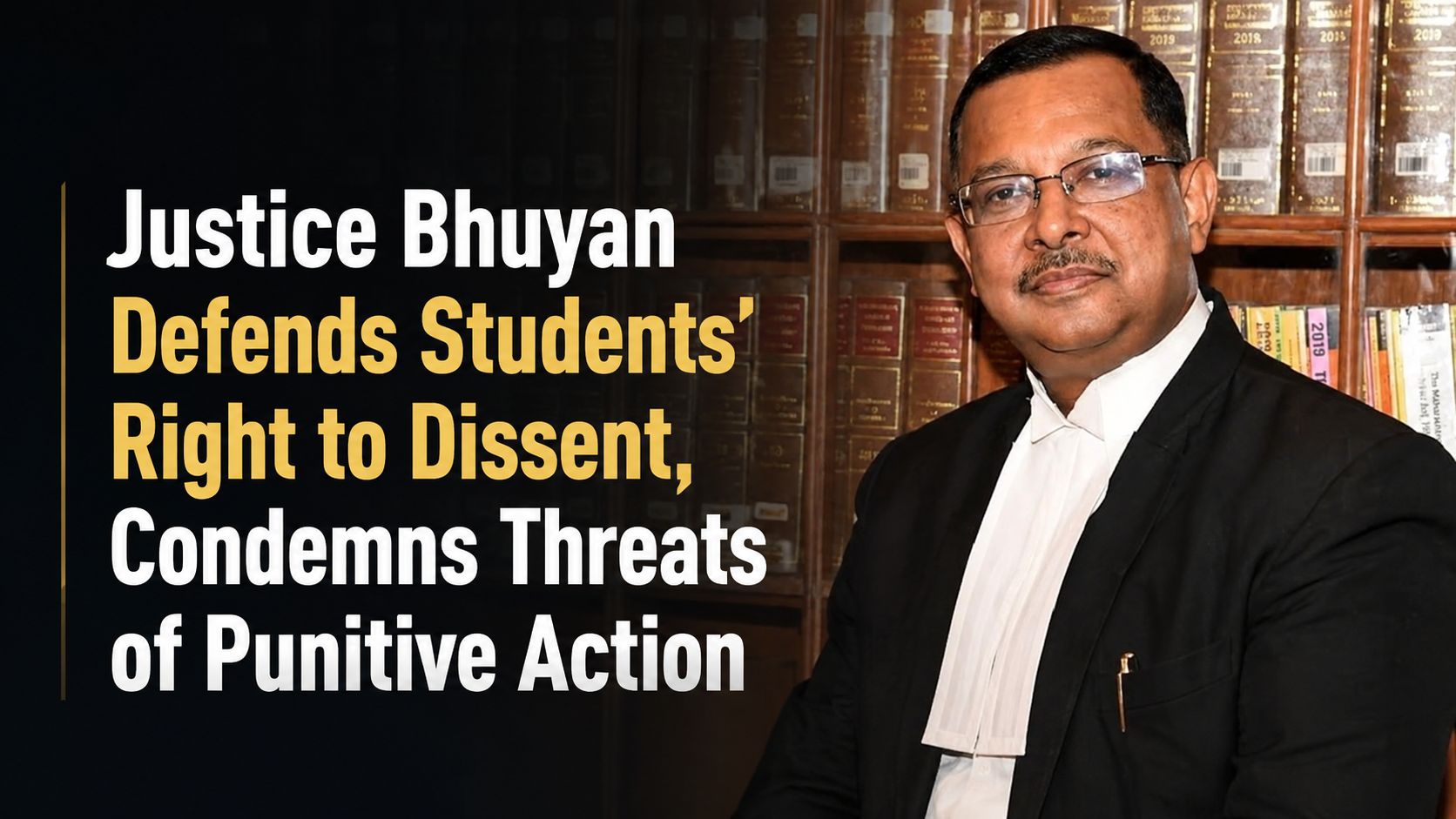
NEW DELHI, August 31, 2026: Supreme Court judge Justice Ujjal Bhuyan has strongly defended the right of students to question authority and express dissent, warning that threatening them with punitive action merely for holding a different point of view is unconstitutional and amounts to a misuse of power.


Addressing the 13th Convocation of the LL.M. programmes at National Law University, Delhi, Justice Bhuyan spoke extensively on the role of universities in a constitutional democracy, the importance of independent thought and dissent, and the responsibility of the legal profession to uphold constitutional values.
The right to question, he said, should not be regarded as an act of defiance but as an essential expression of citizenship, liberty and constitutional responsibility.


Students who hold or express views different from those of people in positions of authority cannot be threatened or subjected to punitive action simply for asking questions, he said.
Justice Bhuyan stressed that constitutional democracy does not demand agreement or uniformity of thought. The Constitution, he said, provides a framework within which people holding different beliefs, opinions and convictions can live with equal dignity and participate in a shared democratic life.
“A democratic society cannot be founded on the assumption that everyone will think alike,” he said, emphasising that differences are inevitable and must be accommodated within the constitutional framework.
Freedom of expression and meaningful participation in public life, he added, can flourish only when there is adequate space for disagreement and dissent.
Justice Bhuyan also highlighted the importance of tolerance, cautioning that intolerance is fundamentally incompatible with the spirit of the Constitution. He warned that intolerance could become another form of violence and said disagreement should never become a reason for silencing, rejecting or punishing those who hold different views.
Universities, he said, have a crucial responsibility in nurturing a democratic culture.
Institutions of higher learning should be spaces where students encounter ideas different from their own, examine established positions and engage in disagreement through reason rather than hostility, he said.
A healthy academic environment does not require everyone to arrive at the same conclusion, Justice Bhuyan observed. Instead, universities should encourage the expression, examination and debate of different viewpoints.
He urged academic institutions to cultivate the habit of independent thinking and create an atmosphere in which students are not afraid to ask difficult questions simply because the answers may be uncomfortable.
Linking freedom of inquiry with legal education, Justice Bhuyan said one of the most valuable contributions of legal education was to equip students with the courage to question established assumptions and examine whether the application of law has genuinely served the cause of justice.
The law, he noted, frequently presents situations in which individual freedoms may appear to conflict, the exercise of state power must be balanced against personal rights, and established positions need to be tested against constitutional principles.
Justice Bhuyan said legal professionals and academics carry a responsibility that goes beyond merely knowing what the law states.
They must understand the values that give the law its legitimacy, he said, adding that liberty, equality, dignity and justice must remain central to the understanding and application of law, particularly during moments of disagreement, dissent and conflict.
The Supreme Court judge also described the judiciary and academia as complementary institutions.
Strong academic work could contribute intellectual input to the judiciary, while academia could serve the legal system through research into different branches of law, including the work of judges, judicial institutions and the functioning of courts, he said.
Justice Bhuyan also referred to Article 124(3) of the Constitution, which provides for the appointment of a “distinguished jurist” to the Supreme Court. He questioned why the provision had remained unused for more than 76 years and suggested that the possibility of appointing distinguished legal academics to the apex court deserved serious consideration.
Rejecting the argument that legal academics necessarily lack the practical experience required for judicial office, he described such a view as superficial and pointed to the contributions made by academics to constitutional courts in other jurisdictions.
Justice Bhuyan’s remarks came amid recent controversies involving students at leading law universities who had expressed objections over the participation of senior judicial and legal figures in their convocations.
At Hyderabad’s NALSAR University of Law, students had objected to the proposed participation of Chief Justice of India Surya Kant at their convocation over his remarks concerning student protest violence. The controversy escalated after the Bar Council of India initially directed State Bar Councils not to enrol NALSAR's 2026 graduates pending an inquiry into the student campaign.
The directive was later withdrawn following widespread criticism. The Supreme Court subsequently questioned the Bar Council of India’s intervention and directed that no punitive action be taken against students or faculty members.
The controversy later extended to the National Law School of India University in Bengaluru, where outgoing students objected to the proposed participation of the Chief Justice of India and the Bar Council of India chairman at the university's 2026 convocation.
NLSIU subsequently cancelled its convocation, citing “unavoidable circumstances”, and announced that students would receive their degrees in absentia.
Against this backdrop, Justice Bhuyan’s address placed the freedom to question, the acceptance of dissent and the protection of constitutional values at the centre of his message to the graduating law students.
Courtesy: LiveLaw



© 2026 CATHOLIC CONNECT POWERED BY ATCONLINE LLP