- 25 April, 2026
“A ‘Useless Slaughter’: The Papal Cry for Peace in World War I”

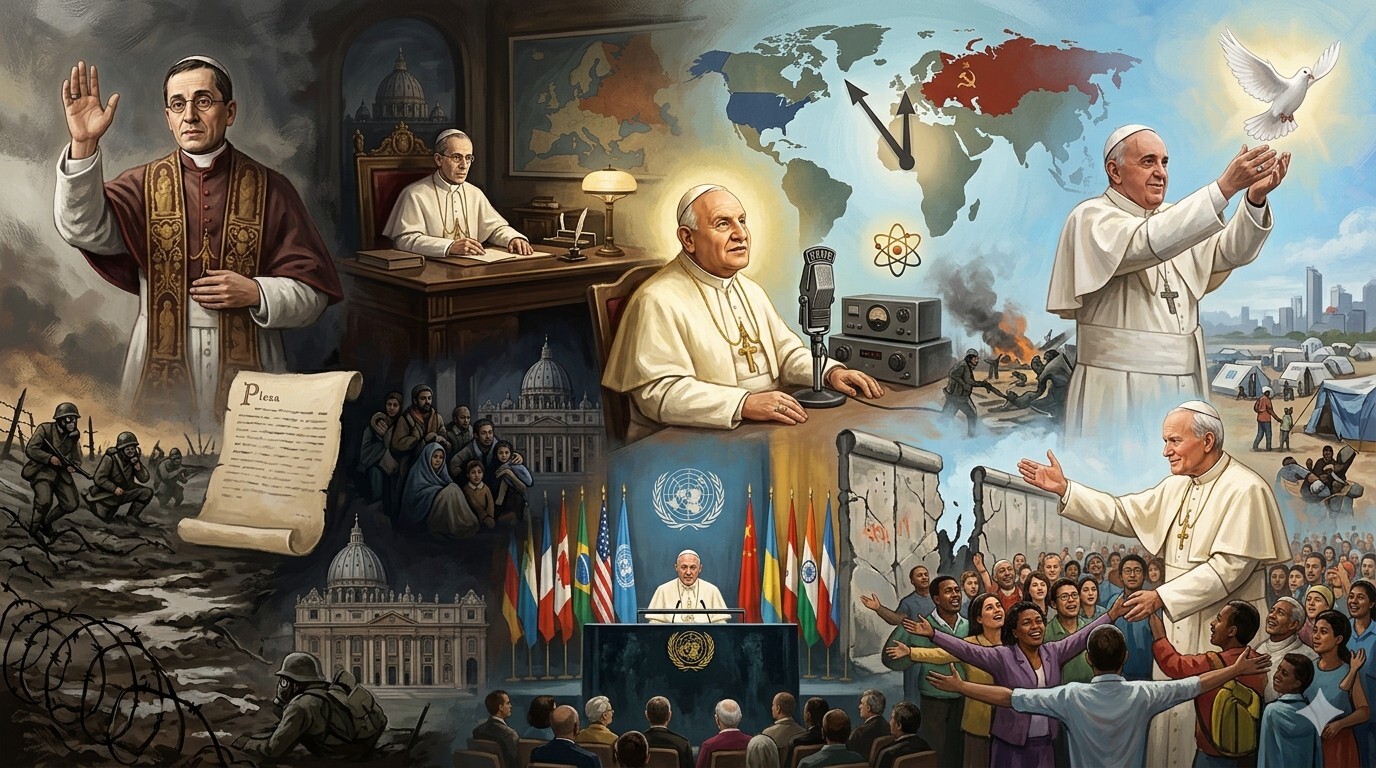
April 25, 2026: During the First World War, Pope Benedict XV emerged as one of the strongest religious voices for peace. He condemned the conflict as a “useless slaughter” and consistently urged warring nations to end the violence through negotiation rather than continued fighting. In 1917, he presented a detailed peace proposal calling for disarmament, freedom of the seas, arbitration of disputes, and fair territorial settlements. Although the plan was rejected by governments still committed to victory, his humanitarian efforts were significant. He worked to assist prisoners of war, refugees, and wounded soldiers, reinforcing the Vatican’s role as a neutral mediator focused on human suffering rather than political gain.
“Silence and Diplomacy: The Church in the Shadow of World War II”
During the Second World War, Pope Pius XII adopted a policy of cautious neutrality. He spoke against the horrors of war and repeatedly called for peace, but avoided directly naming aggressor states in public statements. His approach was based on the belief that quiet diplomacy would be more effective in protecting lives and preserving the Church’s ability to act behind the scenes. The Vatican supported humanitarian efforts, including sheltering refugees, assisting persecuted communities, and coordinating relief operations across war-torn Europe. His leadership remains debated, with supporters highlighting his discreet rescue efforts and critics questioning his public silence during the Holocaust.


“Nuclear Fear and a Call for Restraint: The Cuban Missile Crisis”
In 1962, the world stood on the edge of nuclear war during the Cuban Missile Crisis. Pope John XXIII responded with an urgent public appeal for peace, warning world leaders of the catastrophic consequences of nuclear conflict. His message, broadcast globally, called on both the United States and the Soviet Union to act with reason and avoid disaster. Although he held no political power, his moral authority contributed to the atmosphere of restraint that helped ease tensions during one of the most dangerous moments of the Cold War.
“No More War: The Voice of the Vatican at the United Nations”
As the Vietnam War escalated, Pope Paul VI took the unprecedented step of addressing the United Nations in 1965. His message, famously summarised as “No more war, war never again,” called for global disarmament and an end to armed conflict as a means of solving disputes. He repeatedly urged negotiations to end the Vietnam War and promoted international cooperation as the foundation of peace. His papacy marked a shift toward a more global and public diplomatic role for the Church in international affairs.
“Faith, Freedom and the Fall of Communism”
During the later Cold War, Pope John Paul II became a powerful moral influence in Eastern Europe. Drawing on his experience in communist Poland, he strongly defended human rights, religious freedom, and human dignity. His 1979 visit to Poland inspired widespread social and political awakening, strengthening the Solidarity movement. Many historians argue that his moral leadership contributed significantly to the weakening of communist regimes across Eastern Europe and the eventual end of the Cold War, achieved largely through peaceful transformation rather than armed conflict.
“A ‘Piecemeal World War’: Papal Appeals in the Age of Modern Conflict”
In the contemporary era, Pope Francis has responded to ongoing global conflicts, including the Russia–Ukraine War and violence in the Middle East, with continuous appeals for ceasefires and dialogue. He has described modern conflicts as a “piecemeal World War III,” highlighting how multiple regional wars together create global instability. His approach focuses heavily on humanitarian concern, refugee support, and diplomatic engagement, while consistently urging world leaders to reject escalation and prioritise peace talks.
A Century-Long Papal Message of Peace
Across more than a century of global warfare, popes have consistently responded not with military force, but with moral leadership. From Benedict XV’s urgent peace proposals during World War I to Pope Francis’s calls for restraint in modern conflicts, the papacy has maintained a consistent message: war brings suffering, and lasting peace can only be achieved through dialogue, justice, and respect for human dignity.
By Thangkhansiam
© 2026 CATHOLIC CONNECT POWERED BY ATCONLINE LLP