- 08 April, 2026

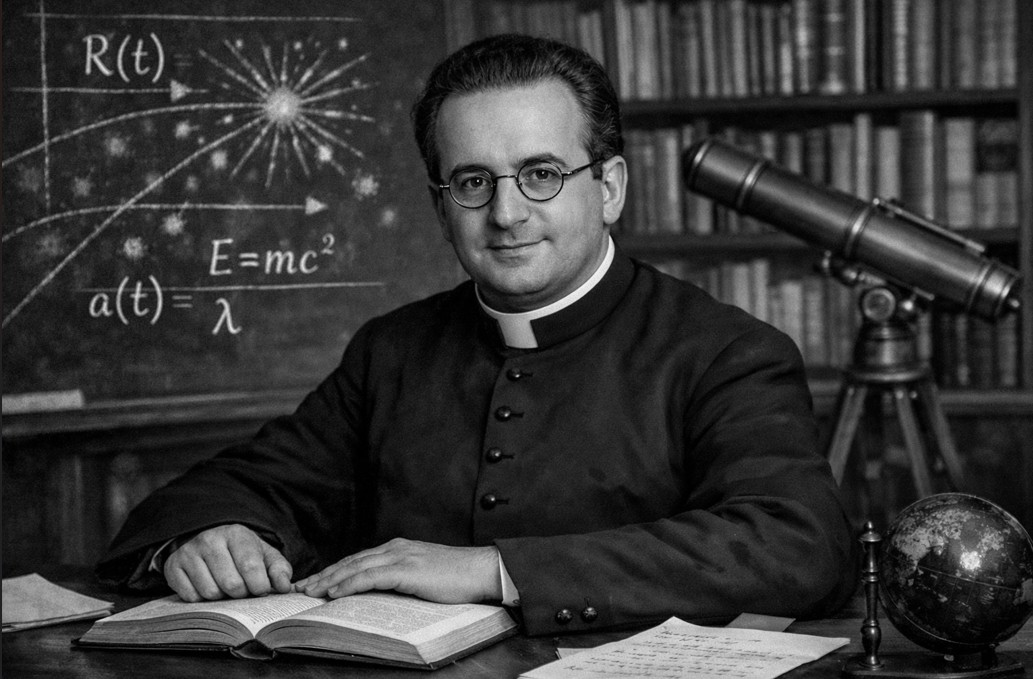
Belgium, April 9, 2026: “The Big Bang theory wasn’t created by an atheist scientist—but by a Catholic priest.”

In a world where science and faith are often portrayed as rivals, one quiet, brilliant priest shattered that myth—by helping humanity understand how the universe itself began.
Long before the term “Big Bang” became popular, a Belgian Catholic priest named Georges Lemaître was gazing not only at Scripture—but at the stars. What he discovered would forever change cosmology.
Born in 1894 in Belgium, Georges Lemaître was not an ordinary priest. He was also a mathematician, physicist, and astronomer with a deep curiosity about the nature of the universe. After serving in World War I, he pursued both theological training and advanced studies in science, eventually earning a doctorate in physics.


But unlike many scientists of his time, he saw no contradiction between his priesthood and his scientific work. Instead, his faith gave him a sense of wonder—a belief that the universe was intelligible, ordered, and worth exploring.
In the 1920s, most scientists—including the great Albert Einstein—believed the universe was static and eternal.
He dared to think differently.
Using equations derived from Einstein’s theory of relativity, he proposed a startling idea: the universe is expanding. Going even further, he suggested that if you trace this expansion backward in time, everything must have originated from a single, incredibly dense point—what he called the “primeval atom.”
This was the first formulation of what we now call the Big Bang theory.
At first, his idea was met with skepticism—even dismissal.
Ironically, Albert Einstein himself initially rejected his theory, reportedly saying, “Your calculations are correct, but your physics is abominable.”
But science has a way of catching up with truth.
In 1929, American astronomer Edwin Hubble discovered that galaxies are indeed moving away from each other—providing strong evidence that the universe is expanding, just as he had predicted.
Suddenly, the priest’s “wild idea” became the foundation of modern cosmology.
One might expect tension between such a groundbreaking scientific theory and religious belief—but the opposite happened.
The Catholic Church did not condemn his work. In fact, it supported scientific inquiry. Even when Pope Pius XII publicly referenced the Big Bang as compatible with creation, he himself urged caution—insisting that science and theology answer different kinds of questions.
He believed deeply that:
This intellectual humility made his work even more powerful.
For him, studying the cosmos was not a threat to faith—it was an act of reverence.
He once saw the universe not as something that replaced God, but as something that pointed toward deeper mystery. His priesthood didn’t limit his science—it expanded his imagination.
Today, the Big Bang theory is the leading explanation for the origin of the universe—taught in classrooms, studied by astrophysicists, and confirmed by modern observations.
And at its origin stands a priest.
A man who wore a collar, celebrated Mass, and at the same time unlocked one of the greatest scientific truths in human history.
In an age where faith and science are often framed as opposites, the story of Georges Lemaître offers a powerful reminder:
They don’t have to compete.
They can collaborate.
They can inspire.
And sometimes—together—they can explain the very beginning of everything.
The universe didn’t just expand from a single point.
So did human understanding—thanks to a priest who dared to believe in both God and the cosmos.
By Catholic Connect Reporter
________________________
Relevant Keywords: Big Bang theory origin, Georges Lemaître Big Bang, Catholic priest scientist, who discovered the Big Bang theory, origin of the universe theory, science and religion relationship, expanding universe discovery, Einstein and Big Bang theory, Edwin Hubble universe expansion, faith and science coexist, history of the Big Bang theory, cosmology breakthroughs, Catholic Church and science, primeval atom theory, universe expansion evidence


© 2026 CATHOLIC CONNECT POWERED BY ATCONLINE LLP