- 16 September, 2026

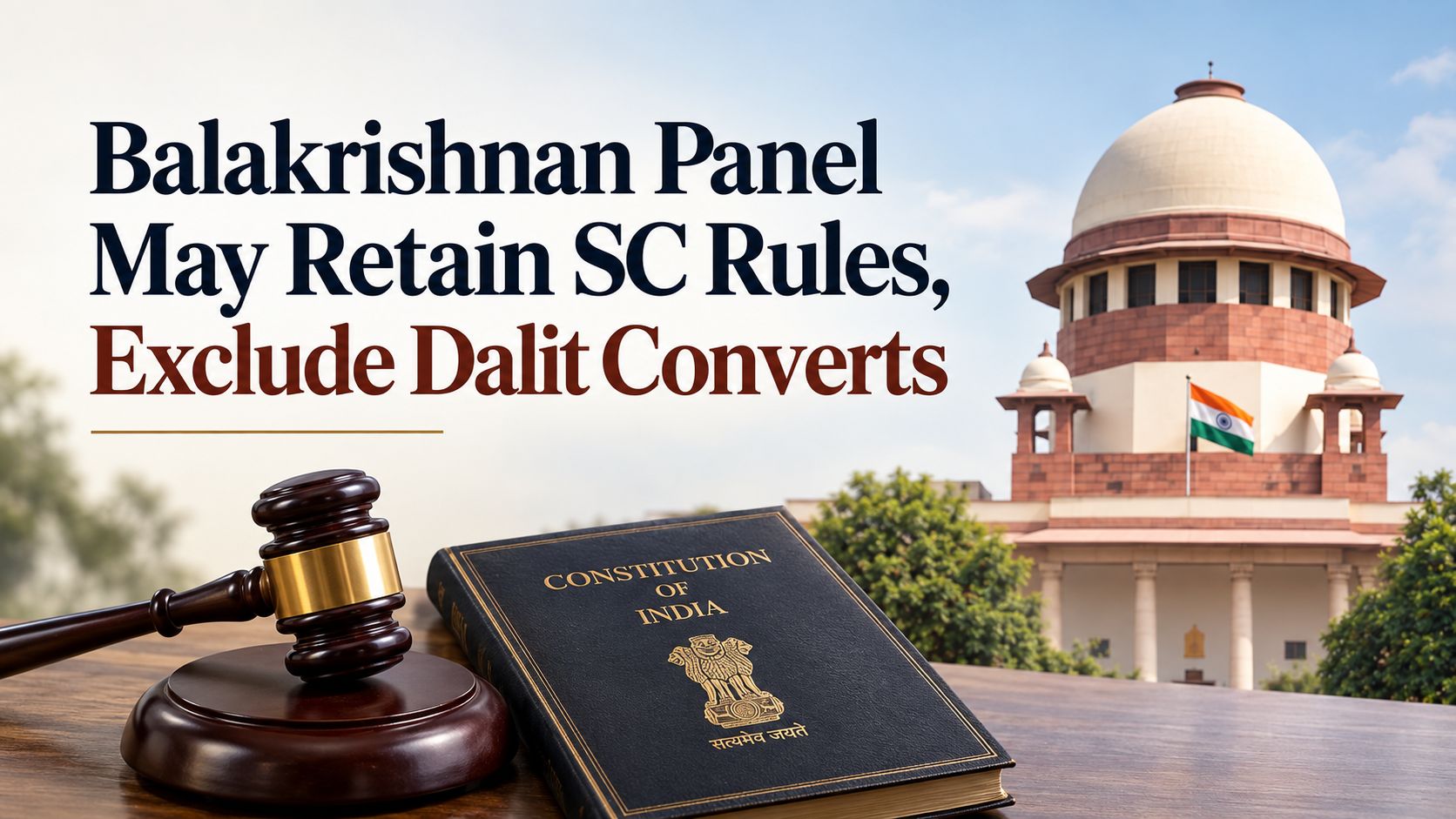
NEW DELHI, September 16, 2026: A special panel headed by former Chief Justice of India K.G. Balakrishnan may recommend that the existing definition of Scheduled Castes be retained without extending SC status to Dalit converts to Christianity and Islam, according to a report by The Times of India.

The commission of inquiry has been mandated to examine whether Scheduled Caste status can be extended to persons who have converted to religions other than those currently eligible for it, popularly known as Dalit converts to Christianity and Islam.
The Presidential (Scheduled Castes) Order, 1950, states that only persons belonging to Hinduism, Sikhism and Buddhism can be members of Scheduled Castes.

The issue has been pending before the Supreme Court for more than 20 years, with Dalit converts seeking inclusion in the Scheduled Castes list.
The Balakrishnan Commission has examined reports of earlier commissions, including the Kaka Kalelkar Commission, the Sachar Committee and the Ranganath Misra Commission, as well as positions taken by the National Commission for Scheduled Castes (NCSC) over the years. A 1911 book by a Christian missionary has also been relied upon as background material.
According to The Times of India, the Sachar Committee did not recommend Scheduled Caste status for religious converts, while the Ranganath Misra Commission recommended that the Scheduled Castes list be made religion-neutral. The recommendation was apparently not accepted by the government because the panel did not conduct a study to reach its conclusion. Sources cited by the newspaper said the Kalelkar Commission recommended only OBC status, and not Scheduled Caste recognition, for Dalit converts.
The NCSC took a contradictory stand during the UPA government, including mentioning that the 50% cap on reservations should not be disturbed.
According to sources cited in the report, the 1911 book states that Dalits gain social status after conversion, something which seems to lessen the burden of disability cited for providing affirmative action benefits to Scheduled Castes. Sources also said there is a lack of clarity on which religious converts were formerly members of Scheduled Castes.
Given these inputs, the commission may recommend that the present arrangement governing eligibility for inclusion in the Scheduled Castes list should remain.
The demand for religious converts to be included in the Scheduled Castes list has remained pending for more than two decades and has become controversial because of its political dimensions. Existing Dalit communities are often found to oppose fresh inclusions in the Scheduled Castes list, arguing that such a move would increase the number of claimants for job and educational reservations.
The BJP argues that making Scheduled Caste status religion-neutral would encourage religious conversions.
News Credits: The Times of India

© 2026 CATHOLIC CONNECT POWERED BY ATCONLINE LLP