- 10 September, 2026

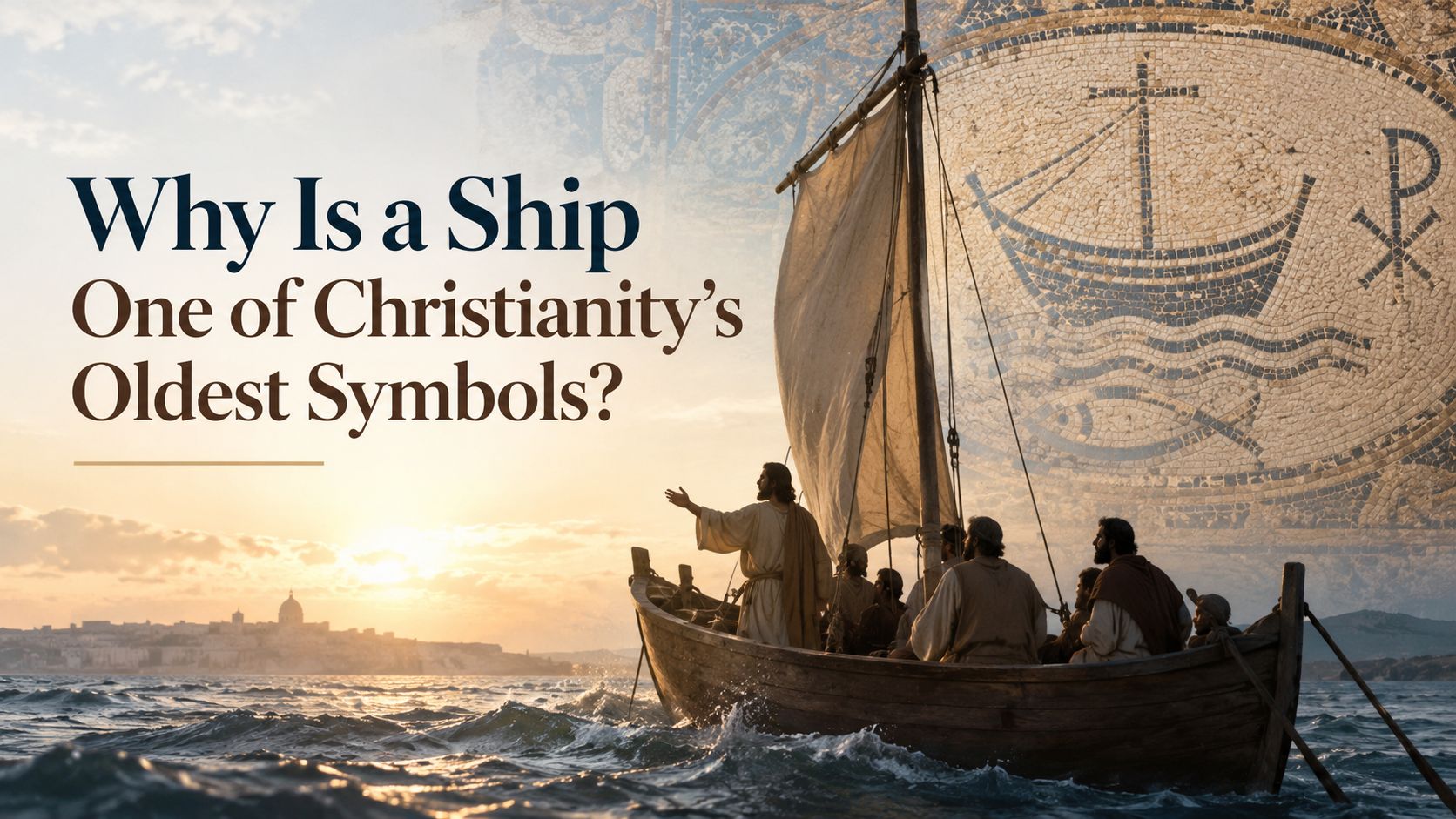
Sep 10, 2026: A ship may seem like an unlikely symbol of the Church. Yet across centuries of Christian art, boats and ships have appeared in mosaics, sarcophagi, sculptures, manuscripts and church furnishings.


For early Christians, the ship carried a powerful message: the Church is on a journey through the storms of the world, with Christ guiding His people.
It begins with Christ in the boat
The imagery has deep roots in the Gospels.

Jesus taught from boats, called fishermen to follow Him, and performed several important signs around the Sea of Galilee. One of the most powerful episodes is the storm in which the disciples panic while Jesus remains in the boat and eventually calms the sea.
(CLICK HERE to follow Catholic Connect and to stay updated with Catholic News & Content)
For Christians, the scene became more than a story about a storm. The boat could represent the community of believers gathered around Christ, while the turbulent sea could represent the trials and dangers surrounding them.
A ship in troubled waters
Early Christian writers developed this symbolism further.
Tertullian compared the Church to a ship tossed by waves of persecution and temptation. Hippolytus of Rome likewise used the image of a vessel shaken by the waves but not overcome, with Christ as its pilot.
This imagery found its way into Christian art. A ship could therefore communicate an entire theological message without words: The Church is travelling. The waters are dangerous. But Christ is aboard.
Why Peter’s boat became so important
The ship also became closely connected with St. Peter. Peter was a fisherman, and several Gospel accounts place him and the apostles in a boat. After the Resurrection, Christ appears to the disciples during the miraculous catch of fish described in John 21.
The boat therefore became associated with the apostles and the Church’s mission. The Church has consequently been described as the **“Bark of Peter”** — the vessel continuing the apostolic journey.
Even the mast can speak of Christ
Christian symbolism could become remarkably detailed.
In representations of the **Bark of Peter**, the mast can evoke the Cross, while the sails and wind suggest the forces guiding the Church forward. Vatican sources have preserved this interpretation of the ship imagery.
The ship was therefore not simply decoration. Its very structure could become a visual confession of faith.
Why is the main part of a church called the “nave”?
There is even a linguistic connection between the ship and the church building.
The 'nave' is the main section of a church — the area containing the pews where the congregation participates in the liturgy. The word comes from the Latin navis, meaning “ship.”
The name reflects the ancient Christian image of the Church as a vessel carrying believers through the storms of life, with Christ guiding them.
So the ship symbolism did not remain only in paintings, mosaics and other Christian art. It eventually became part of the language of church architecture itself.
The Church was never promised calm seas
Perhaps that is why the ship remains such a compelling Christian symbol. The image does not portray a Church sailing on perfectly calm waters. It shows a vessel capable of encountering storms.
That makes the symbol remarkably relevant even today. The Church has faced persecution, division, uncertainty and countless other storms throughout history. Yet the ancient image does not ask whether the waters will become rough.
It asks a more important question: Who is in the boat? For Christians, the answer is Christ.
And that is ultimately what the ship in Christian art proclaims — not that the Church will never face storms, but that it does not sail through them alone.
By Catholic Connect Reporter
Read More:
1) Why Is the Pelican a Symbol of Christ? The Christian Meaning Explained
2) Why Are the Four Gospels Represented by a Man, Lion, Ox and Eagle?
3) Why Is the Rooster a Symbol in Christian Art?
4) Why Do Peacocks Appear in Early Christian Tombs?
5) Why Does a Phoenix Appear in Christian Art?
6) Why Does a Pomegranate Appear in Christian Art?
7) A.M., AM or M? What Do These Mysterious Marian Letters Mean?



© 2026 CATHOLIC CONNECT POWERED BY ATCONLINE LLP