- 10 August, 2026

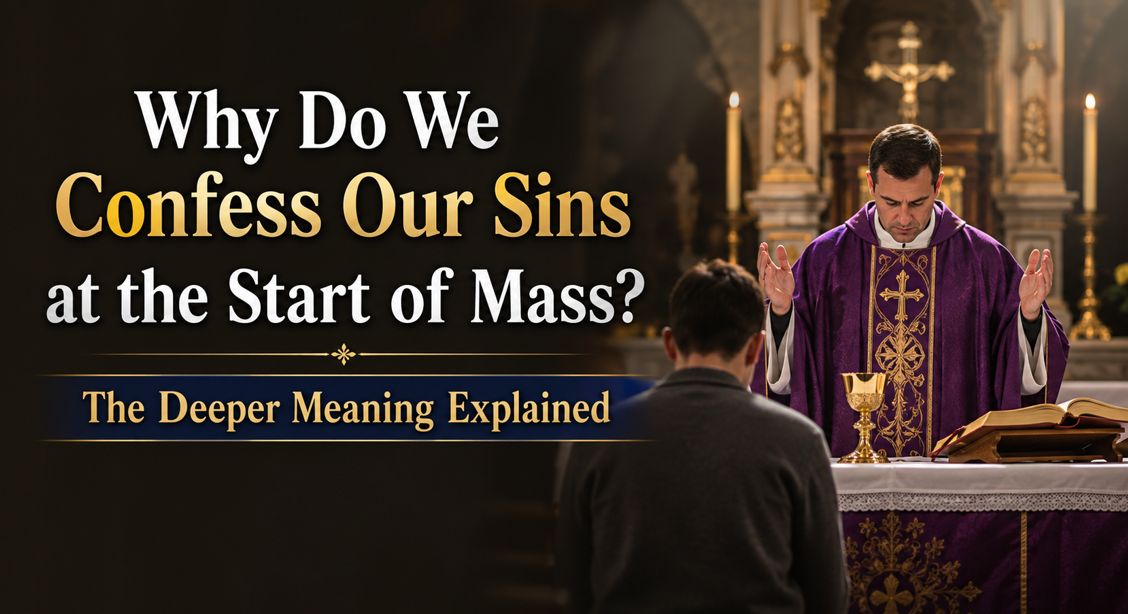
August 10, 2026:Early in the celebration of Mass, during the Introductory Rites, the Church invites us to recognise our need for God’s mercy. During the Penitential Act when it is used, the faithful acknowledge their sins and ask the Lord for mercy. Far from being an exercise in dwelling on guilt, this is an act of humility that helps prepare our hearts to celebrate the sacred mysteries and encounter Christ in the Eucharist.


Although this is the usual practice, on some occasions—particularly when the blessing and sprinkling of water is used—the Penitential Act may be replaced by another permitted form.
The Penitential Act gives us a moment to examine our lives and recognise where we have fallen short. We are invited to turn away from sin and turn towards God with humility and trust.
It is rather like preparing ourselves before meeting an important guest. We want to approach God with an open and contrite heart. The Penitential Act helps us acknowledge our sins and approach the Eucharist with the proper spiritual disposition.


However, it does not replace the Sacrament of Reconciliation. Anyone conscious of mortal sin must receive sacramental absolution before receiving Holy Communion.
(Click Here to follow Catholic Connect for regular News & Content)
One of the most familiar forms of the Penitential Act is the Confiteor, beginning, “I confess to almighty God…” The faithful acknowledge sins committed in thought, word, deed and omission.
At the words “through my fault, through my fault, through my most grievous fault”, worshippers strike their breast as a physical expression of sorrow, humility and personal responsibility.
This confession is also communal. The faithful pray together and ask for the intercession of the Blessed Virgin Mary, the angels, the saints and one another. It reminds us that Christians do not journey towards holiness in isolation, but as members of Christ’s Body.
The Roman Missal provides three forms of the Penitential Act.
The first is the Confiteor, in which the congregation makes a fuller confession of sin and seeks the prayers of the saints.
The second is a brief dialogue of mercy between the priest and people, acknowledging sinfulness and asking the Lord to show mercy and grant salvation.
The third uses invocations addressed to Christ, each followed by “Lord, have mercy” or “Christ, have mercy”. This form particularly connects Christ’s saving work with the plea for mercy.
The words “Kyrie Eleison”, meaning “Lord, have mercy”, express one of the central themes of Christian prayer. They acknowledge our dependence upon God while placing our hope in His compassion.
The purpose is not simply to remind us that we are sinners. Rather, recognising our weakness opens our hearts to God’s mercy, forgiveness and healing.
The theme of mercy does not end with the Penitential Act. When the Gloria is prescribed, the faithful praise God while asking Christ, “You take away the sins of the world, have mercy on us.”
Before proclaiming the Gospel, the priest quietly asks God to cleanse his heart and lips. During the preparation of the gifts, he likewise prays with humility and asks to be cleansed from sin.
Then, immediately before Holy Communion, the Agnus Dei turns our attention once again to Christ: “Lamb of God, you take away the sins of the world, have mercy on us.”
Finally, the congregation acknowledges its unworthiness before receiving Christ in the Eucharist: “Lord, I am not worthy that you should enter under my roof, but only say the word and my soul shall be healed.”
The Penitential Act therefore gives the Mass a profound beginning. It teaches us to approach God not by pretending to be perfect, but by honestly recognising our need for His mercy. We confess our sins, ask for forgiveness and place our trust in Christ — preparing our hearts to celebrate the Eucharist with humility, faith and hope.
By Catholic Connect Reporter
Read more:
Why Does the Priest Kiss the Altar at Mass?
Why Does Mass Begin and End with the Sign of the Cross?
What Makes the Catholic Mass Different from Other Christian Worship Services?
If God Made the Seventh Day Holy, Why Do Catholics Worship on Sunday?
Four Parts, One Beautiful Story: Understanding the Flow of the Mass
Why Does the Mass Follow the Same Order Every Time? The Church's Timeless Wisdom
Why Do Catholics Call It the Mass? The Answer Begins with Three Latin Words
How the Mass Developed Over 2,000 Years: A Journey Through History and Worship
Is the Mass Biblical? Discover the Bible in Every Part of the Holy Mass
© 2026 CATHOLIC CONNECT POWERED BY ATCONLINE LLP