- 24 November, 2026
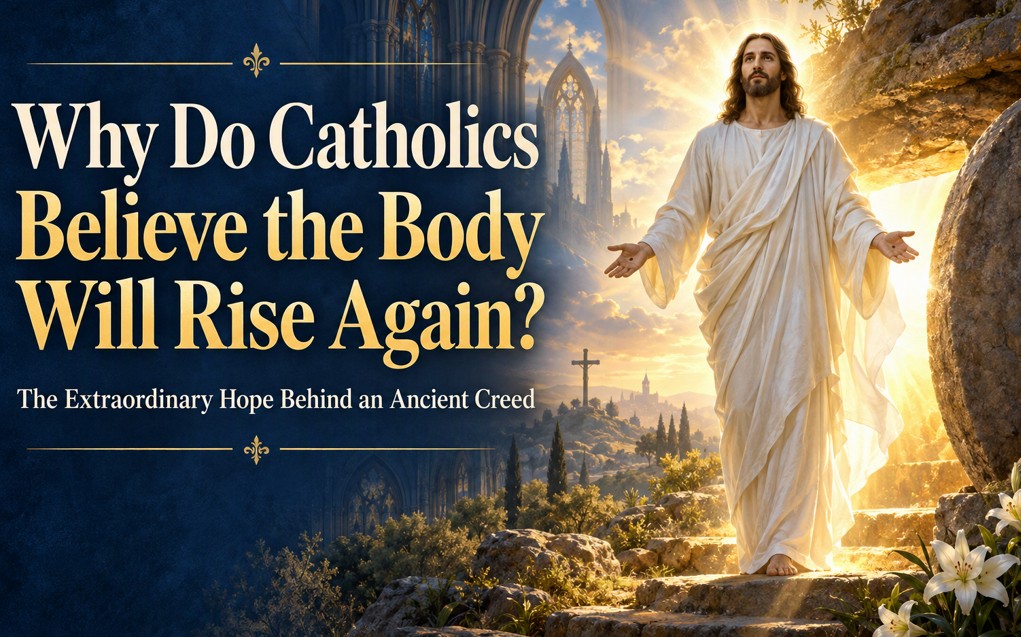
November 24, 2026 : For many people, death seems to mark the end of physical existence. Yet Catholics profess a remarkable belief every Sunday: “I look forward to the resurrection of the dead and the life of the world to come.” Why does the Church insist that our bodies, not just our souls, will live again?
The answer lies at the heart of Christian faith: God intends to redeem the whole human person. Christian hope is not simply that the soul survives death, but that God will raise the dead and restore the human person in the fullness of body and soul.
The foundation of this belief is the Resurrection of Jesus Christ. Catholics do not believe that Jesus simply survived as a spirit or remained alive in His disciples’ memories. He rose bodily, although His body was transformed and glorified.
(CLICK HERE to follow Catholic Connect and to stay updated with Catholic News & Content)
In Luke 24:39, Jesus tells His disciples: “Touch me, and see; for a ghost does not have flesh and bones as you see that I have.” He also eats with them (Luke 24:41–43).
Christ’s Resurrection is therefore more than a miracle of the past. As St. Paul teaches, Christ is “the first fruits of those who have died” (1 Corinthians 15:20). His victory over death is the foundation of the promise that His followers, too, will be raised.
The risen Christ is the beginning and guarantee of the resurrection promised to humanity.
Catholic theology teaches that a human being is a unity of body and soul. The body is not a prison from which the soul must escape, nor is it something worthless or disposable. It is an essential part of who we are, created by God and declared good.
At death, the soul separates from the body. The body decays, while the soul goes to meet God, awaiting its reunion with a glorified body at the resurrection.
This separation is not humanity’s final destiny. At the end of time, God will raise the dead and reunite each soul with its own body, transformed by divine power.
The resurrection therefore restores the fullness of human existence. God does not save merely a part of the human person; His plan concerns the whole person, body and soul.
St. Paul explains this mystery in 1 Corinthians 15:42–44. He writes that the body is “sown perishable, it is raised imperishable”.
Our present bodies experience weakness, illness, ageing and death. The resurrection, however, will bring a transformation beyond the limitations of our present earthly existence.
This does not mean returning to ordinary earthly life as before. Christ did not rise to resume His former mortal existence. His risen body was real and physical, yet glorified and no longer subject to death.
Jesus promises in John 6:40: “I will raise him up at the last day.”
The Church teaches that all the dead will rise, but Scripture also distinguishes between a resurrection to life and a resurrection to judgment (John 5:28–29). Those who belong to Christ and share in eternal life will receive glorified bodies, freed from suffering, corruption and death. The resurrection is universal, but the final destiny of the risen is not the same for everyone.
The Church teaches that those who share in the glory of heaven will receive bodies transformed and perfected by God. They will no longer experience suffering, corruption or death.
St. Thomas Aquinas traditionally describes four qualities of glorified bodies: impassibility, subtlety, agility and clarity. These terms help explain how the human body will be perfected in the resurrection.
These qualities do not suggest that the body becomes a spirit or loses its physical nature. Rather, they describe how completely God will perfect and glorify the human body.
Nevertheless, the precise manner of the resurrection remains a mystery beyond our present understanding. As the Catechism of the Catholic Church teaches, the question of how the resurrection will take place exceeds our imagination and understanding.
The resurrection gives profound dignity to the human body. If God intends to raise our bodies and bring them into eternal life, then our physical existence has lasting significance.
This belief calls Catholics to care for the sick, respect human life, protect the dignity of every person and treat the bodies of the deceased with reverence. Our bodies are not disposable possessions; they are part of the person God created and loves.
The resurrection also gives hope amid grief. When we lose someone we love, death can seem like an unbearable separation. Yet Christian faith assures us that death will not have the final word. God promises to raise the dead, and those who remain faithful to Him may look forward to sharing eternal life in His presence.
The Catechism of the Catholic Church (988–1019) teaches that belief in the resurrection of the body belongs to the very heart of Christian faith.
Ultimately, Catholics believe in the resurrection of the body because God does not abandon what He has created. Through Christ, He promises to raise the dead and transform the human person. All will rise, but the final destiny of each will be revealed in God's judgment.
Christian hope, therefore, is not simply that the soul survives death. It is the extraordinary promise that, through Jesus Christ, the whole human person is destined for resurrection, and that those who share in His victory will enjoy eternal life with God.
By Catholic Connect Reporter
Read More on Sainthood:
1) What If You Are Called to Be a Saint? Finding Holiness in Everyday Life
2) The Communion of Saints: How Are We Connected to Those Who Have Gone Before Us?
3) Do You Have to Be Extraordinary to Become a Saint? The Catholic Teaching on Holiness?
4) St Ignatius of Loyola: The Five-Minute Practice That Can Bring You Closer to God
5) What Does the Bible Say About Becoming a Saint? Understanding the Call to Holiness
6) St. Augustine: The Power of Conversion and a New Beginning
7) St. Monica: The Mother Who Never Stopped Praying – A Story of Faith, Patience and Perseverance
8) St. Francis of Assisi: He Gave Up Everything to Discover What Truly Matters
9) Live Like St. Joseph: Discovering Holiness in Life’s Quietest Moments
10) Beyond Likes and Followers: Five Virtues for a Holier Digital Life
11) St. Maximilian Kolbe: What Could Make a Man Choose Death to Save a Stranger?
12) St. Teresa of Calcutta: In a World of AI Conversations, Are We Forgetting Human Connection?
13) Why Do Catholics Ask Saints to Pray for Them? The Meaning Behind This Belief
14) The Beauty of Small Things: How St. Thérèse of Lisieux Found a Path to Sainthood
16) Are Catholics Worshipping Statues? The Catholic Explanation Behind Sacred Images
17) Are Catholic Relics Biblical or Pagan? What Scripture and Early Church History Reveal
18) St. Devasahayam Pillai: A Life That Refused to Renounce Christ
19) St. Maria Goretti : How Did an Eleven-Year-Old Girl Teach the World to Forgive?
20) St. Kuriakose Elias Chavara: Can a Classroom Become a Path to Holiness?
23) Why Do We Admire Saints but Rarely Imagine Becoming One?
© 2026 CATHOLIC CONNECT POWERED BY ATCONLINE LLP