- 11 November, 2026
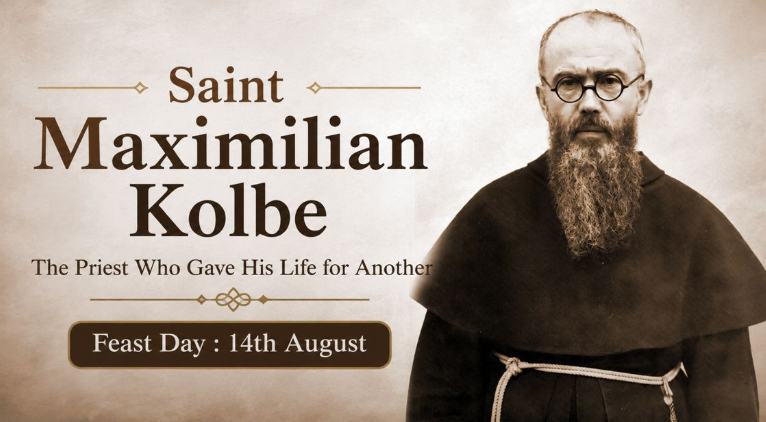
November 11, 2026: What could make someone willingly surrender their life so that a stranger might live? For St. Maximilian Kolbe, the answer was a love rooted so deeply in Christ that even the fear of death could not overcome it. His extraordinary sacrifice at Auschwitz remains one of the most powerful examples of Christian charity in modern history.

In July 1941, a prisoner escaped from the Nazi concentration camp of Auschwitz. As punishment, the authorities selected ten men to die by starvation. Among them was Franciszek Gajowniczek, who cried out in despair for his wife and children.
At that moment, Kolbe, a Polish Franciscan priest, stepped forward and asked to take the man's place. The authorities accepted his request.
Kolbe was taken to the starvation bunker with the other condemned prisoners. During their final days, he encouraged them through prayer and hymns. After surviving longer than the others, he was killed by a lethal injection on 14 August 1941. Gajowniczek survived the war.
Kolbe's decision was not simply a spontaneous act of bravery. It reflected a lifetime devoted to prayer, missionary work and service.
He had founded the Militia Immaculatae, an apostolic movement dedicated to the Blessed Virgin Mary and the spread of the Gospel. His Marian devotion was closely connected to his desire to bring people closer to Christ.
For Kolbe, faith was not merely something to profess; it was something to practise through self-giving love. His final action expressed the Christian conviction that another person's life possesses profound dignity and must never be treated as disposable.
Jesus teaches in John's Gospel: “Greater love has no one than this, that someone lay down his life for his friends” (John 15:13).
Kolbe's sacrifice gives striking witness to these words. He offered his life not for a relative or close companion, but for another human being facing death.
Catholic teaching understands charity as more than kindness or emotion. It is the theological virtue by which we love God above all things and our neighbour for God's sake. This love calls Christians to seek another person's good, sometimes at considerable personal cost.
Kolbe's example also reflects Christ's own self-offering. His death did not redeem humanity as Christ's sacrifice does, but it pointed towards the love revealed on the Cross.
On 10 October 1982, Pope St John Paul II canonised Kolbe and proclaimed him a martyr of charity. Gajowniczek attended the ceremony, a living reminder of the life saved through the priest's sacrifice.
The title captures what made Kolbe's witness so remarkable: he gave himself so another could live.
Most people will never face such an extreme choice. Yet Kolbe challenges us to practise sacrificial love in everyday life: defending the vulnerable, forgiving others, serving without recognition and giving time to those in need.
His story reminds us that extraordinary courage can grow from ordinary faithfulness.
Kolbe did not discover love in the Auschwitz bunker. He had spent his life learning to live it.
Read More:
1) What If You Are Called to Be a Saint? Finding Holiness in Everyday Life
2) The Communion of Saints: How Are We Connected to Those Who Have Gone Before Us?
3) Do You Have to Be Extraordinary to Become a Saint? The Catholic Teaching on Holiness?
4) St Ignatius of Loyola: The Five-Minute Practice That Can Bring You Closer to God
5) What Does the Bible Say About Becoming a Saint? Understanding the Call to Holiness
6) St. Augustine: The Power of Conversion and a New Beginning
7) St. Monica: The Mother Who Never Stopped Praying – A Story of Faith, Patience and Perseverance
8) St. Francis of Assisi: He Gave Up Everything to Discover What Truly Matters
9) Live Like St. Joseph: Discovering Holiness in Life’s Quietest Moments
10) Beyond Likes and Followers: Five Virtues for a Holier Digital Life


© 2026 CATHOLIC CONNECT POWERED BY ATCONLINE LLP