- 25 June, 2026
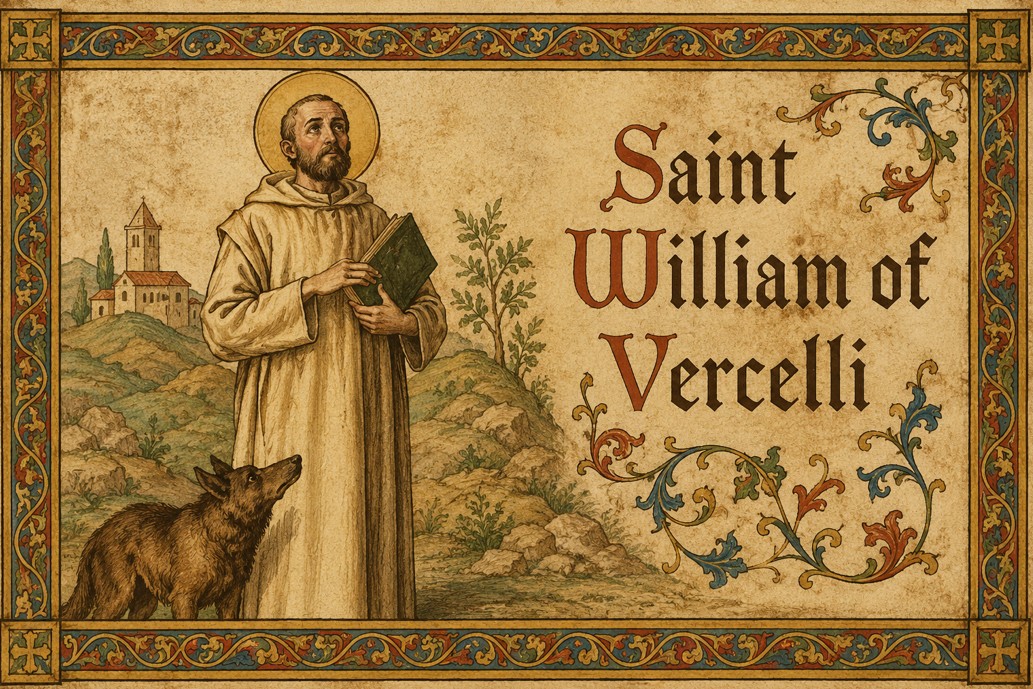
Italy, June 25, 2026: Why is Saint William of Vercelli remembered as one of the greatest Italian hermits and spiritual reformers of the Middle Ages? Discover the extraordinary story of the pilgrim who abandoned worldly ambitions, embraced a life of prayer and penance, founded the Congregation of Monte Vergine, and inspired generations of monks through his devotion to God and simplicity of life.


Feast Day: 25 June
Born: Around 1085, Vercelli, Piedmont, Italy
Died: 25 June 1142, Goleto, Italy
Canonized: 1209 by Pope Innocent III


Patron of: Monks, hermits, pilgrims, and those seeking spiritual guidance
Known For: Founding the Monte Vergine religious community, promoting contemplative life, prayer, fasting, and monastic renewal
Title: Founder of the Congregation of Monte Vergine
Few saints represent the search for God through solitude and sacrifice as deeply as Saint William of Vercelli.
Born in medieval Italy, William felt called from a young age to leave behind ordinary ambitions and dedicate himself completely to a life of prayer and penance.
His journey was not one of comfort or recognition. He travelled as a pilgrim, lived as a hermit, endured hardship, and sought a deeper union with God away from worldly distractions.
Through his holiness and wisdom, many people were drawn to him, eventually leading to the foundation of the religious community of Monte Vergine.
His life became a powerful witness that silence, humility, and prayer can transform both individuals and communities.
(CLICK HERE to follow Catholic Connect for regular News and Content)
Saint William of Vercelli was born around the year 1085 in Vercelli, in the region of Piedmont, Italy.
He was orphaned at a young age and was raised with a strong sense of faith.
As a young man, William developed a deep desire for spiritual growth. Rather than seeking wealth, comfort, or social success, he longed to dedicate his life entirely to God.
Inspired by the example of the saints and the ancient tradition of Christian pilgrimage, he decided to leave behind the familiar world and seek a life of greater holiness.
William began a pilgrimage toward the shrine of Santiago de Compostela, one of the most important Christian pilgrimage destinations of the Middle Ages.
During his journey, he embraced a life of simplicity and sacrifice.
According to tradition, he travelled with great devotion and even carried out severe acts of penance as an expression of his love for God.
His pilgrimage strengthened his desire for a life completely devoted to prayer.
After completing his journey, William continued searching for a place where he could live in solitude and contemplation.
William eventually settled on Monte Vergine, a mountain near Avellino in southern Italy.
There, he built a small hermitage and began living a life of prayer, fasting, and solitude.
The place was difficult and isolated, but William found peace in the presence of God.
Soon, people began hearing about the holy hermit living on the mountain. Men who desired a deeper spiritual life came to seek his guidance.
What began as one man’s search for God gradually became a community of prayer.
Around 1118, Saint William founded the religious community that became known as the Congregation of Monte Vergine, also called the Williamites or Verginians.
The monks followed a strict way of life inspired by Benedictine spirituality, focusing on:
The community grew rapidly because many people were attracted to William’s example of holiness.
Although he sought solitude, God used his life to create a spiritual family that would continue his mission.
Saint William became known not only as a hermit but also as a wise spiritual guide.
People from different backgrounds came to him for advice and encouragement.
He taught that true holiness required humility, patience, and complete trust in God.
William did not seek personal influence, but his holiness naturally attracted others.
His life showed that those who seek God sincerely can become a source of inspiration for many.
Like many religious reformers, Saint William faced difficulties.
Some people misunderstood his strict way of life, and others questioned the demands of his community.
At one point, because of criticism and opposition, William left Monte Vergine and continued his mission elsewhere.
However, he never abandoned his calling.
Wherever he went, he established communities dedicated to prayer and spiritual renewal.
In his later years, William founded another community at Goleto, near Sant’Angelo dei Lombardi.
There, he continued guiding monks and encouraging people to seek holiness.
He died on 25 June 1142 at Goleto.
After his death, devotion to him spread throughout Italy, and many Christians remembered him as a model of prayer, humility, and dedication to God.
Saint William of Vercelli was canonized in 1209 by Pope Innocent III.
His religious family, the Congregation of Monte Vergine, continued to preserve his spiritual tradition for centuries.
Today, he is honoured as one of Italy’s great medieval saints and as an example of contemplative spirituality.
His life continues to inspire monks, religious communities, and all Christians who seek a deeper relationship with God.
The message of Saint William’s life is especially meaningful in a world filled with distractions.
He teaches that silence and simplicity are not escapes from life but opportunities to discover what truly matters.
By removing unnecessary attachments, William created space for prayer, reflection, and service.
His example reminds believers that a heart focused on God can find peace even in difficult circumstances.
The life of Saint William teaches important lessons:
Saint William reminds Christians that the greatest journey is the journey toward God.
In a modern world often filled with noise and constant activity, Saint William of Vercelli offers a powerful example of spiritual focus.
He was a pilgrim who searched for God, a hermit who founded a community, and a humble servant whose life changed countless others.
From the mountains of Monte Vergine to monasteries inspired by his vision, his legacy continues to encourage believers to seek prayer, simplicity, and holiness.
Saint William teaches a timeless truth: when a person gives their heart completely to God, even a life lived in silence can transform the world.
To know about more saints please visit the spiritual section.
By Catholic Connect Reporter
Saint William of Vercelli, Saint William feast day, Monte Vergine, Italian saints, Catholic hermit saints, medieval saints, monastic founders, saints of June, Benedictine spirituality, Catholic monks, contemplative saints, founders of religious orders
© 2026 CATHOLIC CONNECT POWERED BY ATCONLINE LLP