- 08 July, 2026

July 8, 2026: Some places preserve history. Others seem to stand outside it.


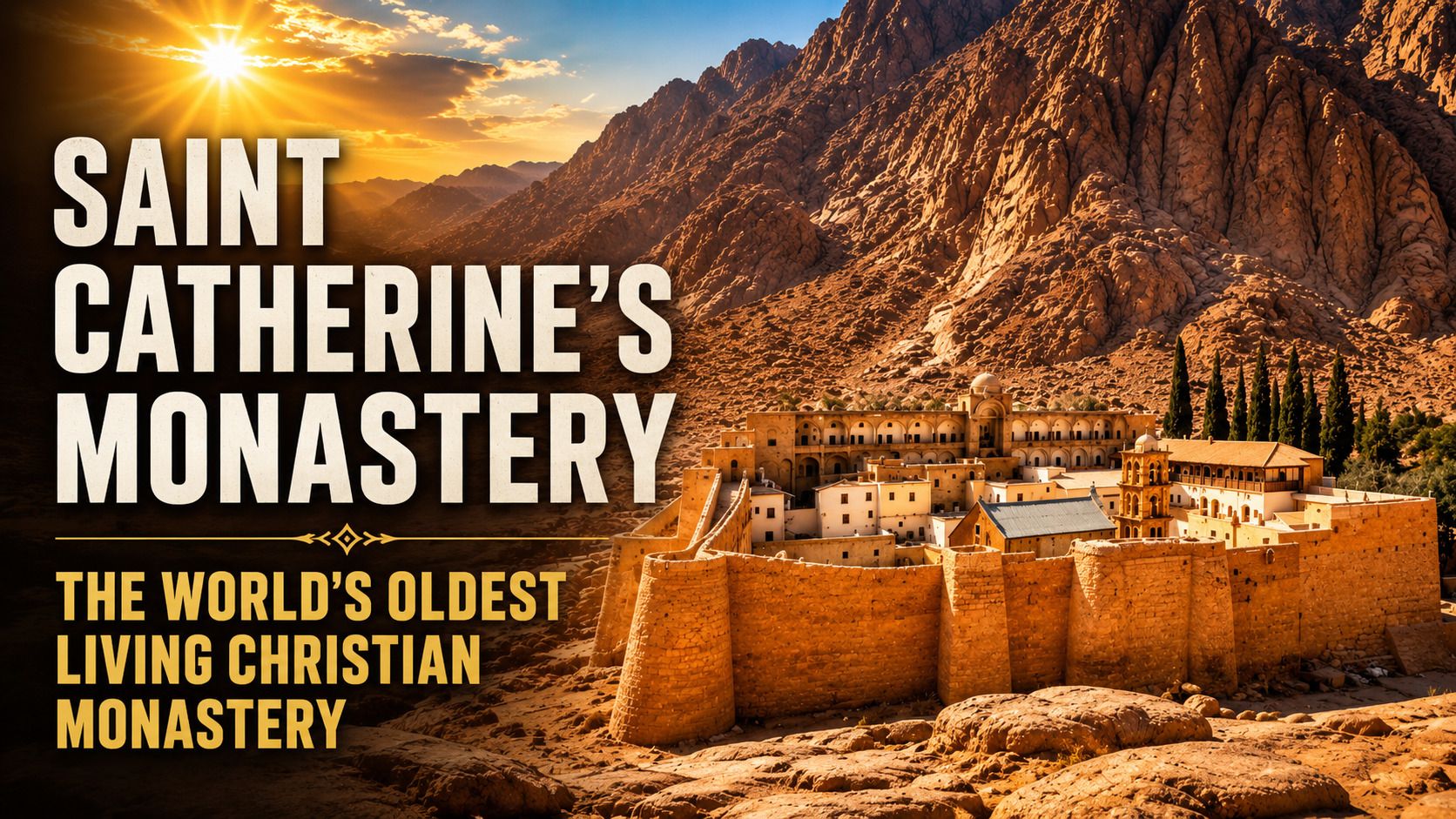
At the foot of Egypt's Mount Sinai rises Saint Catherine's Monastery—a fortress of granite, faith and silence that has remained alive for more than 1,500 years. It is not only the world's oldest continuously inhabited Christian monastery but also a place where architecture, prayer and history have become inseparable. Every wall, stone and pathway quietly tells a story that refuses to fade.
Built Around a Sacred Encounter
Founded between 527 and 565 CE by Byzantine Emperor Justinian I, the monastery was built for a remarkable reason—to protect the traditional site of the Burning Bush, where God first spoke to Moses.


Long before the great basilica was raised, Empress Helena had ordered a small chapel at the site in the fourth century. When Justinian's fortress-monastery was built, the altar was placed directly above the roots of the sacred bush, while the living bramble was carefully transplanted just outside the wall, where it continues to grow today. Revered as a direct descendant of the original, it remains one of the monastery's most treasured symbols.
Within the same sacred enclosure lies the Well of Moses, traditionally recognised as the place where Moses met his future wife, Zipporah. Even today, it continues to provide water for the monastery.
(CLICK HERE to follow Catholic Connect for regular News and Content)
A Fortress in the Desert
The monastery's setting is as striking as its history.
Surrounded by the wilderness of Sinai, Justinian enclosed the complex within towering granite walls reaching up to 11 metres high and 2.5 metres thick. For centuries, there were no ground-level entrances. Visitors and supplies entered only by being lifted several storeys through a wooden winch system—a design that transformed the monastery into both a sanctuary and a fortress.
Its architecture reflects more than craftsmanship. It reveals a community determined to protect prayer, tradition and sacred memory against the passing of centuries.
A Library That Safeguarded Civilisation
Because the monastery was never plundered or abandoned, it became one of history's greatest guardians of knowledge.
Its Sinai Library holds the world's second-largest collection of early codices and ancient manuscripts after the Vatican Library. Thousands of priceless texts in Greek, Arabic, Syriac, Georgian and Slavonic continue to be preserved there. It also once housed the fourth-century Codex Sinaiticus, one of Christianity's most important biblical manuscripts.
The monastery is equally renowned for its extraordinary collection of more than 2,000 religious icons, including rare pre-ninth-century icons that survived the Byzantine Iconoclasm because of the monastery's remote isolation.
A Sanctuary Respected Across Faiths
Saint Catherine's Monastery stands at a unique meeting point of Judaism, Christianity and Islam.
According to historical tradition, the Prophet Muhammad granted the monks a document known as the Achtiname in 623 CE, offering protection, exempting them from taxes and instructing Muslims to defend the monastery.
During the Fatimid Caliphate, a Crusader chapel within the monastery walls was permitted to become a mosque, strengthening its protection under Islamic rule. In later centuries, both Ottoman Sultan Selim I and Napoleon Bonaparte also issued decrees safeguarding the monastery, with Napoleon ordering repairs to its northern wall.
A Living Witness
Originally dedicated to the Virgin Mary and the Transfiguration, the monastery later became known as Saint Catherine's after the relics of Saint Catherine of Alexandria were traditionally brought there in the tenth century.
In 2002, UNESCO recognised the Saint Catherine Area as a World Heritage Site, honouring not only the monastery itself but also the surrounding sacred landscape of Mount Sinai.
More than an ancient monument, Saint Catherine's Monastery remains a living witness to faith, history and peaceful coexistence. In its silent stones, soaring walls and sacred spaces, the past is not remembered—it is still alive.
By Catholic Connect Reporter
Read More :
The Church of the Holy Sepulchre: Walking Through the Sacred Heart of Christianity
Inside St. Mark's Basilica: The Church That Glows Like Heaven
Notre-Dame Cathedral: The Gothic Masterpiece That Rose from the Ashes to Inspire the World
Milan Cathedral: Italy's Crown of Marble Reaching Towards Heaven
Chartres Cathedral: Where Stone, Light, and Heaven Meet
Montserrat Monastery: A 1,000-Year-Old Architectural Marvel in the Mountains
Inside the Sagrada Família: The Incredible Story of Gaudí's Greatest Masterpiece
© 2026 CATHOLIC CONNECT POWERED BY ATCONLINE LLP