- 11 July, 2026

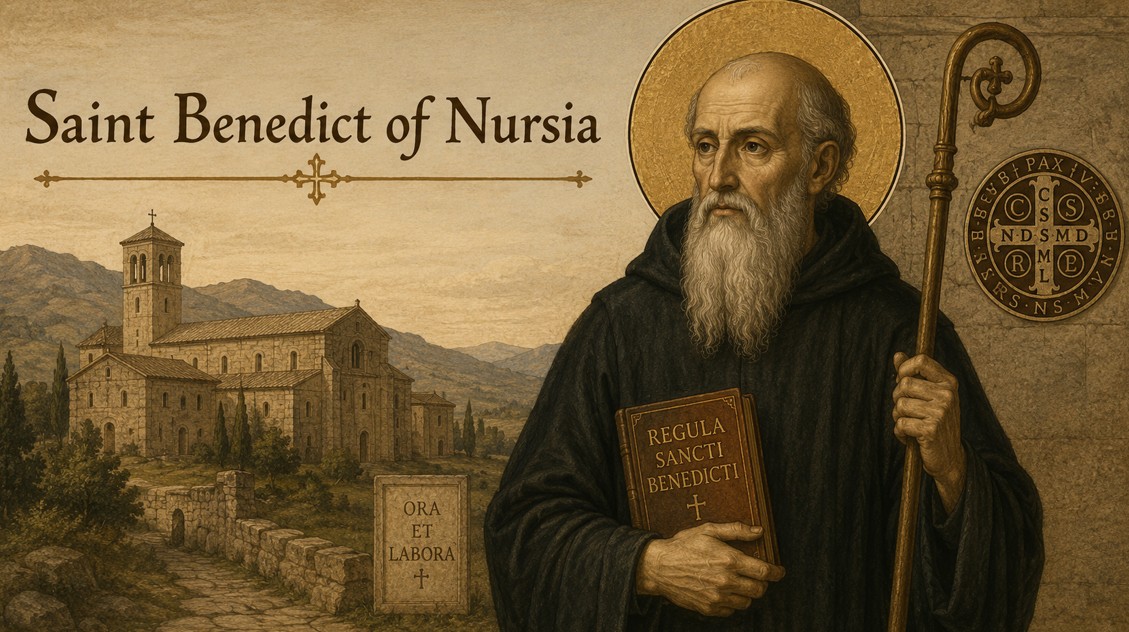
Italy, July 11, 2026: Why is Saint Benedict of Nursia regarded as one of the most influential saints in Christian history? Discover the extraordinary story of the humble monk who left behind a life of privilege to seek God in solitude, founded the Benedictine Order, wrote the famous Rule of Saint Benedict, and laid the spiritual foundations that shaped Western Christianity for centuries.


Feast Day: 11 July
Born: c. 480 AD, Nursia (Norcia), Italy
Died: c. 547 AD, Monte Cassino, Italy
Canonized: Recognized as a saint by early Church tradition (pre-congregation canonization)


Patron of: Europe, monks, students, cave explorers, agricultural workers, and those seeking protection against evil
Known For: Founding the Benedictine Order, writing the Rule of Saint Benedict, establishing Monte Cassino Abbey, and earning the title "Father of Western Monasticism"
Title: Abbot
Few saints have influenced both the Church and the world as profoundly as Saint Benedict of Nursia.
While kings ruled nations through armies and politics, Benedict transformed Europe through prayer, discipline, education, and community life.
His vision of balancing prayer with honest work became the foundation of Western monasticism, preserving Christian faith, culture, and learning during some of history's most turbulent centuries.
More than 1,500 years after his death, millions continue to follow his spiritual wisdom through the Rule of Saint Benedict.
Benedict was born around the year 480 in Nursia, a town in central Italy, into a respected Roman family.
As a young man, he was sent to Rome to pursue higher education.
However, he quickly became disillusioned by the moral decline and worldly distractions he witnessed in the city.
Rather than seeking wealth or political success, Benedict desired a life completely devoted to God.
Leaving Rome behind, he chose the path of solitude, prayer, and spiritual discipline.
(CLICK HERE to follow Catholic Connect for regular News and Content)
Benedict withdrew to a remote cave near Subiaco, where he lived as a hermit for nearly three years.
Under the guidance of the monk Romanus, he devoted himself to fasting, prayer, Scripture, and contemplation.
Hidden from the world, Benedict sought only to grow closer to Christ.
His holiness eventually became known, and people began seeking his counsel and spiritual direction.
What began as a life of solitude gradually developed into a mission of guiding others toward God.
As more disciples gathered around him, Benedict established several small monastic communities.
He recognized that monks needed both spiritual discipline and practical organization to grow in holiness.
To guide them, he wrote the Rule of Saint Benedict, one of the most influential spiritual texts in Christian history.
The Rule emphasized:
Its famous principle, "Ora et Labora" ("Pray and Work"), became the hallmark of Benedictine spirituality.
Around the year 529, Benedict founded the famous Monte Cassino Abbey on the site of a former pagan temple.
The monastery soon became one of Christianity's greatest centers of prayer, education, agriculture, and scholarship.
Monks copied sacred manuscripts, preserved classical literature, educated future leaders, cared for the poor, and cultivated the land.
During the centuries following the fall of the Roman Empire, Benedictine monasteries became beacons of hope and learning across Europe.
Numerous miracles are associated with Saint Benedict throughout his life.
According to the traditions preserved by Pope Gregory the Great in his Dialogues, Benedict:
These accounts reflect the deep faith of the early Church in Benedict's holiness and God's power working through him.
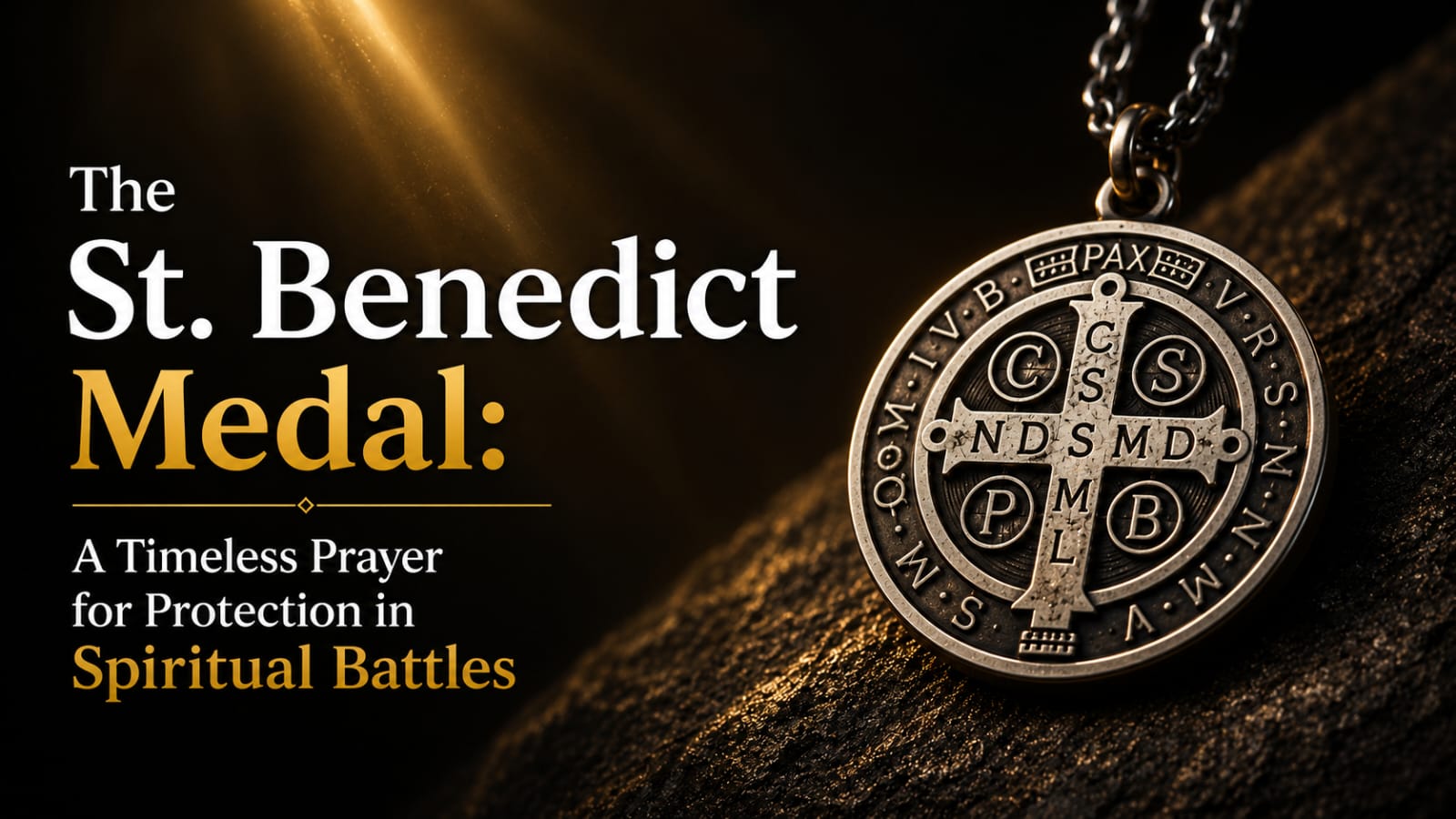
One of the most well-known sacramentals in the Catholic Church is the Medal of Saint Benedict.
The medal bears ancient prayers asking God's protection through the intercession of Saint Benedict.
For centuries, Catholics have worn or displayed the medal as a sign of faith and trust in Christ's victory over evil.
Its inscriptions remind believers to reject temptation and remain faithful to the Gospel.
Today, the Saint Benedict Medal remains one of the Church's most beloved devotional symbols.
Although Benedict became widely respected, he remained deeply humble.
He believed that abbots should lead through service rather than power.
His Rule encouraged patience, compassion, forgiveness, and respect for every member of the community.
He taught that Christ is encountered not only in prayer but also in daily work and in welcoming guests.
His emphasis on balance continues to guide monasteries and Christian communities around the world.
Tradition records that Benedict foresaw the day of his death.
After receiving Holy Communion, he stood in prayer with his hands raised toward Heaven and peacefully surrendered his soul to God around the year 547.
He was buried at Monte Cassino beside his sister, Saint Scholastica, whose own life reflected the same deep devotion to Christ.
Their witness continues to inspire countless religious communities.
Recognizing Benedict's immense contribution to Christian civilization, Pope Paul VI declared him the Patron Saint of Europe in 1964.
His monasteries helped preserve not only the Christian faith but also education, agriculture, literature, science, and culture during the early Middle Ages.
His influence extends far beyond monasteries, shaping Christian spirituality throughout the world.
The life of Saint Benedict offers enduring lessons for every Christian:
His Rule reminds believers that small acts of faithfulness can transform both individuals and entire societies.
More than fifteen centuries after his death, Saint Benedict remains one of Christianity's greatest spiritual teachers.
He was a hermit who became a founder, a monk who shaped civilizations, and a humble servant whose wisdom continues to guide millions around the world.
From the quiet cave at Subiaco to the great abbey of Monte Cassino, Benedict's life demonstrates that societies are renewed not merely through political power but through hearts transformed by prayer, discipline, and love of God.
His legacy proclaims a timeless truth:
When prayer guides work, humility shapes leadership, and Christ remains at the center, lives, communities, and even civilizations can be transformed.
To know about more saints please visit the spiritual section.
By Catholic Connect Reporter
Saint Benedict of Nursia, Saint Benedict feast day, Rule of Saint Benedict, Benedictine Order, Father of Western Monasticism, Monte Cassino Abbey, Saint Benedict Medal, Ora et Labora, Catholic monasticism, Patron Saint of Europe, Benedictine spirituality, July saints, Saint Benedict biography, Catholic saints, Saint Scholastica
© 2026 CATHOLIC CONNECT POWERED BY ATCONLINE LLP