- 04 July, 2026
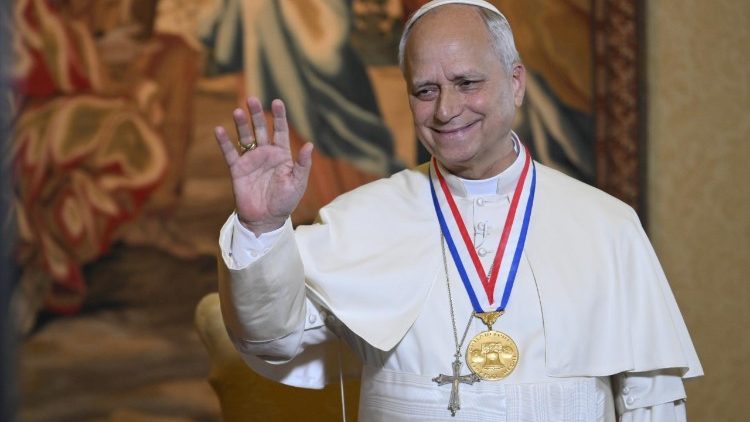
Vatican, July 4, 2026: Pope Leo XIV received the 2026 Liberty Medal from the U.S. National Constitution Center, accepting the honour from Rome during a ceremony held in Philadelphia. The award recognises his lifelong commitment to promoting religious freedom and the freedoms of conscience and expression worldwide.


The medal was first presented to the Pope during a private audience at the Vatican in April, when a delegation from the National Constitution Center travelled to Rome to confer the honour. It recognises his efforts to advance religious liberty and freedom of conscience and expression, principles reflected in the First Amendment to the U.S. Constitution.
Three months later, on the eve of the 250th anniversary of the founding of the United States, Pope Leo formally accepted the 38th Liberty Medal and reflected on the country's founding values, their significance today and the meaning of the award.


"As a son of this great country, founded by courageous men and women who dreamed of liberty and of a better life for themselves and for their children, I join you in asking God’s blessings upon America’s future, that the lofty ideals enshrined at the beginning of the Declaration of Independence may continue to guide the flourishing of the nation in unity, justice and peace."
These were among the Pope's opening remarks as he received the medal on Friday. The National Constitution Center presents the Liberty Medal each year to individuals whose courage and conviction have advanced the cause of liberty around the world.
Speaking from Rome, Pope Leo said he was honoured to receive the medal, particularly during the year marking the 250th anniversary of the signing of the Declaration of Independence on July 4, 1776.
Inalienable rights
The Pope reflected on the enduring significance of the Declaration of Independence, saying many people had long admired its affirmation that all people are created equal and possess inalienable rights, including life, liberty and the pursuit of happiness.
"While couched in the language of the Enlightenment," he said, "that claim is ultimately grounded in an understanding of the human person inspired by the great biblical vision of man and woman being created in the divine image."
He added: "It is indeed here that we discover the basis of human dignity; dignity which precedes the establishment of any State, and whose custody constitutes its very purpose."
Freedom and the nation's history
Reflecting on the past 250 years, Pope Leo said the determination to pursue the vision of the nation's founders had made America widely associated with freedom. He noted that the country welcomed successive generations of immigrants, allowing them and their descendants to contribute to its future.
He also recalled that the same commitment to freedom led the United States to defend liberty beyond its own borders during the two world wars, despite the sacrifices involved.
At the same time, the Pope acknowledged that building a society based on liberty and justice had not always been easy and remained an ongoing responsibility for every generation.
A time to renew founding ideals
Looking ahead, Pope Leo said the 250th anniversary offered an opportunity to reflect once again on the nation's founding principles. He expressed hope that the United States would remain faithful to the ideals that earned it the description as the "land of the free and home of the brave."
He highlighted that the first right identified by the nation's founders was the right to life, noting that liberty and the pursuit of happiness cannot exist without it.
"A country’s vitality is deeply tied to the value it affords to human life in every form and condition, acknowledging the dignity endowed upon every human person by virtue of their very existence."
Protecting human life
The Pope said recognition of the dignity of every human life had inspired generations to honour the Creator and value the gift of life.
"It is precisely this reverence," he said, "that we must continue to cultivate—one that sways the hearts of individuals and inspires laws that recognize and safeguard the gift from the moment of conception to natural death."
He also reminded those present of their responsibility to care for those entrusted to them.
"In this regard, the moral greatness of a nation is manifested, above all, in its capacity to support, protect and cherish the lives of all, especially the most vulnerable and those whose worth is questioned."
Religious freedom and conscience
Turning to the subject of liberty, Pope Leo said the desire for truth, freedom and happiness continued to lead people to ask fundamental questions about life, purpose and God.
"The desire for truth and freedom, as well as the very pursuit of happiness," he said, "continues to inspire people of all generations to ask fundamental questions regarding the meaning of life, our ultimate purpose, and indeed about God, and it is proper for magnanimous hearts to endeavor to answer these questions with sincerity."
He noted that the answers people give to these questions shape the direction of their lives.
The Pope also praised the United States' longstanding commitment to religious freedom, saying the protections guaranteed by the First Amendment allow people to follow their conscience, worship freely and publicly express their faith without coercion.
He said this tradition had encouraged interfaith dialogue and cooperation while contributing to discussions on important moral and ethical issues throughout the nation's history.
A call for unity and peace
Pope Leo expressed hope that this tradition would continue to promote respectful public dialogue, mutual understanding and efforts towards peace and reconciliation.
Recalling that America's founders came from different cultures, languages and religions, he said they united around shared principles.
"The principles that inspired America’s founders, rooted as they are in the truth of the human person," he said, "brought them together in a single cause, a common dream. Unity lent strength to that dream, giving rise, under God, to the United States of America. E pluribus unum — out of many, one."
He added that lasting national flourishing depends not on temporary objectives but on enduring ideals.
Recommitting to founding values
The Pope concluded by praying that the anniversary would inspire renewed commitment to the values of human dignity, equality and the rights proclaimed in the Declaration of Independence.
"May the principles we have reflected upon today—a shared human dignity, equality and the rights laid out in the Declaration of Independence—ever be a source of such unity and a guiding light for the present moment and for the years to come."
He continued: "In accepting this award, I therefore pray that this, the 250th anniversary of the founding of this great nation, may be the occasion of a solemn recommitment to these ideals that have made America a country that values peace and prosperity, a country characterized by generosity and nobility of heart."
Entrusting the nation to God, Pope Leo ended his address with the words: "May God bless America!"
Courtesy: Vatican News
© 2026 CATHOLIC CONNECT POWERED BY ATCONLINE LLP