- 25 November, 2026

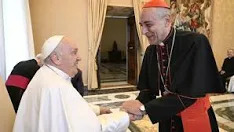
VATICAN CITY, November 25, 2026: The private writings of Pope Francis reveal an intensely personal spiritual journey marked by mystical experiences, periods of deep interior crisis and an enduring conviction of God's love, according to Cardinal Victor Manuel Fernández, Prefect of the Dicastery for the Doctrine of the Faith.

In an interview with Vatican News, Cardinal Fernández discussed the origins and significance of The Private Diary of Pope Francis, a collection of the late Pope's personal writings published in English by Penguin Random House in the United States and the United Kingdom.
The cardinal, who was a close collaborator and friend of Francis, said the diary offered insights into aspects of the Pope's spiritual life that he had rarely shared, even with those close to him.
He recalled discovering the diary during a private conversation at the Casa Santa Marta, where Francis showed him three documents and an appointment book containing handwritten reflections. The Pope indicated that these materials could be used after his death for the spiritual benefit of others.
After Pope Leo XIV's election, Fernández informed him of Francis' request and sought permission to undertake the work. According to the cardinal, Pope Leo located the box containing the writings and handed it over to him, supporting the publication and the decision to provide contextual explanations.
Fernández said the book was compiled around the principle of “spiritual edification”, a phrase Francis himself had used when entrusting the writings to him. The publication excludes repetitive notes, routine appointments and private details concerning living individuals, but retains passages that illuminate the Pope's personality, convictions and spiritual experiences.
Among the most striking revelations are Francis' accounts of personal encounters with Jesus and Mary, including experiences in which he felt their loving presence. Fernández said the Pope had never spoken to him about these deeply personal experiences, although he was generally open about his social, political and pastoral convictions.
The diary also contains Francis' accounts of encounters with what he perceived as the devil. Fernández said these experiences, which appear at several points in the writings, prompted the Pope to examine his life more deeply and remain vigilant about his spiritual mission.
The cardinal described a particularly significant period of spiritual crisis that Francis experienced in 2021 and 2022, marked by what the Pope called dryness, desolation and darkness.
According to Fernández, Francis understood such difficult experiences as opportunities for spiritual purification. The crisis ultimately led him towards a deeper inner peace and a more complete surrender to God's love.
He said this transformation found expression in two of Francis' major documents, C'est la confiance, his apostolic exhortation on St Thérèse of Lisieux, and the encyclical Dilexit nos, on the human and divine love of the heart of Jesus Christ.
Both documents, Fernández explained, reflected the Pope's mature spirituality, particularly his conviction that complete trust in God's love must lead to greater concern for others.
The diary also sheds light on Francis' attachment to popular piety. Fernández recalled the Pope's practice of placing written petitions beneath an image of St Joseph and spending extended periods in prayer before the image of Mary, Salus Populi Romani, in the Basilica of St Mary Major.
These practices, he said, reflected Francis' humility and his recognition of his dependence on God's grace rather than his own abilities.
Among the documents containing Francis' handwritten underlinings, Fernández highlighted two passages that reveal the foundations of his vision. One was the Latin phrase from Virgil, “There are tears of things,” which expressed the Pope's deep sensitivity to human suffering.
The other was a passage from the Puebla Document calling for “a bold Christian profession and an effective promotion of human dignity”.
Fernández said Francis consistently linked Christian faith with the defence of human dignity, particularly that of the poor, migrants, prisoners and persons with disabilities. He also highlighted an underlined passage in the Aparecida Document emphasising the importance of offering the faithful a personal and profound encounter with Jesus Christ.
Explaining why he decided to publish the diary, the cardinal said he had initially hesitated to speak publicly about his relationship with Francis. The book, however, allowed the late Pope to speak through his own writings rather than through other people's recollections.
He also described the publication as an opportunity to respond to what he considered unjust criticism of Francis and present a fuller picture of his spiritual life.
Asked which passages had affected him most, Fernández cited two contrasting entries. In a June 7, 2018, reflection, Francis described a frightening vision of the entrance to hell and the power of what he called pagan seduction.
A later entry, dated May 1, 2019, expressed his profound experience of God's unconditional love and faithfulness.
“I felt with certainty that the Lord loved me with a predilection,” Francis wrote, describing the experience as an embrace that protected him from falling apart.
For Fernández, these reflections capture the two dimensions of the late Pope's spiritual journey: an acute awareness of the struggles of human existence and an unwavering trust in God's love.
Courtesy: Vatican News


© 2026 CATHOLIC CONNECT POWERED BY ATCONLINE LLP