- 01 July, 2026
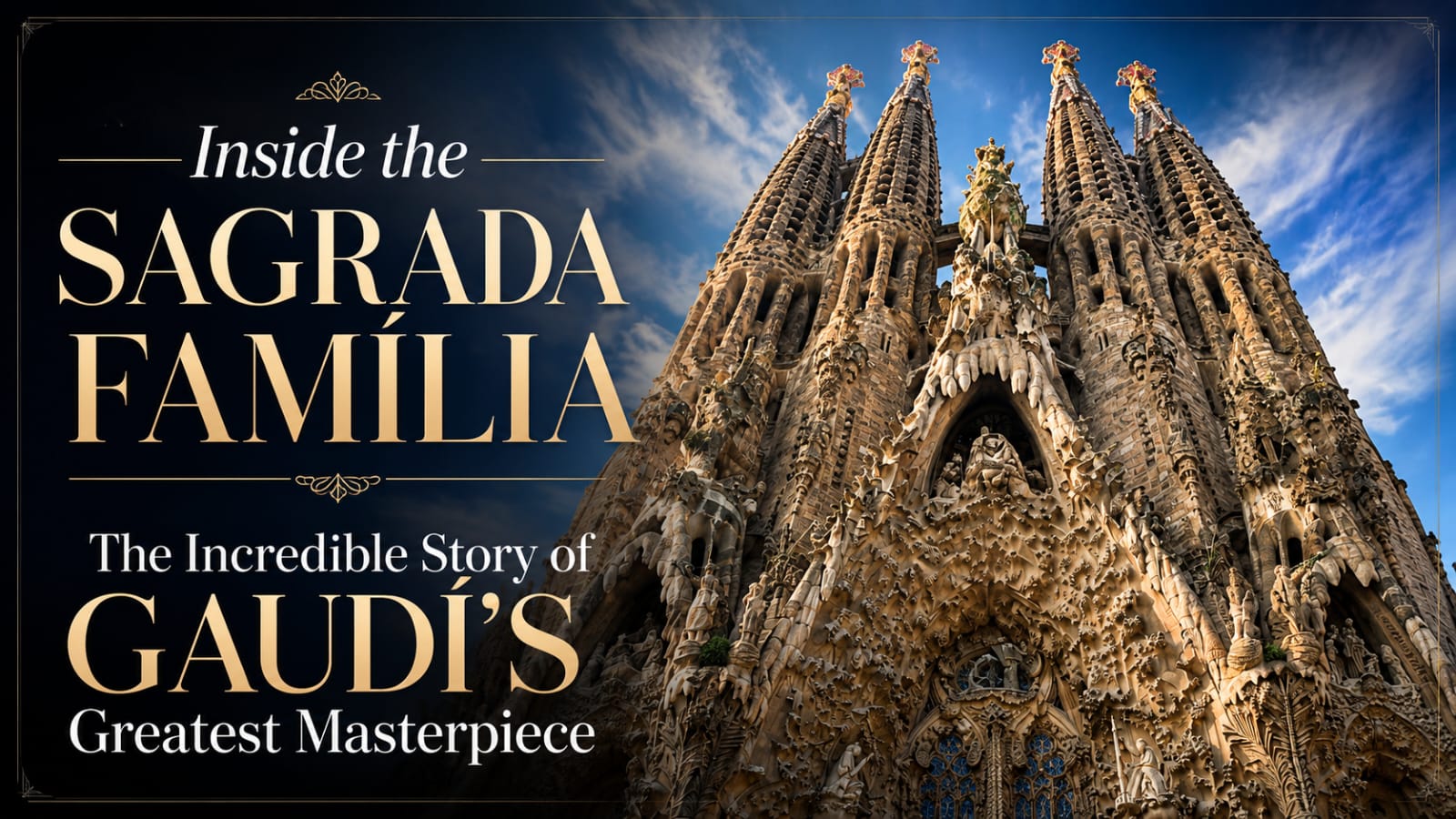
July 1, 2026: More than 140 years after construction began in 1882, Barcelona’s Basílica de la Sagrada Família still remains unfinished. Antoni Gaudí, who took over the project in 1883, devoted the final years of his life almost entirely to the basilica, fully aware he would never see it completed. He famously remarked that his client was God, and God was in no hurry. Today, the unfinished church stands not only as one of the world’s greatest architectural achievements, but also as a living symbol of faith, patience and devotion.

Nature as the Blueprint
Rising above Barcelona’s orderly Eixample district, the Sagrada Família appears less like a conventional church and more like a living mountain of stone. Towers twist skyward like branches, walls bloom with plants and animals, and sunlight pours through stained glass like liquid colour. Gaudí rejected rigid straight lines and instead used forms inspired by nature.
Inside, massive columns branch like trees, ceilings resemble a forest canopy, and leaves, flowers and shells are woven into the design. Walking through the basilica feels more like standing inside a stone forest than a traditional church. Gaudí also used mathematical patterns found in nature, making the structure both visually extraordinary and remarkably strong.


( CLICK HERE to follow Catholic Connect for regular News and Content)
A Bible Carved in Stone
Every part of the basilica tells the Gospel story. The Nativity Façade, completed during Gaudí’s lifetime, celebrates the birth of Christ with carvings overflowing with life, animals and joyful scenes. In contrast, the Passion Façade portrays Christ’s suffering and crucifixion through stark, angular sculptures created by Josep Maria Subirachs following Gaudí’s vision.
The Glory Façade, still under construction, represents humanity’s journey toward God and eternal life. Together, the façades transform the church into what many describe as a Bible carved in stone, designed so that even those unable to read could understand the story of salvation.
A Symphony of Light
Light itself becomes part of the architecture. The stained-glass windows are arranged so that cool blues and greens illuminate one side of the basilica while fiery reds, oranges and golds fill the other. As the sun moves across the sky, the entire interior changes colour, creating an atmosphere that feels both prayerful and alive.
Towers Reaching Toward Heaven
The basilica’s eighteen towers symbolise the Apostles, Evangelists, the Virgin Mary and Jesus Christ. The central tower dedicated to Jesus will rise to about 172.5 metres, intentionally kept slightly shorter than Barcelona’s highest natural hill because Gaudí believed human creations should never surpass God’s work.
Remarkably, Gaudí designed many of the basilica’s complex curves and arches long before computers existed, using hanging chains, weights and plaster models to calculate structures capable of naturally distributing weight.
A Living Witness of Faith
Parts of the basilica are recognised as a UNESCO World Heritage Site, while Pope Benedict XVI consecrated it as a Minor Basilica in 2010, despite construction still continuing. Built almost entirely through donations and ticket sales, the Sagrada Família reflects Gaudí’s vision of a “temple of the people.”
For millions of visitors, its greatest beauty lies not only in its scale or craftsmanship, but in how every column, sculpture and beam of light directs the eye and heart toward God.
By Catholic Connect Reporter

© 2026 CATHOLIC CONNECT POWERED BY ATCONLINE LLP