- 15 August, 2026
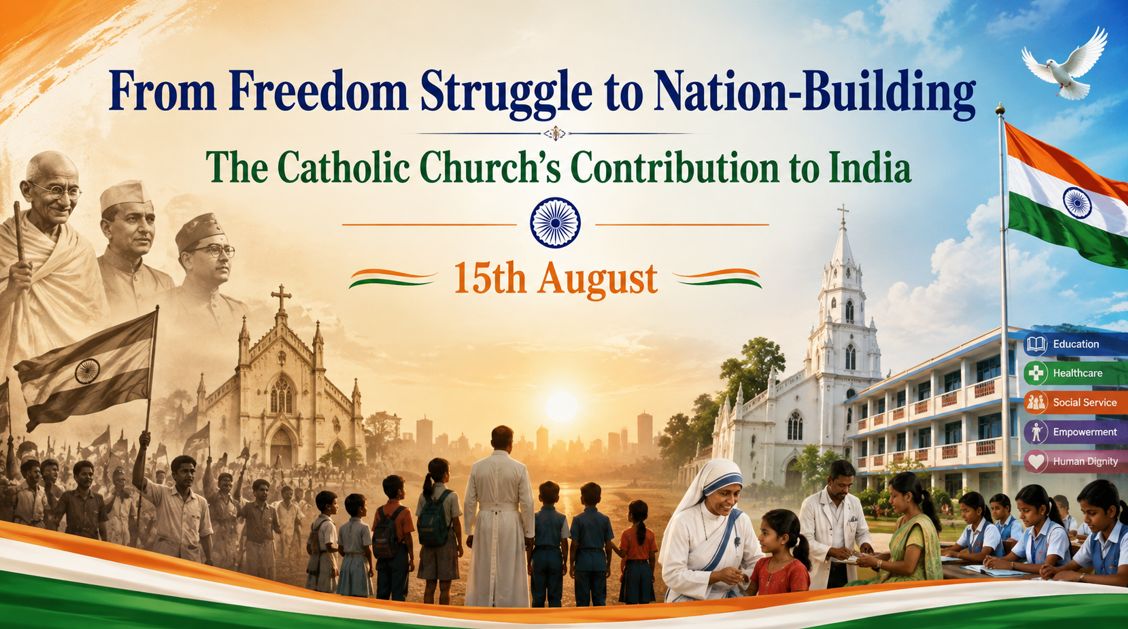
New Delhi, August 15, 2026 : Every Independence Day, India remembers the sacrifices that made freedom possible in 1947. The story of independence, however, does not end with the lowering of the Union Jack. Freedom also created the responsibility to build a nation in which education, healthcare, dignity and opportunity would be available to ordinary citizens.


In this larger story of nation-building, the Catholic Church and the wider Christian community have played a significant role. Through schools, colleges, hospitals, social-service institutions and grassroots programmes, Christian organisations have worked for generations in some of India's most remote and disadvantaged communities.
The contribution is particularly visible in education and healthcare, where Catholic religious congregations established institutions that eventually became part of India's social infrastructure. Their work was not confined to Christian communities. Many institutions served people regardless of caste, religion or social background.


Education has perhaps been the most visible contribution of the Catholic Church to independent India.
Catholic religious congregations ((Society of Jesus (Jesuits), Carmelites of Mary Immaculate (CMI), Franciscan Missionaries, Institute of the Blessed Virgin Mary Society of the Sacred Heart of Mary, etc) established schools and colleges across the country, including in rural and economically disadvantaged areas. Institutions run by priests, religious sisters and lay organisations helped generations of Indians gain access to literacy, professional education and higher learning.
(Click Here to follow Catholic Connect for regular News & Content)
The importance of this contribution extends beyond examination results. Schools became places where young people encountered ideas of discipline, responsibility, service and citizenship. Many former students went on to become teachers, doctors, civil servants, lawyers, engineers, politicians, scientists and professionals in almost every field of national life.
For girls and women, Christian educational institutions were particularly important in regions where access to formal education was historically restricted. Convents and women's colleges created opportunities for generations of Indian women to pursue education and professional careers.
Education therefore became a form of nation-building. By investing in human potential, the Church contributed to India's emergence as a modern democratic society.
The same philosophy shaped Catholic healthcare.
Catholic hospitals, dispensaries and medical centres have served communities in cities as well as remote villages. Religious sisters and medical workers have frequently worked in areas where healthcare infrastructure was limited, providing treatment to people who might otherwise have had little access to professional medical care.
The Church's healthcare ministry has traditionally placed particular emphasis on the sick, poor and vulnerable. Hospitals and charitable institutions have treated patients without making religious identity the basis of service.
In tribal and rural regions, healthcare initiatives have often been connected with education, nutrition, sanitation and community development. Such work illustrates an important principle: national development cannot be measured only by economic growth. A nation becomes stronger when its poorest citizens are healthier, better educated and able to live with dignity.
The Catholic contribution to India is therefore not simply an institutional one. At its heart is the Christian idea of service — the belief that care for the vulnerable is a moral responsibility.
On Independence Day, this aspect of the Church's history deserves recognition. India's freedom was won through political struggle, but the work of making freedom meaningful has continued through schools, hospitals, social organisations and community initiatives.
The Church's contribution to nation-building can consequently be understood as a long-term investment in India's people.
The contribution of Indian Christians to the freedom movement is sometimes overlooked in popular accounts of independence. Yet Christian men and women participated in political movements, journalism, civil disobedience, underground resistance and the struggle for constitutional democracy.
Their motivations varied. Some were inspired by Gandhian non-violence; others advocated more radical nationalism. What united many of them was the conviction that being Christian did not make them less Indian or less committed to India's freedom.
Joseph Baptista (1864–1930), a prominent lawyer from Bombay and associate of Lokmanya Tilak, became an important nationalist voice. He participated in the Home Rule movement and used his legal knowledge in support of India's political cause.
His association with the demand for Swaraj illustrates how Indian Christians participated in the wider nationalist movement rather than remaining on its margins.
Baptista also became an important figure in organised labour and served as the first president of the All India Trade Union Congress. His career connected the struggle for political freedom with the demand for greater rights for workers.
Accamma Cherian (1909–1982), from a Syrian Christian family in Kerala, became one of the most courageous women of the freedom movement.
She emerged as a prominent leader of the Travancore State Congress and led a major peaceful protest against the Travancore administration. Her courage earned her Mahatma Gandhi's description of the "Jhansi Rani of Travancore".
Cherian's story is significant because it demonstrates that Christian women were active participants in India's political struggle. She did not merely support the movement from the sidelines; she stood at the front of mass mobilisation.
Few figures demonstrate the intellectual complexity of Indian Christian nationalism better than Brahmabandhab Upadhyaya (1861–1907).
Born Bhavani Charan Banerjee, Upadhyaya became a Catholic theologian and philosopher while remaining deeply engaged with Indian nationalism. Through his Bengali newspaper Sandhya, he advocated Swaraj and fiercely criticised British rule.
His journalism was uncompromising. He rejected gradual concessions and argued for complete independence. His writings led to his arrest on sedition charges.
Upadhyaya's story is particularly important because it challenges the colonial assumption that Christianity and Indian nationalism were incompatible. His life demonstrated that Christian faith could coexist with a powerful commitment to India's cultural identity and political independence.
Annie Mascarene (1902–1963), another prominent Christian leader from Kerala, participated in the Travancore State Congress and endured imprisonment for her political activism.
She later became a member of India's Constituent Assembly. Her journey from anti-colonial activism to constitution-making reflects the transition from the freedom struggle to the construction of independent India's democratic institutions.
The Mangalorean Catholic couple Joachim Alva (1907–1979) and Violet Alva (1908–1969) also represent this transition.
Joachim participated in the Civil Disobedience Movement and was imprisoned. He later founded the Nationalist Christian Party, seeking to bring Indian Christians into mainstream nationalist politics.
Violet Alva became an important parliamentary figure in independent India and eventually served as Deputy Chairperson of the Rajya Sabha.
Together, the Alvas demonstrate that Christian participation in the freedom struggle did not end in 1947. It continued through the institutions of parliamentary democracy.
The resistance also extended into less visible forms.
Catholic families such as the Alvares and Pinto families in Mumbai and Mangalore were associated with underground nationalist activities during the Quit India Movement. Their homes and properties were used in resistance networks, including clandestine communication activities.
Felix Albuquerque Pai of Mangalore participated in the Salt Satyagraha by manufacturing salt in defiance of British law.
These stories reveal that the Christian contribution to independence was not confined to speeches or political organisations. It also involved personal risk, imprisonment, civil disobedience and underground resistance.
The achievement of independence created a new challenge: transforming political freedom into social freedom.
The Catholic Church and other Christian organisations continued their work through education, healthcare, social welfare and rural development. Their contribution became particularly significant among communities facing poverty, social exclusion and limited access to government services.
The work of J.C. Kumarappa offers another perspective on the meaning of national development.
A Christian economist and close associate of Mahatma Gandhi, Kumarappa developed ideas centred on decentralisation, village industries and an economy based on human needs rather than unlimited consumption.
His concept of an "Economy of Permanence" argued that economic activity should respect nature and serve society. He supported local production, village industries and what Gandhi described as production by the masses rather than simply mass production.
Kumarappa's thinking remains relevant to contemporary India, particularly in discussions about sustainable development, rural employment and environmental responsibility.
The Christian contribution to India's freedom movement and national development extends well beyond the better-known names.
Figures associated with different strands of Indian Christian public life included George Joseph, Madusudan Das, Kalicharan Banerjee, Venkal Chakkarai, A.J. John, Harendra Kumar Mookerjee, T.M. Varghese, P.T. Chacko, C.M. Stephen, T.V. Thomas, Paul Ramasamy, Jerome A. Saldanha, K.C. Mammen Mappillai, Lambert Mascarenhas and Thevarthundiyil Titus, among others.
Their political, intellectual, journalistic and social contributions formed part of a much wider Christian engagement with India's public life.
Not all belonged to the same denomination or followed the same political philosophy. That diversity itself is important. The history of Indian Christianity is not a single political story. It contains Catholics, Protestants, Syrian Christians and other communities who participated in India's struggle and later contributed to its democratic institutions.
Today, Catholic educational and healthcare institutions remain part of India's social landscape.
Schools continue to educate children from different communities. Colleges produce professionals who enter India's public services, scientific institutions, businesses and civil society. Hospitals and social-service organisations continue to work with the poor, elderly, sick and marginalised.
In many places, Catholic religious congregations have also supported tribal communities, women's empowerment, rural development, rehabilitation and community-based initiatives.
This work gives practical meaning to the idea that nation-building is a continuing responsibility.
Independence Day is therefore an opportunity not only to remember 1947 but also to ask what freedom should mean in everyday life.
Freedom requires education. It requires access to healthcare. It requires dignity for the poor and marginalised. It requires equality before the law and respect for India's religious and cultural diversity.
The Catholic Church's contribution to India can be understood within this wider vision of the common good.
The legacy of Christian freedom fighters also reminds the country that patriotism has never belonged to one religion. India's independence movement was strengthened when people of different faiths stood together against colonial rule.
From Joseph Baptista and Accamma Cherian to Brahmabandhab Upadhyaya, Annie Mascarene, Joachim and Violet Alva, Felix Albuquerque Pai and the many lesser-known Christians who participated in the national movement, the history of India's independence contains stories of courage that deserve to be remembered.
After independence, that commitment took a different form. Schools replaced political platforms; hospitals became places of service; social programmes became instruments of empowerment; and educators, doctors, priests, religious sisters and lay workers became partners in the long process of nation-building.
On India's Independence Day, remembering this history does not diminish the contribution of others. Instead, it enlarges the national story.
India was built by people of many communities, languages and faiths. The Catholic Church and the wider Christian community form one important part of that story — a story that began with the struggle for freedom and continues today in the daily work of educating, healing, serving and building a more just society.
The true measure of independence is not simply that a nation became free, but that its people are given the opportunity to live freely, with dignity, equality and hope.
By Catholic Connect Reporter
© 2026 CATHOLIC CONNECT POWERED BY ATCONLINE LLP