- 02 April, 2026
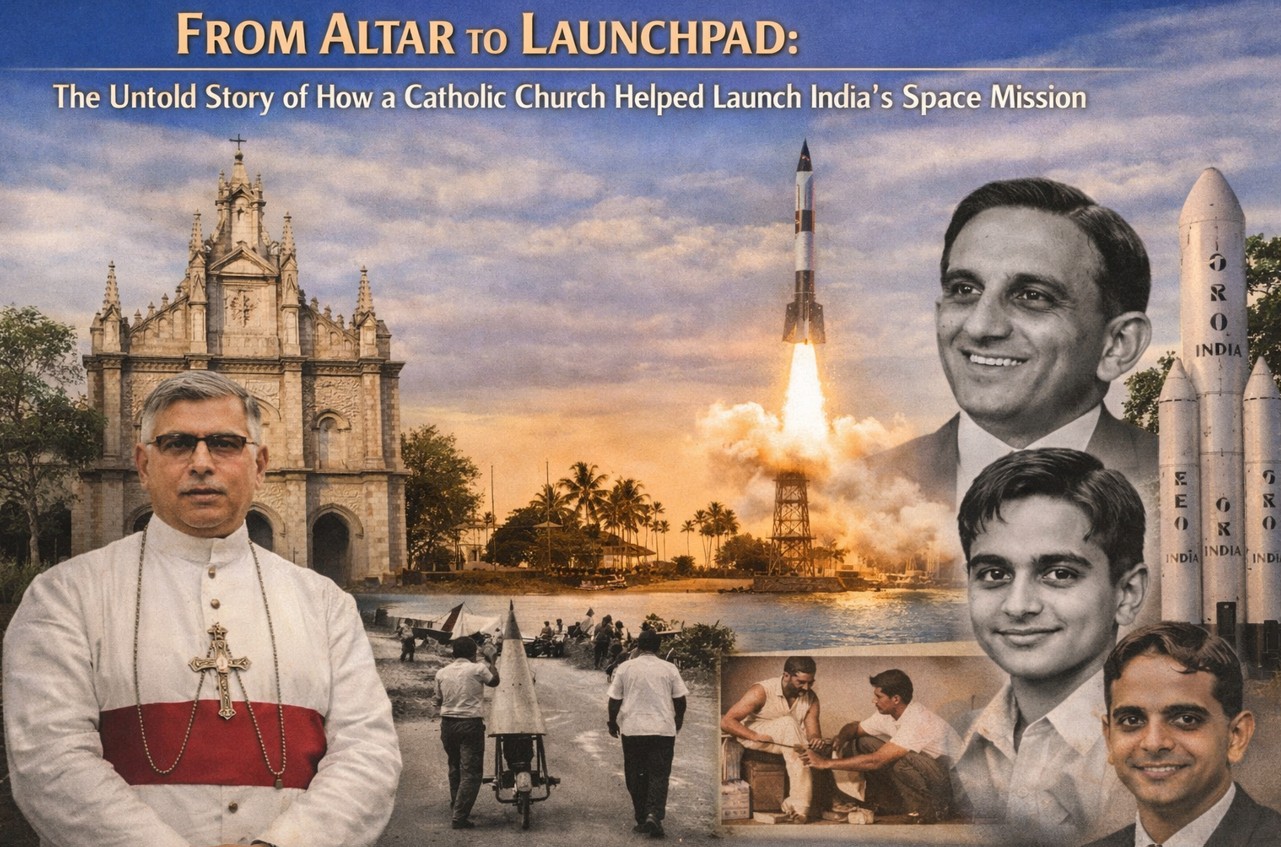
Thiruvananthapuram, April 2, 2026: Discover how a Catholic church in Kerala played a pivotal role in launching India’s first Nike-Apache rocket in 1963. Learn how faith and science came together at St. Mary Magdalene Church, shaping the origins of ISRO.

In one of the most extraordinary intersections of faith and science, a humble Catholic parish in Kerala became the cradle of India’s space journey—demonstrating how the Church contributed not only to spiritual life but also to national progress.
The historic moment unfolded at St. Mary Magdalene Church Thumba, where India’s first sounding rocket was launched, marking the beginning of what would later become the globally respected Indian Space Research Organisation.
On November 21, 1963, India launched its first sounding rocket, a US-made Nike-Apache, from Thumba, Kerala—an event that placed the nation on the global space map and signalled the beginning of its scientific journey into space.


At a time when the country lacked infrastructure for advanced scientific research, the Catholic Church played a decisive and generous role. The parish church was transformed into a functioning space research centre—serving as a laboratory, workshop, and administrative office—while the bishop’s residence supported operational needs.
This remarkable contribution was made possible by Bishop Peter Bernard Pereira, whose visionary decision to offer Church land and facilities for scientific research stands as a historic example of faith in action. His gesture reflected the Church’s commitment to the common good, supporting a mission that would benefit the entire nation.
The project was led by Vikram Sarabhai, widely regarded as the father of India’s space programme, along with a young scientist, A. P. J. Abdul Kalam, who would later become the President of India. Working under modest conditions, these pioneers carried forward their mission with determination and vision.
In the absence of modern transport and facilities, rocket components were famously carried on bicycles and bullock carts, while scientists worked out of converted church rooms. Despite these humble beginnings, the successful launch from Thumba marked India’s entry into the space age.
Over time, the site developed into the Vikram Sarabhai Space Centre, a major hub of India’s space research activities. Today, the original church stands preserved as a museum, symbolising a unique chapter where faith and science worked together for national advancement.
For the Catholic community, this story remains a powerful testament to the Church’s role beyond the sanctuary. It highlights how the Church, through courageous leadership and openness, contributed to shaping modern India’s scientific future.
The legacy of St. Mary Magdalene Church Thumba continues to inspire generations, reminding the world that faith and science are not opposing forces but partners in the pursuit of truth and progress.
By Catholic Connect Reporter
---------------------------------------
Relevant Keywords: Catholic Church India, St Mary Magdalene Church Thumba, ISRO history Kerala church, Catholic priest contribution to science India, Bishop Peter Bernard Pereira, Vikram Sarabhai space program, Abdul Kalam early career ISRO, faith and science Catholic Church, Indian space program origin, TERLS Kerala history
© 2026 CATHOLIC CONNECT POWERED BY ATCONLINE LLP