- 23 April, 2026

Vatican, April 23, 2026: On his final full day in Africa, Pope Leo XIV travels to Bata, where he shares a moving encounter with inmates at the city’s prison.

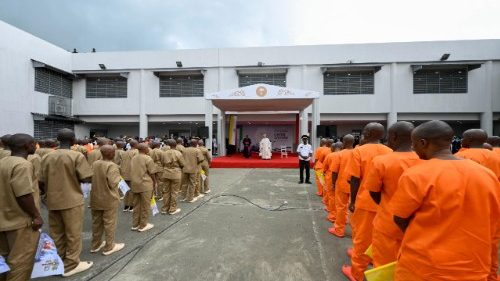
A powerful scene greeted Pope Leo XIV at Bata Prison in Equatorial Guinea on 22 April: hundreds of men and women stood silently in orderly rows, their heads shaven, holding Vatican flags and flags bearing images of the Pontiff. Some were dressed in olive-green prison uniforms, while others wore bright orange, with matching rubber slippers on their feet.
They remained still, all turned towards the small stage from where the Pope would soon address them.


As the Holy Father arrived, the inmates broke into song and dance, the flags in their hands no longer hanging loosely but waving energetically above them. The tall concrete and plaster walls of the rectangular courtyard echoed the sound of their coordinated welcome. “Nuestro Santo Padre, te damos gracias. Ora por nuestros pecados y nuestra Libertad,” they sang. “Our Holy Father, we thank you. Pray for our sins and our freedom.”
The Holy Father observed the scene attentively, waiting for the inmates to complete their song. He then listened to testimonies from several prisoners, who expressed gratitude for his visit and shared their hopes for peace, reconciliation, and a new beginning.
Just as Pope Leo was about to speak, the rain began. What started as a light drizzle quickly intensified into a heavy downpour within minutes. Members of the press opened their umbrellas in haste but soon abandoned them and rushed to seek shelter.
However, the men and women in their uniform colours and rubber slippers remained in place. Without umbrellas or cover, they stood in their rows, their eyes fixed on the Pope as he addressed them.
“In some places, it is said that rain is a sign of God’s blessing,” the Pope began, acknowledging the sudden change in weather. “Let us pray that this may indeed be the case,” he said, “and let us also live this moment as a sign of God’s closeness, a God who never abandons us.” He continued by offering what he described as a “simple” message to the inmates, namely, that “no one is excluded from God’s love!”
He emphasised that “every effort should be made” to ensure that prisoners “are given the opportunity to study and to work with dignity while in prison,” adding that “life is not defined solely by one’s mistakes.” There is always the chance, he said, “to start over, learn and become a new person.”
Following the Pope’s address, which was met with loud applause and cheers, the inmates presented him with a wooden cross they had crafted. The Pope raised it for all to see, prompting a deafening response from the crowd. He then showed them the statue of Saint Francis of Assisi that he had brought with him.
This gift carried deep symbolism, as a defining phase of Saint Francis’ spiritual journey took place during his months-long imprisonment after the conflict between Assisi and Perugia (1202–1203). That time of isolation and hardship set him on a path of conversion towards the radical joy of the Gospel, demonstrating that true peace arises from a profound transformation of the heart.
As for the inmates’ farewell to the Pope, on an ordinary day, the scene at the end of the visit might have resembled a prison disturbance, with prisoners breaking formation and moving towards the exit, their chants rising above the sound of the rain. Yet this was no ordinary occasion, and those men and women were not stirring unrest. They were expressing their longing for the freedom they had lost, many due to “difficult and complex circumstances,” as the Pope noted in his remarks.
In those moments, they may have experienced a glimpse of that lost freedom, singing and dancing with the Pope among them, praying alongside the messenger of peace who had come to a place few could have imagined he would visit.
Courtesy: Vatican News
© 2026 CATHOLIC CONNECT POWERED BY ATCONLINE LLP