
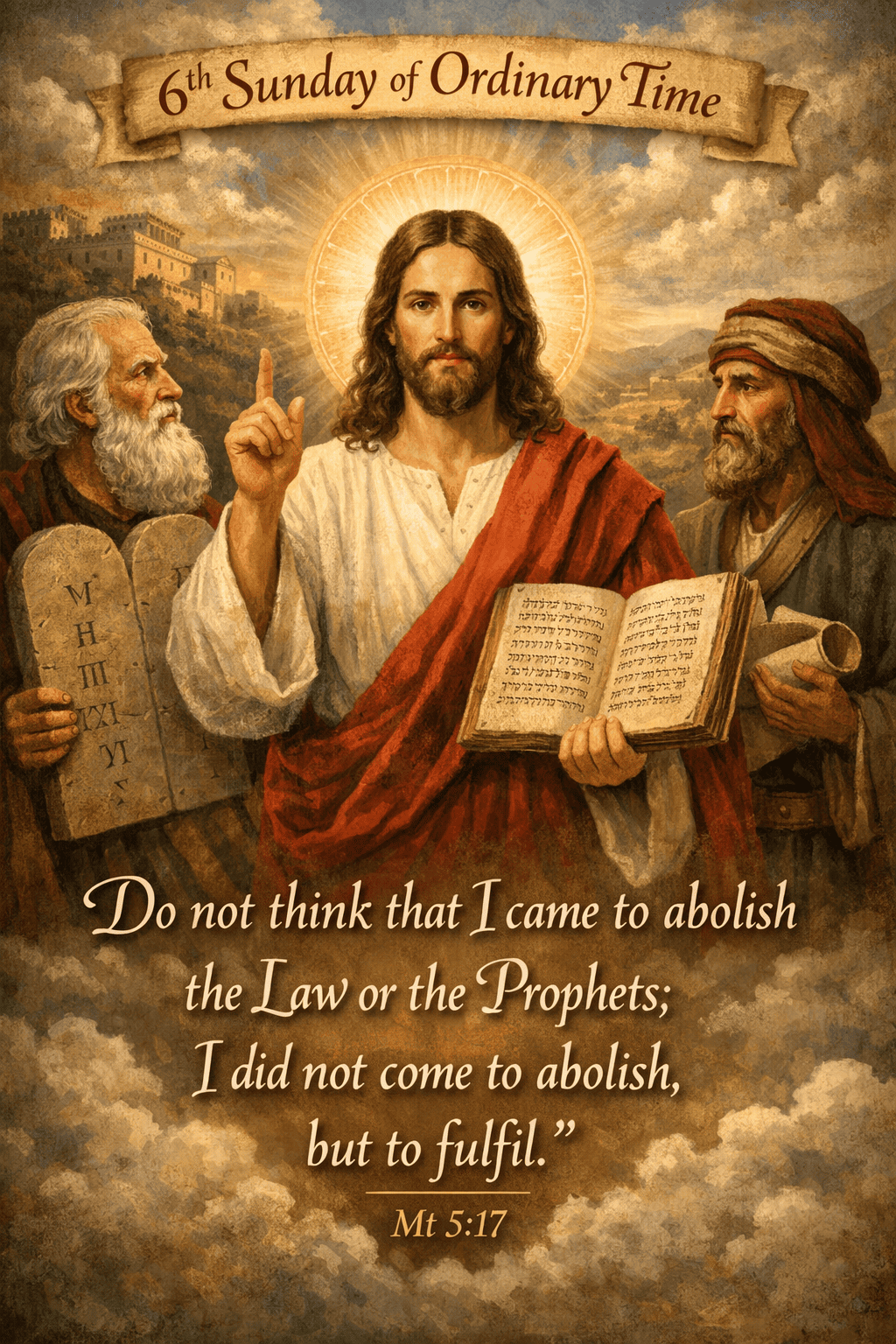
Sir 15:16-21, Ps 119, 1Cor 2:6-10, Mt 5:17-37
English
Key Verse to Meditate: "Do not think that I came to abolish the Law or the Prophets; I did not come to abolish, but to fulfil (Mt 5:17).
Dear Brothers and Sisters in the Lord,
The first and second readings of this Sixth Sunday in Ordinary Time call us to freely choose God’s ways and to shape our lives according to His wisdom rather than worldly values. The Sermon on the Mount continues in this Sunday’s Gospel as well, where Jesus speaks at length on several important themes of Christian discipleship, such as the Law and the Prophets, anger, adultery, divorce, and oaths. Jesus teaches us that the true fulfillment of the Law is love—love of God and love of neighbor. When we live in Christ and allow Him to transform our hearts, the Law is no longer a burden, but a grace that leads us to holiness and to the fullness of life in God. In His authoritative moral teaching on the life of a disciple, Jesus moves from the external observance of the law to an interior transformation of the heart.
First Reading: The First Reading from Sirach reminds us that God has gifted us with freedom, placing before us life and death, good and evil, and inviting us to make responsible choices. The Book of Sirach reminds us that God has created us with freedom and responsibility. Life and death, good and evil are placed before us, and we are invited to choose wisely. God does not force anyone to sin; our choices flow from our own decisions. True obedience is not fear-driven but arises from love and reverence for God. Choosing God’s commandments is choosing life, wisdom, and blessing.
Second Reading: Saint Paul, in the Second Reading, reveals that true wisdom is not the wisdom of this world but God’s hidden wisdom, prepared for our glory from all eternity. Saint Paul speaks of a wisdom not of this world, but God’s hidden and saving wisdom. This divine wisdom was destined for our glory long before the ages began. Worldly powers failed to recognize this wisdom and crucified the Lord of glory. God reveals His wisdom not through human reasoning, but through the Holy Spirit. What God has prepared for those who love Him surpasses human imagination. The first and the second readings call us to freely choose God’s ways and to shape our lives according to His wisdom rather than worldly values. When we choose God’s wisdom and live by His commandments, we open ourselves to the unimaginable gifts God has prepared for those who love Him.
The Gospel Reading: The Meaning of “the Law and the Prophets”
The expression “the Law and the Prophets” (Mt 5:17) refers to the whole of Israel’s Sacred Scriptures—the Law given through Moses and the message proclaimed by the prophets. These Scriptures revealed God’s will and prepared His people for the coming of the Messiah. When Jesus says, “I have come not to abolish but to fulfill,” He makes it clear that He does not reject the Law, but brings it to its fullness and perfection. He fulfills the Law by revealing its deepest meaning, moving us from mere external observance to an interior transformation of the heart.
The term “the Law” (Greek: Nomos) primarily refers to the Torah—the first five books of the Old Testament—which contain the Ten Commandments (Ex 20; Deut 5), ritual and ceremonial laws, and covenant regulations. The term “the Prophets” refers to the Major Prophets (Isaiah, Jeremiah, and Ezekiel) and the Twelve Minor Prophets. Thus, the phrase “the Law and the Prophets” is a way of referring to the whole of Jewish Scripture (Tanakh), which comprises the Torah (Law), Nevi’im (Prophets), and Ketuvim (Writings).
Jesus frequently came into conflict with the Pharisees because they believed that He went against or broke the Law. In reality, Jesus did not break the Law itself, but only challenged the Pharisees’ interpretation of it. In other words, it is not that the Pharisees observed the Law while Jesus did not; rather, Jesus did not share their interpretation of the Law. This is why Jesus declares in today’s Gospel: “Do not think that I have come to abolish the Law or the Prophets; I have come not to abolish but to fulfill. For truly I tell you, until heaven and earth pass away, not one letter, not one stroke of a letter, will pass from the Law until all is accomplished” (Mt 5:17–18).
In the New Testament, Jesus stands as the fulfillment of the Law and the Prophets (Mt 5:17). The key word in Matthew 5:17 is “fulfill” (plērōsai in Greek), which means “to bring to completion,” “to bring to fullness,” or “to accomplish what was intended.”
Jesus fulfills the moral law and deepens it through His authoritative teaching: “You have heard… but I say to you” (Mt 5:21–48). He also fulfills the ceremonial law by becoming the true Passover Lamb (Ex 12; Jn 1:29; 1 Cor 5:7), by identifying Himself as the true Temple (Jn 2:19–21), and as the final High Priest (Heb 4:14; 9:11–12). Furthermore, Jesus fulfills all the prophecies spoken about Him in the Old Testament: the virgin birth (Is 7:14; Mt 1:22–23), His birth in Bethlehem (Mic 5:2; Mt 2:5–6), the suffering servant (Is 53; Acts 8:32–35), and the New Covenant (Jer 31:31; Lk 22:20). Thus, Jesus refers to this fulfillment when He says, “Everything written about me in the Law of Moses, the Prophets, and the Psalms must be fulfilled” (Lk 24:44).
Jesus also summarizes the entire moral teaching of Scripture in the Golden Rule, identifying it with the Law and the Prophets: “In everything do to others as you would have them do to you; for this is the Law and the Prophets” (Mt 7:12). For Jesus, the phrase “the Law and the Prophets” not only points forward to the coming Kingdom but also shows how salvation history moves toward its fulfillment in Him: “For all the prophets and the Law prophesied until John” (Mt 11:13; Lk 16:16). Furthermore, love of God and love of neighbor summarize the entire Old Testament revelation. After giving the two great commandments (Deut 6:5; Lev 19:18), Jesus says: “On these two commandments hang all the Law and the Prophets” (Mt 22:40).
Concerning Anger
In today’s Gospel, Jesus portrays anger as the root of violence (Mt 5:21–22) and as an obstacle to worship (Mt 5:23–24). Going beyond the Fifth Commandment, Jesus demands an end to anger and hateful speech (Mt 5:21–22). The sin of murder can begin with a strong feeling of anger. More than the external offense, it is the inner disposition of harboring anger, hatred, and contempt for others that ultimately results in serious sins.
That is why, in the next two verses (Mt 5:23–24), Jesus proposes reconciliation as the antidote to anger. When you come to offer your sacrifice to God, it is the reconciled heart—a heart willing to forgive completely—that God accepts. Therefore, Jesus says, “Leave your offering there before the altar and go; first be reconciled to your brother, and then come and present your offering” (Mt 5:24). Prayer and resentment cannot exist together. Only a heart free of anger can offer God a worthy sacrifice: “Whenever you stand praying, forgive, if you have anything against anyone…” (Mk 11:25).
Christ’s response to anger is forgiveness. He teaches us not merely to forgive seven times, but seventy times seven (Mt 18:21–22). Ultimately, Jesus Himself, on the Cross, responds to humanity not with anger but with mercy: “Father, forgive them; for they do not know what they are doing” (Lk 23:34).
Concerning Adultery
In the following verses (Mt 5:27–30), Christ once again affirms the purity demanded by the Sixth Commandment and calls for a radical commitment to holiness. Here, Jesus deepens the meaning of the commandment and reveals the interior moral vision of the Kingdom of God. The Sixth Commandment prohibited the external act of adultery as marital infidelity (Ex 20:14; Deut 5:18), which is also linked to the Tenth Commandment: “You shall not covet your neighbor’s wife” (Ex 20:17).
For Christ, adultery is not only the betrayal of a spouse; it is also a distortion of authentic and mature love, reducing another person to an object of desire. Therefore, Christ warns: “But I say to you that everyone who looks at a woman with lust has already committed adultery with her in his heart” (Mt 5:28).
Jesus does not abolish this commandment; instead, He radicalizes it by moving from the act to the intention and from behavior to the heart. As Scripture reminds us, “The LORD looks on the heart” (1 Sam 16:7). In today’s Gospel, Christ insists on the importance of purity, which is not repression but the integration of desire according to God’s plan. One must be attentive to one’s interior desires. For Jesus, true holiness is the transformation of the heart. The heart must constantly be formed according to God’s commandments. As Jesus warns in Matthew 15:19, “Out of the heart come evil thoughts, murder, adultery…”
Jesus teaches that sin begins in the heart, not merely in outward behavior. Therefore, interior purity preserves us from falling into serious sin and safeguards our personal integrity. This teaching concludes with the strong and radical language of Christ (Mt 5:29–30): “If your right eye causes you to sin, tear it out… If your right hand causes you to sin, cut it off…” Jesus is not commanding literal self-mutilation, but emphasizing the seriousness of uncontrolled desire and the urgent need for decisive action against temptation. All of us are morally responsible for our choices.
From this teaching, Christ continues His instruction concerning divorce (Mt 5:31–32). For Christ, marriage is indissoluble (Mt 19:3–9), for it is a sacred union made holy by God’s presence in the lives of the couple. Fidelity in marriage is the permanent will of God and cannot be altered according to changing modern times.
Points for Personal Reflection
Love, therefore, is not merely a feeling or the freedom to do whatever we want. On the contrary, it is the driving force of service to others according to God’s design. This is why Jesus presents six concrete situations from daily life—of which we encounter the first four today—in which this love must be lived out: reconciliation with others, avoiding anger and insults, purity of heart that goes beyond external fidelity, rejecting adultery even in desire, avoiding divorce, renouncing anything that leads us to sin, even if it seems precious to us and concerning oaths
Following this teaching on the Law and the Prophets come Jesus’ famous antitheses (Mt 5:21–48). Six times we hear Jesus say, “You have heard that it was said,” followed by a quotation from the Torah, and then, “But I say to you.” This formula might seem to suggest that Jesus is weakening or contradicting the Law, but in fact He intensifies its demands. Not only is murder condemned, but even anger must be mastered. Not only must adultery be avoided, but illicit desire must be eliminated. Not only must divorce be regulated, but it should not occur at all. Not only must vows be kept, but one should avoid swearing altogether. Not only must retaliation be limited, but it should be renounced entirely. Not only must one love one’s neighbour, but even one’s enemy.
In short, Matthew’s Jesus does not compromise the Torah; rather, He makes its demands even more radical. This is why Jesus says: “For I tell you, unless your righteousness exceeds that of the scribes and Pharisees, you will never enter the kingdom of heaven” (Mt 5:20).
A Christian, therefore, is first of all a disciple of Jesus, not merely an observer of the Law. The Pharisees were obsessed with the literal and meticulous observance of the Law, yet they lost its true spirit. Jesus is the fullness of the Law because He is the definitive Word of the Father (cf. Heb 1:1). Once again, we are reassured by His words: “Heaven and earth will pass away, but my words will not pass away” (Mt 24:35). Saint Paul reminds us: “Whoever loves another has fulfilled the law… Love is the fulfillment of the law” (Rom 13:8–10). In this sense, Jesus is the fullness of every word that comes from the mouth of God, for “God so loved the world that He gave His only-begotten Son… so that the world might be saved through Him” (Jn 3:16–17).
For devout Jews, the religious ideal consisted in observing the Law, through which God’s will was revealed. Meditating on and fulfilling the Law was Israel’s inheritance, a lamp for their steps, a refuge, and a source of peace (cf. Ps 119).
Conclusion
This Gospel invites each one of us to examine our hearts: How sincere am I in fulfilling what the Lord asks of my life? Do I truly delight in the Law of the Lord, or do I follow it only externally? Jesus calls us today not merely to observe the law, but to allow Him to transform our hearts. For it is only a transformed heart that can overcome anger, remain pure in thought, and remain faithful in love.
If we walk in the path shown by Christ, we can be confident that we are on the journey toward eternal life. Therefore, let us strive to live lives of integrity, discipline, and truth. Let our commitment to God be firm and sincere, so that our words and actions reflect the holiness to which we are called. As the Lord teaches us today, let your “Yes” be “Yes,” and your “No,” “No” (Mt 5:37). In this fidelity, we will truly become disciples who fulfill the Law through love and inherit the fullness of life in Christ.
© 2026 CATHOLIC CONNECT POWERED BY ATCONLINE LLP