
English
Dear Brothers and Sisters in the Lord,
As we near the close of the liturgical year, today’s readings turn our attention to the ultimate realities - the day of the Lord, the end of time, and the call to perseverance in faith. In the first reading, the prophet Malachi speaks of the day of the Lord as a purifying fire that will separate the righteous from the wicked. For those who live faithfully, this day will not bring fear but healing and renewal, for “the sun of righteousness” - Christ Himself- will rise with saving power.
In the second reading, St. Paul exhorts the Thessalonians to live responsibly and diligently, avoiding idleness. Through steady and honest work, believers cooperate with God’s grace and bear witness to their faith in daily life. Perseverance in ordinary duties becomes a form of holiness and endurance. In the Gospel, Jesus foretells the destruction of the Temple in Jerusalem and speaks of the trials that will precede the end. He reminds His disciples not to be terrified, for these are opportunities to bear witness. True faith endures even amid persecution, rooted not in worldly structures but in Christ, the new and everlasting Temple. Together, these readings call us to live with hope and vigilance — to remain faithful, steadfast, and courageous, trusting that those who endure in faith will share in the glory of Christ’s eternal kingdom.
The First Reading
The prophet Malachi speaks of the day of the Lord as a purifying fire that distinguishes the righteous from the wicked. “See, the day is coming, burning like an oven, when all the arrogant and all evildoers will be stubble; the day that comes shall burn them up, says the LORD of hosts, so that it will leave them neither root nor branch” (Mal 4:1). While evildoers face destruction, the faithful are promised the “sun of righteousness,” pointing to Christ, who brings healing and salvation. The reading calls us to vigilance, moral integrity, and perseverance in faith, inviting self-examination and purification. God’s judgment is just and rooted in His holiness, while His rewards for endurance and fidelity assure hope. Ultimately, it challenges us to live in holiness, justice, and mercy, reflecting the coming kingdom in our daily lives.
The Second Reading
In this passage, St. Paul exhorts the Thessalonians to live responsibly and diligently, avoiding idleness and unproductive behaviour. Work is presented as both a duty and a means of personal and communal holiness. Paul emphasizes that the Christian life requires active cooperation with God’s grace in everyday life. Laziness and mere busyness without purpose are discouraged; instead, believers are called to earn their living and contribute to the well-being of the community. By working quietly and faithfully, we witness Christ through our actions and preserve the integrity of our faith. Ultimately, perseverance in daily duties is a form of spiritual endurance that strengthens character and safeguards the soul.
The Gospel Reading
In today’s Gospel passage (Lk 21:5–19), which speaks about the destruction of Jerusalem, verses 5–6 contain Jesus’ prediction of the destruction, verses 7–11 describe the events that will precede it, and verses 12–19 focus on the persecutions that will take place before it occurs.
Both the first reading and the Gospel of Luke speak of the end times using vivid images. In Malachi, the day of the Lord is depicted as a furnace of fire consuming the evildoers. In the Gospel, Jesus predicts the destruction of the Jerusalem Temple, warning his disciples of the challenges and trials they will face. The Temple was a symbol of national pride and religious identity, yet Jesus reveals that true worship will now center on himself, the new Temple, who will suffer and rise again.
King Nebuchadnezzar of Babylon led the destruction of the First Jerusalem Temple in 587 BC. The Second Temple was later destroyed in A.D. 70 during the First Jewish Revolt against the Roman Empire. In today’s Gospel, Jesus prophetically foretells this tragic event—the fall of Jerusalem. The destruction of Jerusalem will be due to its sin of not recognising the visit of Jesus the promised Messiah and their rejection of him.
The Glory of Jerusalem Temple
The people of His time firmly believed that the glory of the rebuilt Temple—magnificently renovated by King Herod—would last forever. For every Jew, entering its sacred precincts was a moment of national pride and profound devotion. The great Jewish historian Josephus, in his Jewish Wars, describes the Temple’s splendour: some of its stones measured between 12 and 60 feet in length, 7.5 feet in height, and 9 feet in width, and it was richly adorned with gifts dedicated to God. No wonder the Temple made a deep impression not only on the pilgrims who came to worship but also on the disciples of Jesus themselves.
Not Stone will be Left upon Another
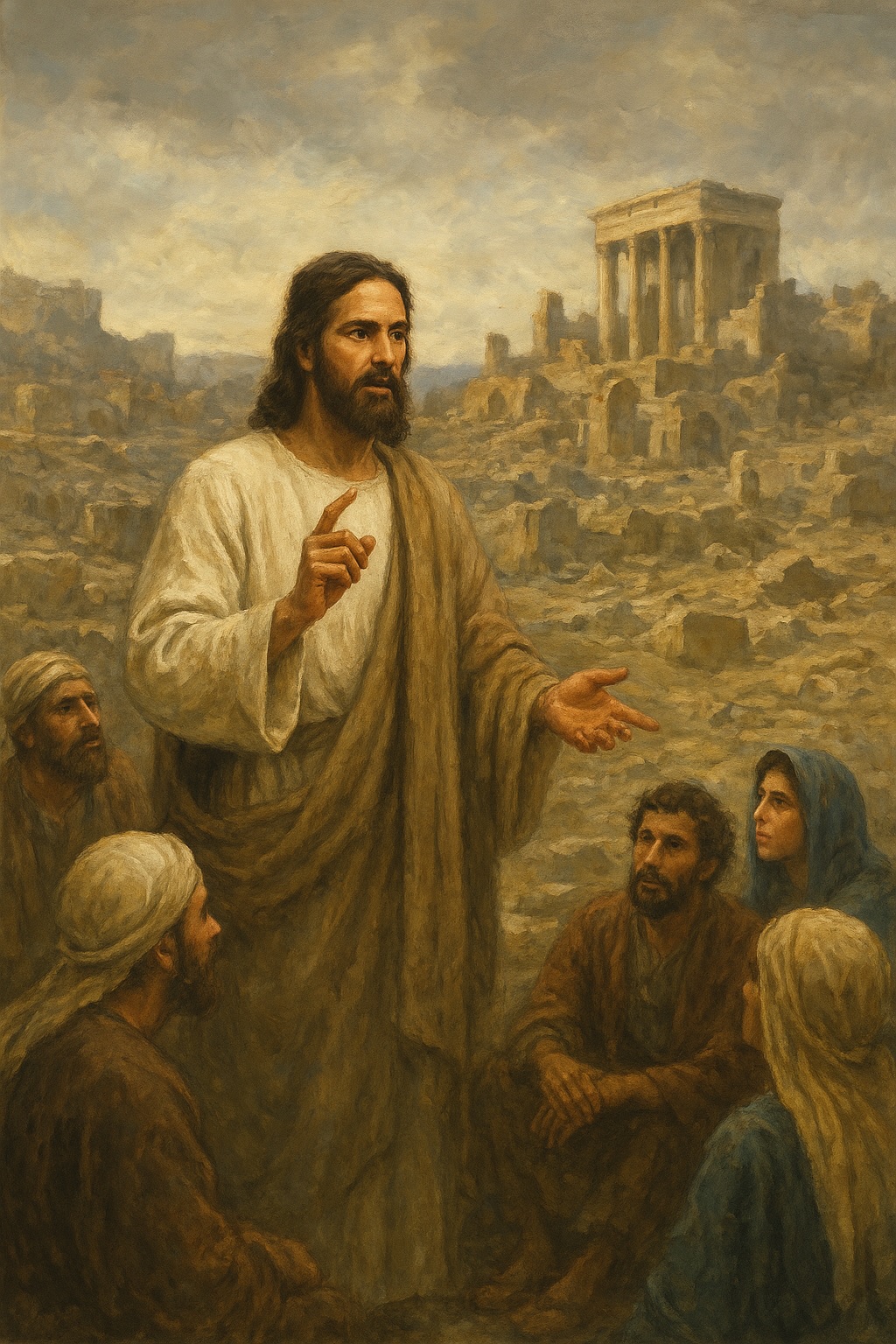
Yet, Christ—who sees beyond the visible—shatters their illusions with His prophetic warning words: “As for these things which you see, the days will come when there will not be left one stone upon another that will not be thrown down.” (Lk 21:6). The stones of the temple structures were indeed massive, and the disciples, like the common folk, were awe-struck by its beauty and splendour. But Jesus takes this opportunity to speak of the coming days when it would lie in ruins. Like the prophets Isaiah, Jeremiah, and Ezekiel, Jesus announces divine judgment upon Israel (Jer 7:1-14; 22:5; 52:12-13). The magnificent Temple, the heart of Israel’s worship and the visible sign of God’s dwelling among His people, was destined to fall. His words must have shocked His listeners-the centuries of faith, labour, and devotion seemingly brought to nothing. Yet, in 70 A.D., Jesus’ prophecy was fulfilled. The Lord reminds us that temples built by human hands, however glorious, are not eternal.
Jesus Predicts the Destruction of the Temple
In today’s Gospel, Jesus not only predicts the destruction of the Temple but also speaks of tumultuous times ahead: social upheaval, civil unrest, wars, earthquakes, famines, and even plagues-signs that would shake human confidence (2 Chr 15:6; Is 14:30; 19:2; Ezek 36:29–30; Amos 8:11; Zech 14:5). These fearful events are not random; they are signs of God’s mysterious activity in history. In using this apocalyptic language (cf. Book of Revelation), Jesus draws out the lesson that, despite these earthly happenings, God is in control even in the worst of conditions.
Therefore, Jesus exhorts His disciples not to be terrified. Suffering, persecution, and cosmic chaos must not disturb the peace of those who trust in Him. Even in moments of confusion and pain, Christ’s followers are called to bear witness to the Gospel. He assures them: “I will give you words and a wisdom that none of your opponents will be able to withstand or contradict.” (Lk 21:15; cf. Acts 4:8–12; 7:54).
In the gospel passage of today dealing with the destruction of Jerusalem, we have verses 5-6 speaking about the prediction of destruction, vv.7-11 dealing with the events preceding the destruction and f vv. 12-19 deals with the persecution preceding the destruction.
Not a Hair of your Head will Perish
Unfortunately, Jesus also warns that persecution will come from parents, brothers, relatives, and friends. Yet discipleship demands placing Christ and the values of the Kingdom above all else (cf. Lk 14:26). Christ had already warned that choosing the Kingdom of God will bring divisions even within families (Lk 12:53; 14:26; 18:29). Yet God’s faithful care remains constant: “Not a hair of your head will perish. By your endurance you will gain your lives” (Lk 21:18-19). These words beautifully express God’s tender protection and invite us to persevere with faith and patience through every trial. The fall of the Jerusalem Temple, then, is not the end of God’s plan-it is a sign pointing toward the ultimate fulfilment of history in the coming of the Son of Man.
Points for Personal Reflection
Last Sunday’s liturgy invited us to reflect on the Temple through the Feast of the Dedication of the Lateran Basilica. In the first reading, the prophet Ezekiel described the life-giving waters flowing from the Temple—a profound image of divine healing, renewal, and restoration (Ezek 47:1-12). The Temple’s holiness does not come from its stones or structure but from the presence of the Lord who dwells within. Wherever God is present, that place becomes holy. The stream that flows from beneath the Temple symbolizes divine grace—bringing healing, forgiveness, and life to all creation.
In his First Letter to the Corinthians, St. Paul deepens this teaching: “You are God’s building... you are God’s temple and God’s Spirit dwells in you” (1 Cor 3:9-11, 16-17). Christ, the Master Builder, shapes us into living stones with Himself as the cornerstone (1 Pt 2:4-8; Eph 2:20-22). The true Temple of God is no longer a structure of stone but a community of believers built upon the foundation of Christ.
Points for Personal Reflection
Conclusion
Dear brothers and sisters, today’s Gospel invites us to examine where we place our security. Are we too attached to the visible, the temporary, and the external signs of faith, forgetting that God desires to dwell in the temple of our hearts? Buildings may fall, kingdoms may crumble, and history may change, but God’s presence endures forever in those who remain steadfast in faith, hope, and love.
May we, the living temples of God, bear witness to His enduring presence and allow His Spirit to renew the face of the earth.
© 2026 CATHOLIC CONNECT POWERED BY ATCONLINE LLP