English
Key Verse to Meditate: Jesus answered them, "Destroy this temple, and in three days I will raise it up" (Jn 2:19).
Dear Brothers and Sisters in the Lord, Today, the Holy Mother Church celebrates the Feast of the Dedication of the Lateran Basilica in Rome, the oldest and highest-ranking of the four major basilicas. The Lateran Basilica is honored as “the mother and head of all churches of Rome and the world” (omnium urbis et orbis ecclesiarum mater et caput). Many mistakenly believe that St. Peter’s Basilica holds this distinction, but it is the Basilica of St. John Lateran that serves as the cathedral of the Diocese of Rome and the official ecclesia stical seat of the Holy Father.
Historically, the Lateran Basilica was also the papal residence until the Avignon period. It was the first basilica constructed after Emperor Constantine’s edict in 313, which granted Christians the freedom to practice their faith openly. The basilica has been known as the Church of the Holy Savior (Sancta Sanctorum) and the Church of St. John the Baptist. In ancient Rome, this was the church where the faithful were baptized. As the oldest church built in the West, it was consecrated by Pope Sylvester I in 324. In the 6th century, the names of St. John the Baptist and St. John the Evangelist were added to its dedication. Initially, this feast was observed only in Rome, but from 1565 onward, it was extended to the universal Church of the Roman Rite. Celebrating this feast is a sign of love for, and union with, the See of Peter.
The First Reading
The first reading is taken from the prophet Ezekiel, whose name means “God strengthens” (Ezek 1:3; 24:24). He is often called the Prophet of the Holy Spirit, and also the Prophet of the Temple, since the Temple occupies a central place in his visions and prophecies.
In the Book of Ezekiel, we find two major visions of the Temple: one desecrated and about to be destroyed (chapters 8–11), and the other purified, renewed, and perfectly restored (chapters 40–48). Today’s passage focuses on the second vision, where Ezekiel describes the life-giving water that flows from the Temple—a powerful image of healing, restoration, and divine renewal (Ezek 47:1–12).
The Centrality of the Temple and the Presence of the Lord
Ezekiel’s prophecy opens with a vision of the Lord enthroned in glory (Ezek 1:1ff) and concludes with a vision of a sacred stream flowing from the Temple altar (47:1–12). The book ends with the proclamation of Jerusalem’s new name: Yahweh Shammah—“The Lord is there” (Ezek 48:35). This final name is deeply significant. It reminds us that the Temple is not holy in itself; its holiness comes entirely from the presence of the Lord. Wherever the Lord is present, that place becomes holy. Moreover, Ezekiel emphasizes that God’s presence among His people requires them to live with justice and righteousness in their daily lives. When His people abandon justice, God’s glory can depart from the Temple—and yet, astonishingly, He can reappear even in foreign lands, showing that His presence is not confined to any one place.
The Water That Heals and Restores Life (Ezekiel 47:1–12)
Ezekiel’s vision of the flowing water is a profound image of the newness and renewal that God promises to His people. The stream that flows from beneath the Temple is a sign of divine blessing and life. As the river flows farther from its source, it becomes deeper, stronger, and more powerful—transforming everything it touches. This is living water, pure and fresh, that brings life wherever it flows. It revives the desert, heals the sea, and makes even barren places fertile. Every creature, every plant, and every human being touched by this water is renewed.
The fact that the river flows from the Temple signifies that all true life and blessing come from God’s dwelling among His people. The Temple, where God has once again taken up His abode, becomes the fountainhead of new life for the entire land. In a deeper sense, this river symbolizes the divine life that flows from God Himself—bringing healing, forgiveness, and renewal to all creation. As the closing verses of the chapter indicate, this life-giving water not only restores the land but also reconstitutes the inheritance of Israel (Ezek 47:15–20), marking the dawn of a new era of grace and divine presence.
The Meaning of the Vision of Waters Flowing From the Temple
The vision of waters flowing from the temple in Ezekiel is a beautiful symbol of God’s life-giving presence. The river begins as a small stream but grows deeper and wider, reminding us that God’s grace often starts in humble, unseen ways but can expand to bring abundant life. Just as the water nourishes and restores the land, God’s Spirit purifies and strengthens all who receive it.
These waters bring healing and vitality wherever they flow: “Wherever the river flows, everything will live” (v.9). This teaches us that holiness is not meant to remain private; it is meant to flow outward, touching the lives of others with peace, hope, and renewal. The trees along the riverbanks that bear fruit and heal the nations (v.12) symbolize the mission of the Church and of each Christian: we are called to be channels of God’s grace, bringing life, healing, and spiritual nourishment to a world wounded by sin and despair.
In today’s feast of the Lateran Basilica, we are reminded that the Church, like the temple in Ezekiel’s vision, is the conduit through which God’s living water flows into the world. Our call, then, is to let this same Spirit dwell in us, transforming our hearts and guiding our actions.
The Second Reading
In today’s second reading, St. Paul reminds us that the Church is built upon the firm foundation of Jesus Christ. This holy edifice is the work of every believer, beginning with the apostles themselves. St. Paul emphasizes that we are the temple of God and the dwelling place of the Holy Spirit: "Do you not know that you are God’s temple and that God’s Spirit dwells in you? If anyone destroys God’s temple, God will destroy that person. For God’s temple is holy, and you are that temple" (1 Cor 3:16-17).
Each of us is called to care for our body and soul as a sacred dwelling for God. St. Paul also describes the Church as God’s building, built by God Himself (1 Cor 3:9). We are to become living stones, formed and used by Christ, the Master Builder, with Him as the cornerstone (1 Cor 3:9-11, 16-17; 1 Pt 2:4-8; Eph 2:20-22). The holiness of the Christian community is most profoundly experienced when we gather as the Church to celebrate the Eucharist, listen to the Word of God, and receive the Body and Blood of Christ. Pope Benedict XVI observes that through the Eucharist, the Church of living stones is built up in truth and charity and is inwardly transformed by the Holy Spirit.
The Gospel Reading
In today’s Gospel, St. John recounts the cleansing of the Temple by Jesus. John’s Gospel mentions three Passovers during Jesus’ public ministry (Jn 2:13, 23; 6:4; 11:55; 12:1; 13:1; 18:28, 39; 19:14), which allows us to understand that His ministry spanned roughly three years. At the time of the Jewish Passover, Jesus went up to the Temple in Jerusalem. All three Synoptic Gospels—Matthew, Mark, and Luke—also record the cleansing of the Temple (Mt 21:12–13; Mk 11:15–17; Lk 19:45–46). However, there is one significant difference: in John’s Gospel, this event occurs at the beginning of Jesus’ public ministry, while in the Synoptics, it appears near the end, just before His Passion.
This is not a contradiction but a matter of theological emphasis. John is not primarily concerned with strict chronology; rather, he places this event early in his Gospel to highlight its theological meaning. From the very outset of His ministry, John shows us that Jesus repudiates the corruption of the Temple cult and foreshadows the deeper reality of His death and resurrection, through which the true worship of God will be restored.
The Temple and Its Commercial Activities
The term “temple” in this context refers not only to the main sanctuary or holy place but to the entire Temple precinct, including the various surrounding courts. Most likely, the buying and selling took place in the outer courtyard of the Gentiles, the only area accessible to non-Jews.
Pilgrims who came from distant regions to worship in Jerusalem could not easily bring sacrificial animals with them. Therefore, provisions were made for them to purchase the required offerings—such as oxen, sheep, or doves—within the Temple premises. This practice was meant to facilitate worship according to the prescribed sacrifices of the Law.
Another practical issue concerned currency exchange. Pilgrims from various lands brought different kinds of coinage, many of which bore the image of the Roman Emperor or pagan symbols—both considered inappropriate for Temple use. Hence, a special Temple currency was required for all offerings, and the money changers were responsible for converting foreign coins into this acceptable form. While a small service fee was legitimate, many of these money changers took advantage of their monopoly, often charging exorbitant rates. As a result, poor pilgrims were unfairly burdened, and what was meant to serve worship had become a form of exploitation. This commercial abuse in the sacred precincts explains Jesus’ righteous anger and His cleansing of the Temple.
Jesus’ Righteous Anger
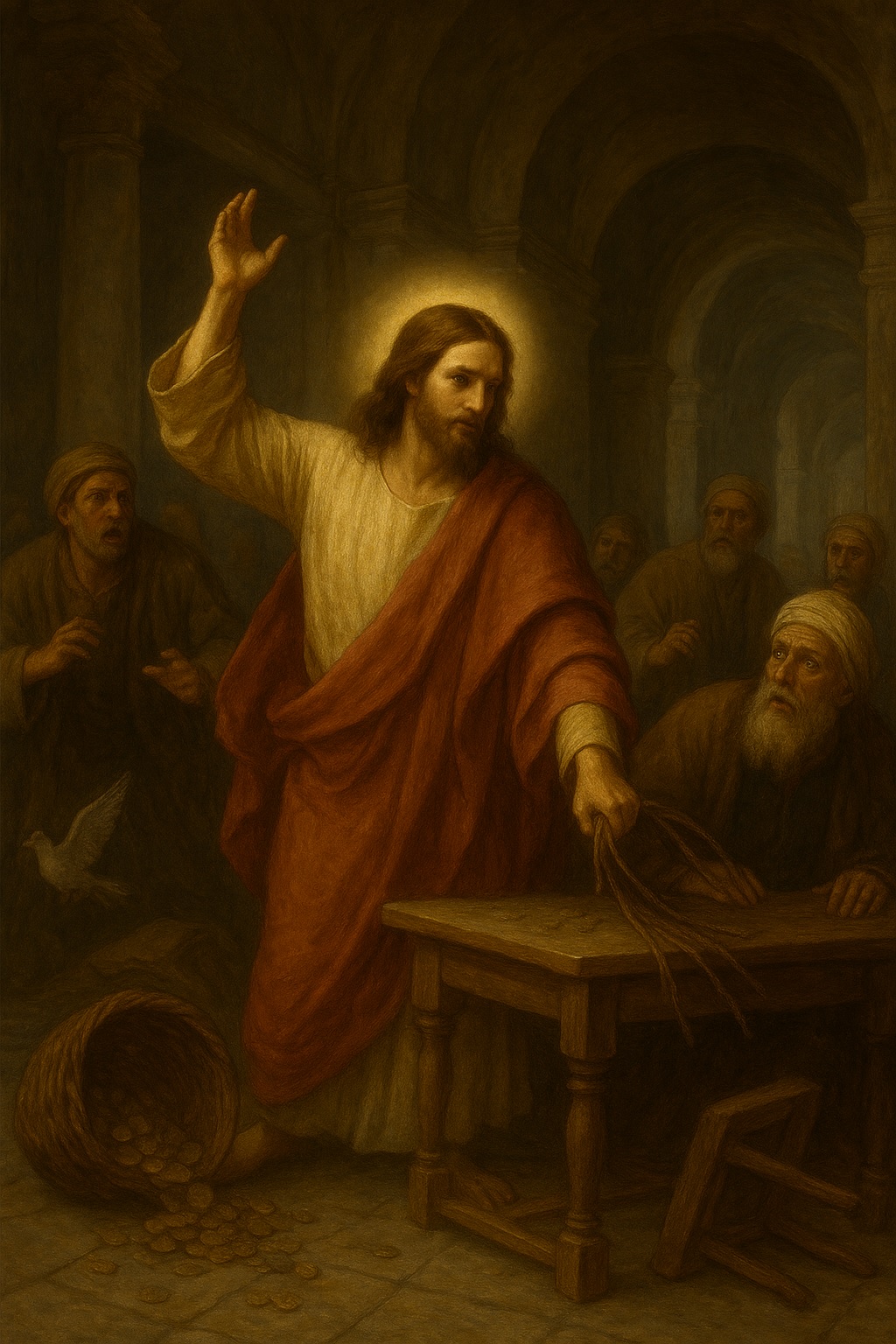
Seeing that the sacred space of God’s Temple had been turned into a marketplace, Jesus was filled with righteous zeal. He drove out those who were buying and selling, saying: “Take these things out of here! Stop making my Father’s house a marketplace!” (Jn 2:16). In Mark’s version, Jesus declares, “My house shall be called a house of prayer for all nations, but you have made it a den of robbers” (Mk 11:17; cf. Is 56:7; Jer 7:11). The message is unmistakable: God’s house is not to be commercialized or reduced to a place of profit. It is a dwelling of holiness, prayer, and divine presence.
Jesus’ anger was directed especially toward the money changers, whose coins He scattered, and those selling doves, whose tables He overturned (Jn 2:15–16). Yet His action was not an outburst of mere human emotion—it was a prophetic and moral act, a sign that the Messiah had come to purify the worship of God’s people. John emphasizes that this action revealed Jesus’ unique relationship with the Father and fulfilled the Scripture: “Zeal for your house will consume me” (Ps 69:9; Jn 2:17).
Thus, the cleansing of the Temple was not merely an act of reform but a manifestation of the Messiah’s authority. Through this, John seeks to show that Jesus is not simply a reformer of religion but the very fulfilment of God’s promises, the One in whom the presence of God truly dwells.
The True Temple: Christ Himself
When the Jewish leaders demanded a sign for His actions, Jesus answered: “Destroy this temple, and in three days I will raise it up” (Jn 2:19). The word Jesus uses for “temple” refers to the sanctuary, the inner dwelling place of God. While His listeners thought He was speaking of the physical Temple—which had taken forty-six years to build—Jesus was in fact speaking of His own body, the true dwelling of God among men. Only after His resurrection did the disciples fully understand His words: “When therefore He was raised from the dead, His disciples remembered that He had said this, and they believed the Scripture and the word which Jesus had spoken” (Jn 2:22).
In the Synoptic Gospels, Jesus also refers to His resurrection as the only sign that will be given to that generation (Mt 12:39–40; 16:4; Lk 11:29). Later, at His trial, this very saying was twisted into an accusation: “This man said, ‘I am able to destroy the temple of God and rebuild it in three days’” (Mt 26:61; Mk 14:58). Even as He hung upon the cross, the mockers hurled the same taunt at Him (Mt 27:40; Mk 15:29).
The early Church faced similar accusations. In the Acts of the Apostles, the opponents of St. Stephen declared, “We have heard him say that this Jesus of Nazareth will destroy this place and change the customs that Moses handed down to us” (Acts 6:13–14; cf. 7:48). Yet Stephen and the early Christians understood what Jesus truly meant: God no longer dwells in temples made by human hands (Acts 7:48; 17:24). The risen Christ Himself is now the new and living Temple, and through the Holy Spirit, the hearts of believers have become the dwelling place of God (1 Cor 6:19).
In cleansing the Temple, Jesus revealed both His divine authority and His mission—to replace the old order of worship with a new and living covenant rooted in His death and resurrection. The true Temple is no longer a building of stone, but the Body of Christ—a living, holy people gathered in faith and animated by the Spirit of God.
Points for Personal Reflection
1) The Church is the visible sign of God’s desire to build a spiritual temple in the world, as Pope Benedict XVI teaches. Do I recognize that God dwells in me and that I am His temple?
2) How do I respect the Church as a sacred place where we gather to listen to God’s Word and receive the Eucharist?
3) Am I actively building myself as a spiritual temple for God, offering my thoughts, words, and actions as living stones in His holy edifice?
4) Like the Lateran Basilica, a place of dedication and steadfast faith, do I dedicate my life fully to Christ, allowing Him to cleanse, guide, and transform me?
5) The Church is not only a building of stones but a community of believers, animated by the Spirit. How am I contributing to the holiness, unity, and love of my local parish community?
May this feast remind us that our life, like the temple, is meant to be a sacred dwelling for God. Let us live with zeal, dedicating ourselves to holiness, building our lives as living temples, and preparing to enter the eternal dwelling of God.
© 2026 CATHOLIC CONNECT POWERED BY ATCONLINE LLP