
English
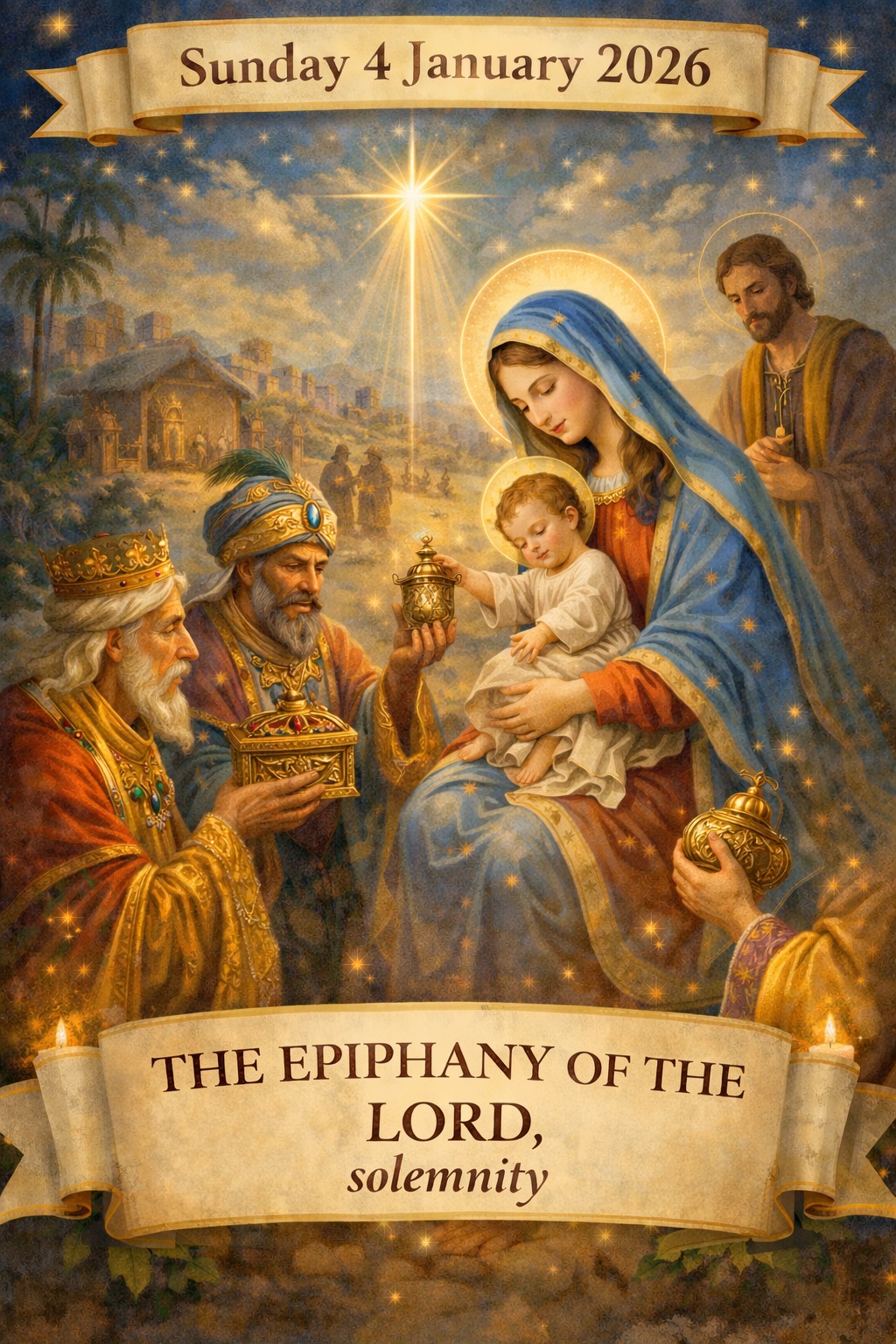
Key Verse to Meditate: On entering the house, they saw the child with Mary his mother; and they knelt down and paid him homage. Then, opening their treasure chests, they offered him gifts of gold, frankincense, and myrrh. (Mt 2:11).
My dear Brothers and Sisters in the Lord,
Today we celebrate the great Solemnity of the Epiphany of the Lord, or the manifestation of the Lord. A few days ago, we celebrated the Nativity of the Lord, and today we celebrate the manifestation of God to the pagans, represented by the Magi from the East. On Christmas Day, we contemplated the Jewish shepherds, who were led to the place of Jesus’ birth by the announcement of an angel. The visit of the Magi to Bethlehem marks the birth of the universal Church, where even the so-called Magi from the East—those outside the chosen people—came to see and adore the infant Jesus. Today we celebrate the Epiphany, that is, the manifestation of Jesus to the world. All those who prostrate themselves in adoration before Jesus are said to be represented in the Magi (cf. Ps 71).
The Magi from the East come to Judea, looking for the King of the Jews, saying: “Where is the child who has been born King of the Jews? For we observed his star at its rising and have come to pay him homage” (Mt 2:2). In the Magi, just as in the poor shepherds, the Gentiles offer their adoration and honour to the promised Messiah of the world. In verse 1, we read certain details that place us in the historical context. Jesus was born during the time of King Herod. According to Josephus, the great historian, Herod probably died shortly before the Passover in 4 B.C., and therefore Jesus must have been born between 7 and 4 B.C. It is also important to note that Herod reigned from 37 to 4 B.C.
The First and the Second Readings :
This mystery of the birth of the Saviour is also very well portrayed in the first and second readings of today. In the first reading, we see that the visit of the wise men, or the coming of the Gentiles to the newborn King, is already foreseen: “Then you shall see and be radiant; your heart shall thrill and rejoice, because the abundance of the sea shall be brought to you, the wealth of the nations shall come to you. A multitude of camels shall cover you, the young camels of Midian and Ephah;
all those from Sheba shall come. They shall bring gold and frankincense, and shall proclaim the praise of the LORD” (Is 60:5–6).
The gifts brought to this newborn King are also mentioned here. In the second reading, St. Paul speaks about how this mystery has been made known to him, as well as through the prophets and apostles, by which the Gentiles are also blessed to come to know the Saviour: “the Gentiles have become fellow heirs, members of the same body, and sharers in the promise in Christ Jesus through the Gospel” (Eph 3:6).
The Gospel Reading
From the Gospel account of the coming of the Magi to Bethlehem, we notice three different reactions to the announcement of the birth of Jesus: that of the Magi, that of Herod, and that of the priests. Scripture tells us that King Herod and the whole of Jerusalem were troubled when they heard this news from the wise men from the East. Herod confirmed with the chief priests and scribes of the people that Bethlehem of Judea was the place where the Messiah was to be born. He also inquired about the exact time when the star had appeared. He asked all these questions not because he was joyful, but because he was deeply troubled in his heart. He was anxious about his position as king. His plan was to turn the Magi from messengers into spies.
King Herod
Another person we are called to reflect upon is Herod, the king of Jerusalem. He had already made his choice. Between God’s will and his own, he clearly chose his own. He saw nothing beyond his own advantage and was determined to crush anything that threatened to disturb this state of affairs. He was driven by what Augustine calls “the love of self, which on occasion can reach the point of contempt for God.” He probably thought he was doing his duty—defending his throne, his family, and the good of the nation. The later part of the Gospel tells us that, when he came to know that the Magi had outwitted him, he ordered the massacre of the innocent children under two years of age. Herod was not happy about the “Epiphany” or the manifestation of God at all. He was so full of himself that he was blinded to the light of truth.
Herod is highlighted here because, once the Magi departed without returning to inform him, he killed all the innocent children, just as Pharaoh once tried to kill Moses. King Herod was also deeply disturbed to learn that a rival king had been born and publicly proclaimed as the “King of the Jews.” There could be only one king. Moreover, the kingdom of Jesus already stood in contrast to the rule and kingdom of Herod. In today’s Gospel, in verse 6, we read: “From you shall come a ruler who is to shepherd my people Israel.” Jesus is therefore a different kind of king. He is a king who leads his people as a shepherd leads his flock—unlike Herod. All the tribes of Israel once said to David: “For some time, while Saul was king over us, it was you who led Israel out and brought it in. The LORD said to you: You shall be shepherd of my people Israel, you shall be ruler over Israel” (2 Sam 5:2).
To ‘Shepherd My People Israel’
The reference to a ruler coming forth to “shepherd my people Israel” reminded the first-century Jews of the eschatological expectation of the ingathering of the twelve tribes of Israel, which is fulfilled in the person of Christ (cf. Ezek 34:4–16; Mic 5:1–9; Ezra 13:34–50). Thus, we already see the tensions beginning for Jesus. The chief priests and scribes of the people confirmed to Herod that the place of the birth of the Saviour was “Bethlehem,” as quoted in Micah 5:2. Secondly, the phrases “Bethlehem of Judea” or “Bethlehem, in the land of Judah” point us to an important truth, because they not only show the connection between Jesus and the patriarch Judah (cf. Gen 49:9–10), but also affirm that the Davidic Messiah was expected to come from the tribe of Judah (Rev 5:5; cf. Heb 7:14).
The Magi from the East
The major protagonists of today’s solemnity are the Magi from the East and the star that guided their journey. The Magi journeyed from the East in search of the Saviour, guided by the star. They had to travel under precarious conditions to see the Saviour of the world. It was not an easy journey because of harsh weather, dangers from thieves, and wild beasts. Yet they were determined to complete their journey, for they were deeply drawn by the star, knowing full well that it was something unique and would lead them to the indescribable joy of seeing Christ, worshipping him, and offering him their gifts.
To arrive at Bethlehem, the Magi had to keep asking questions and faithfully follow the star—the sign sent to them by God. We read that after leaving the palace of King Herod, they were overjoyed to see the star once again in the sky. They had to make enormous sacrifices to reach their final destination. Their greatest satisfaction came when they worshipped the King of kings and the Lord of lords and offered him their gifts. They experienced the joy of contemplating the face of God in that God-promised child who had been revealed to them through the appearance of the star. The star finally stopped over the house where they beheld the vision of God’s only Son. Matthew adds in his Gospel: “When they entered the house, they saw the child with Mary his mother, and they fell down and worshipped him.” The star thus revealed to them the true light of the world, Jesus Christ.
The Magi and Their Gifts
The Magi were able to recognize that the child in the manger was God. In fact, the Gospel tells us that they worshipped him—a gesture that, even in their time, was reserved for God alone. In today’s life of the Church, we rediscover the importance of worshipping Jesus, of kneeling before him in the Eucharist. Jesus, who is present in the tabernacle, is the same God whom the sages once saw in Mary’s arms. Even today, we can say that the same God is hidden in the small piece of bread consecrated in the Eucharist.
The Magi offered him the most precious gifts they possessed: gold, frankincense, and myrrh. Gold symbolises that the child is King. We, as Christians, must strive to allow Jesus to reign in our hearts and in all our activities, seeking to please him in everything. The Magi then offered frankincense, the perfume burned every evening on the altar by the priest, symbolising prayer. Our prayer rising to the Lord is like incense, and our desire to lead a holy life spreads around us what St Paul calls “the fragrance of Christ” (2 Cor 2:15). Finally, the Magi offered myrrh, for Christ would take upon himself our sufferings and bear our pains. Myrrh, which recalls the passion of Jesus, is a symbol of sacrifice that must never be absent from the Christian life.
To Return Back
The wise men returned to their own country by another way after finding the newborn King, guided by the star. The star guided their steps just as the Lord guided the Israelites in the Old Testament. As we read in Exodus 13:21: “The Lord went before them by day in a pillar of cloud to lead them along the way, and by night in a pillar of fire to give them light, so that they might travel by day and by night.” The star became a sign for the Magi, just as a sign was given to the shepherds: “To you is born this day in the city of David a Saviour, who is the Messiah, the Lord. This will be a sign for you: you will find a child wrapped in bands of cloth and lying in a manger” (Lk 2:11–12).
To Gaze at the Star
To arrive at the place where Jesus was, the Magi had to gaze at the star. Finally, the guiding star led them to the Saviour, Jesus Christ. Bowing down, they offered him the gifts of gold, frankincense, and myrrh. These three gifts are symbols of loyalty and submission. After their act of worship, they were warned by the Lord in a dream, and they returned to their own country by another route.
What is signified by the gifts of gold, frankincense, and myrrh is this: gold signifies Jesus as King, frankincense signifies Jesus as God, and myrrh signifies Jesus as the one who would die. In fact, gold and myrrh were among the gifts brought to King Solomon by foreigners, and gold and frankincense were firmly associated with the temple he built (1 Kgs 10:2, 25; 1 Chr 29:9; 2 Chr 9:24; Neh 13:5, 9). Frankincense and myrrh appear together only three times in the Old Testament, each time in connection with Solomon (Song of Solomon 3:6; 4:6, 14). The presence of the Magi thus confirms what is proclaimed in the first reading: “Arise, shine; for your light has come, and the glory of the Lord has risen upon you” (Is 60:1). Later in Matthew’s Gospel, Jesus will say: “I tell you, many will come from east and west and will eat with Abraham and Isaac and Jacob in the kingdom of heaven” (Mt 8:11).
Points for Personal Reflection
Like the Magi, we too are called to return to our lives by taking another way. This means making life choices that lead us to true happiness and fulfilment, enabling us to live a more beautiful, freer, truer, and fuller life in love of God and neighbour. This transformation can happen only when we meet Christ at the manger. Those who truly encounter God can never return to their old, sinful ways of living. Those who meet God at a deeper level dare to take the untrodden path.
Do we follow the signs that God places along our life’s journey to lead us to our destination? What is the star in my life that guides me to Christ and leads me to worship him? Do we walk guided by a star? Do we seek guidance from others, and do we continue to follow the star even when surrounded by doubts and failures?
What is the guiding star of your life? To arrive at Jesus, we must keep our eyes fixed on the guiding star. At times, film stars, sports stars, or television personalities can become our guiding stars, but they cannot give us life or salvation.
The star does not stop or disappear until the destination is reached. In our life of faith too, firmness, constancy, and sacrifice are required if we are to contemplate God and offer ourselves to him in sacrifice. Like the Magi, may our sole aim be to find Christ, so that we may adore him and offer him our sins and brokenness, allowing him to heal us and lead us by another road to life and salvation.
© 2026 CATHOLIC CONNECT POWERED BY ATCONLINE LLP