English
Mass Readings -
Isaiah 7:10-14; 8,10; Psalm 40; Hebrews 10:4-10; Luke 1:26-38
Key Verse to Ponder -
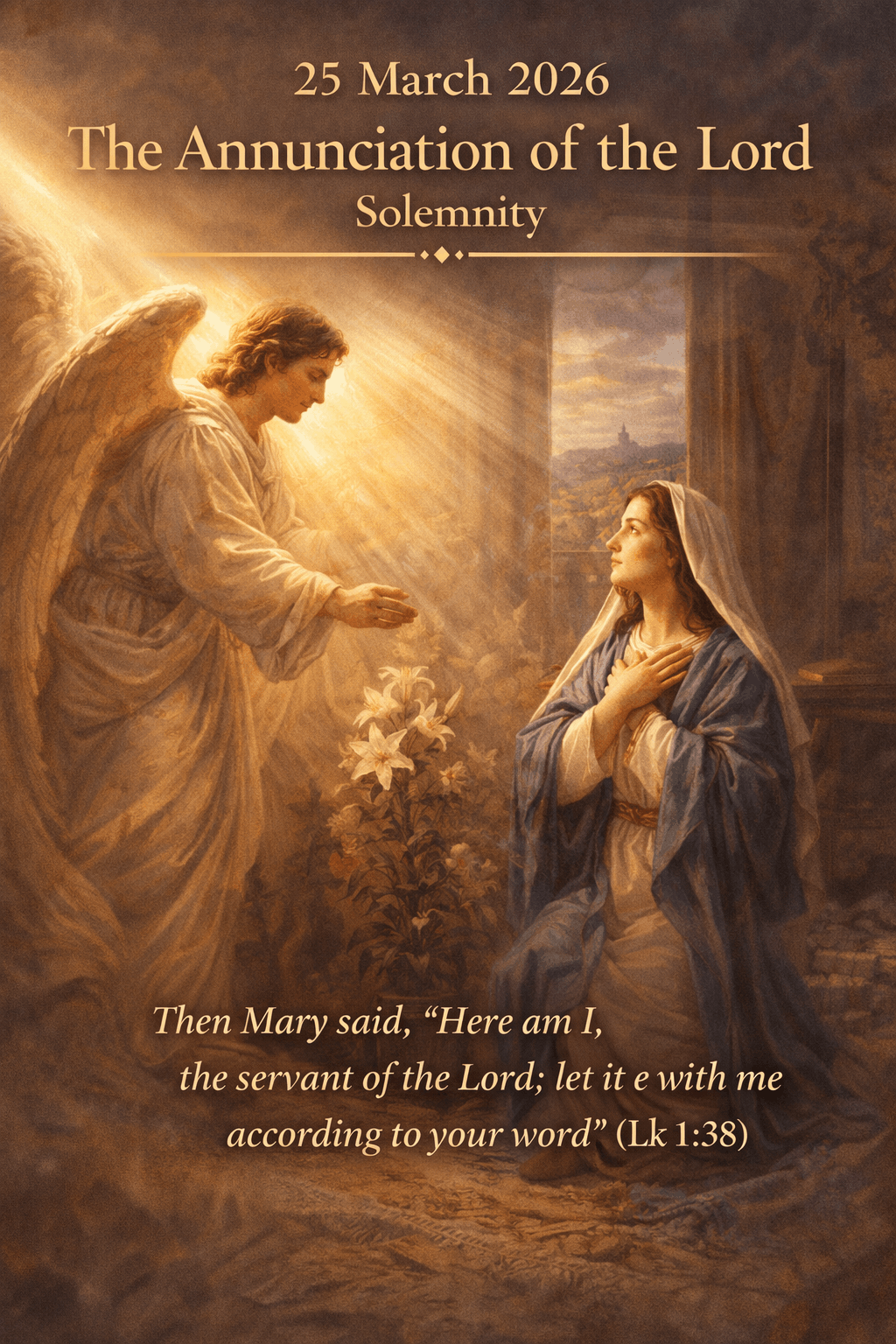
Then Mary said, "Here am I, the servant of the Lord; let it be with me according to your word" (Luke 1:38).
Dear Brothers and Sisters in the Lord,
Today Holy Mother the Church celebrates the Solemnity of the Annunciation of the Lord. Amid our Lenten practices, this feast comes as a message of hope to all of us at a time marked by suffering, the deadly fear of war, and confusion in the minds of many people. The announcement of the birth of our Saviour is always a source of hope for fallen humanity. God comes to enter into dialogue with humankind in order to redeem it.
God spoke to Mary at the fullness of time so that the prophecies foretold throughout the history of Israel—those spoken to Abraham, Moses, and the prophets—might be fulfilled in this Annunciation:
"And now, you will conceive in your womb and bear a son, and you will name him Jesus. He will be great, and will be called the Son of the Most High, and the Lord God will give to him the throne of his ancestor David. He will reign over the house of Jacob forever, and of his kingdom there will be no end" (Luke 1:31–33).
Mary and Joseph responded positively to the call of God, though it initially filled them with fear and trembling. They listened and obeyed; they allowed the Word of God to enter their lives, to speak through their actions, and to bear fruit in their destiny.
The First and Second Readings -
This feast is placed exactly nine months before the great solemnity of Christmas. It begins with the miraculous conception of Jesus in the womb of the Virgin Mary. The Son of God was conceived by the power of the Holy Spirit in the humble Virgin of Nazareth, who found favour with God (Luke 1:28). Jesus is the fulfilment of all the prophecies (2 Samuel 7:12–16; Isaiah 9:6–7; Luke 1:32–33). All this took place because of Mary's wonderful cooperation with the will of God.
The first reading from the prophet Isaiah tells us about the loss of faith and hope of King Ahaz when he was surrounded by enemy forces that threatened to destroy the kingdom. God offered him a sign to reassure him that He would not abandon His promise to David and his descendants. Yet Ahaz refused to ask God for a sign. Nevertheless, God promised a greater sign: a Saviour would be born who would redeem His people with righteousness and peace (Isaiah 7:11ff).
In the second reading, St. Paul emphasizes the obedience of Jesus to the will of God, through which we are sanctified:
"See, God, I have come to do your will, O God" (Hebrews 10:7, 9).
The Gospel Reading -
In today's Gospel passage we encounter a beautiful scene of dialogue between God and humanity. We might even say it resembles a kind of sacred negotiation between God and humankind, in which humanity signs the covenant of God's love. Mary, representing all humanity before God, accepts and obeys the divine will.
What God spoke to Mary was the final and definitive word—the same promise given earlier to Abraham, Moses, and the prophets. St. Paul explains this beautifully:
"In these last days he has spoken to us by a Son" (Hebrews 1:2).
"But when the fullness of time had come, God sent his Son, born of a woman, born under the law" (Galatians 4:4).
When humanity sinned and was in need of God's grace, God did not abandon it. Instead, He loved humanity even more and promised a Saviour who would redeem and save the world:
"She will bear a son, and you are to name him Jesus, for he will save his people from their sins" (Matthew 1:21).
“Here the Word Became Flesh”
When we visit Nazareth, at the Church of the Annunciation—which is believed to be built over the house of Mary—our attention is drawn to the Latin inscription on the altar of the lower church:
Verbum caro hic factum est, meaning “Here the Word became flesh.”
When our student group once celebrated Mass in that church and read this Gospel passage, we proclaimed it as if the angel of the Lord had come to that very place in Nazareth and greeted Mary there. Indeed, the Word of God came to that small town in Galilee, and because of Mary's faith-filled "yes," God's saving plan entered human history in a visible way.
Throughout salvation history, God constantly spoke to His people through His Word and through the prophets, beginning with Abraham, Moses, and many others. What stands out is their ability to listen to God's Word and obey it. They first listened, then obeyed. They allowed the Word of God to enter their lives, shape their actions, and transform their destiny.
“Here Am I, the Servant of the Lord”
Mary also first listened to the Word of God and obeyed it completely through her faith and total surrender to God. From the moment she said "yes," the Word of God took complete possession of her life:
"Here am I, the servant of the Lord; let it be with me according to your word" (Luke 1:38).
Mary allowed God's Word to transform her entire life. Before she conceived the Word of God in her womb, she first conceived the Word in her heart. This is why Jesus later said:
"Blessed rather are those who hear the word of God and obey it" (Luke 11:28).
When Mary first heard the greeting of the angel, she was deeply troubled and perplexed:
"Greetings, favoured one! The Lord is with you" (Luke 1:28).
"But she was much perplexed by his words" (Luke 1:29).
The presence of God often disturbs our lives, because it calls us beyond our comfort and into a deeper mission.
Mary was not an exception. Though she was full of grace, she was still a young woman who experienced fear and uncertainty. God's Word can disturb us because it challenges us to change.
When Mary asked, “How can this be, since I am a virgin?” (Luke 1:34), her question was not one of doubt but of wonder and faith. She believed that God would take care of her fears and doubts.
God’s Incarnate Word Took Flesh in Mary’s Womb
The angel assured her that she was not alone:
"The Holy Spirit will come upon you" (Like 1:35).
Where the Spirit of God is present, there is freedom (2 Corinthians 3:17) to respond to God's plan. Mary gave her fiat trusting completely in God's grace. Thus the Incarnate Word took flesh in her womb.
When God calls someone for His mission, He also gives the grace needed to fulfill that mission. Mary trusted, and therefore she became the Mother of God.
Mary's ‘Yes’ and Our ‘Yes’
It is truly extraordinary that God not only approached Mary but offered His eternal Son to become her Son. The promise “The Holy Spirit will come upon you” reveals that a new creation was about to begin.
Just as the Spirit moved over the chaos at the beginning of creation, the Spirit descended upon Mary to bring forth new life for the world. Mary said:
"Here I am, the servant of the Lord; let what you have said be done to me."
In the Annunciation we see the kind of dialogue that God wishes to have with each one of us. Mary's "yes" brought about a dramatic transformation in her life. Likewise, when God enters our lives, it requires a radical change—a true conversion.
Mary Allowed the Word of God to Replace Everything
The prophets allowed the Word of God to replace their own ideas, and Mary allowed God's Word to transform her entire life. God's Word often disturbs us because it calls us to move beyond our limited plans.
The approach of the infinite God always deeply challenges the human person. Even Mary, though she was "full of grace," was disturbed by God's presence.
If Mary could be filled with grace, we too can be filled with God's grace when we listen to His Word and respond with faith.
Points for Personal Reflection
1. Can I entrust myself to God's plan with the same trust as Mary?
2. When has God made an "annunciation" in my life—an invitation to follow Him more closely?
3. Did God's call disturb my routine life?
4. Do I have the faith of Mary?
Each of us has received a personal "announcement" from God. Have we responded to it? If not, it is never too late to say "yes." We can begin today to live more fully for God and for others.
© 2026 CATHOLIC CONNECT POWERED BY ATCONLINE LLP