
English
Mass Readings -
2 Samuel 7: 4-5.12-14.16; Psalm 89; Romans 4: 13.16-18.22; Matthew 1:16. 18-21. 24
Key Verse to Ponder:
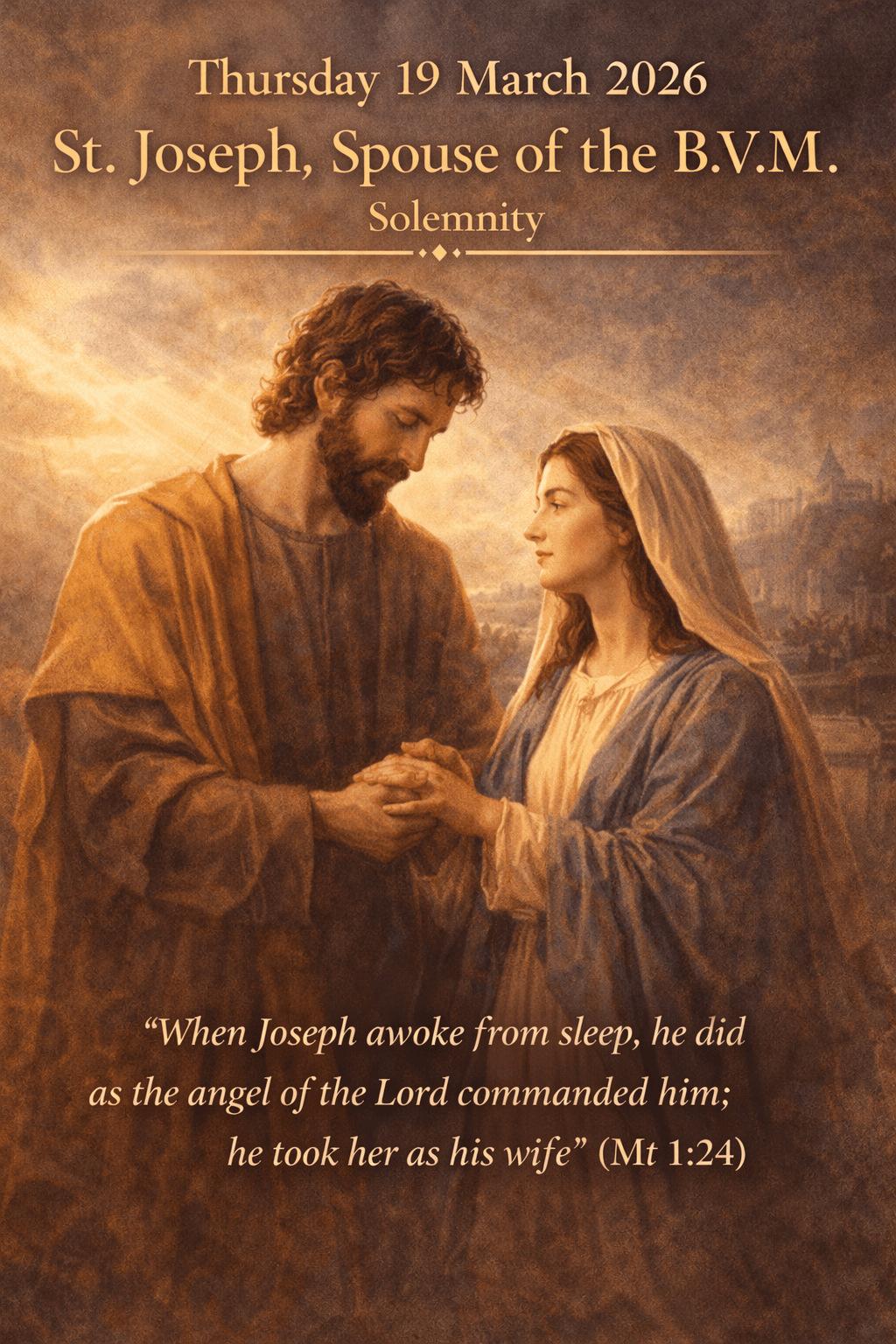
When Joseph awoke from sleep, he did as the angel of the Lord commanded him; he took her as his wife, (Matthew 1:24)
Dear Brothers and Sisters in the Lord,
Today the Church celebrates the Solemnity of St. Joseph, the husband of Mary and the foster father of Jesus. This celebration comes as a welcome break in the midst of our Lenten observances. St. Joseph is a universal saint, loved and revered by the entire Church. We could even say that he was among the greatest of saints, and yet in some sense the most hidden among them. Without his presence alongside the Holy Family of Nazareth, the mystery of our salvation would have unfolded differently.
St. Joseph appears to us as a man of deep obedience to the will of God. He is not mentioned frequently in the New Testament as Mother Mary is, yet the few verses that speak about him summarize the greatness of his character. The Gospel tells us:
"Her husband Joseph, being a righteous man and unwilling to expose her to public disgrace, planned to dismiss her quietly" (Matthew 1:19).
St. Matthew describes him as a “righteous man.” Some commentators even say he was not merely a “just man” but the model of a truly righteous man. This title perfectly reflects the kind of person Joseph was—silent, humble, and attentive to the will of God in his life. The statue of the sleeping St. Joseph, popularized by Pope Francis, beautifully reminds us that God often speaks to us in silence, in the depths of our hearts, and even in our dreams.
The First Reading -
The readings of today’s liturgy highlight the theme of God’s promise and faithful response. A righteous person is one who believes in the promises of God, even when their fulfillment is not immediately visible.
St. Paul, in his Letter to the Romans, reflects on the deep faith of Abraham. God promised Abraham that he would become the father of many nations. Humanly speaking, this promise seemed impossible. Yet Abraham trusted completely in God’s word:
"For the promise that he would inherit the world did not come to Abraham or to his descendants through the law but through the righteousness of faith" (Romams 4:13).
Abraham believed in God’s promise:
"Hoping against hope, he believed that he would become the father of many nations" (Romams 4:18).
Because of this faith, it was reckoned to him as righteousness (Romams 4:22; Genesis 15:6).
The Second Reading -
In the second reading we encounter another great promise of God, delivered through the prophet Nathan to King David. David desired to build a temple for the Lord, but God revealed that it would be his son who would build the house of God.
God promised David:
"When your days are fulfilled… I will raise up your offspring after you… He shall build a house for my name, and I will establish the throne of his kingdom forever" (2 Samuel 7:12–13).
This promise ultimately points to Christ. The kingdom established through Jesus will never end:
"Your house and your kingdom shall be made sure forever before me; your throne shall be established forever" (2 Samuel 7:16).
Jesus himself would become the living temple in whom God dwells among humanity.
The Gospel Reading -
In the Gospel, Joseph is clearly addressed as “son of David.” This title emphasizes that the promises made to Abraham and David are being fulfilled through Joseph in the birth of Jesus, whose kingdom will never end.
From a human perspective, Joseph must have experienced a deep struggle when he discovered that Mary was with child through the Holy Spirit (Matthew 1:18, 20). Even if he sensed that the hand of God was involved, it would have been difficult to explain this mystery to others. To avoid exposing Mary to shame, Joseph decided to divorce her quietly:
"Her husband Joseph, being a righteous man and unwilling to expose her to public disgrace, planned to dismiss her quietly" (Matthew 1:19).
“Joseph, Son of David, Do Not Be Afraid”
Whenever God calls someone to a special mission, He never abandons them in confusion. He guides them and strengthens them.
Through a dream, the angel reassured Joseph:
"Joseph, son of David, do not be afraid to take Mary as your wife, for the child conceived in her is from the Holy Spirit. She will bear a son, and you are to name him Jesus, for he will save his people from their sins" (Matthew 1:20–21).
This was, in a sense, a second annunciation, this time addressed to Joseph. He was told that Mary’s pregnancy was part of God’s saving plan and that the child to be born would be the Saviour of the world.
Joseph reflected deeply on this revelation. Despite his doubts and fears, his faith triumphed. When he awoke, he accepted God’s plan wholeheartedly:
"When Joseph awoke from sleep, he did as the angel of the Lord commanded him; he took her as his wife" (Matthew 1:24).
Joseph’s Obedience to God’s Command
Joseph’s greatness lies in his obedience. Without hesitation, he embraced God’s plan and took responsibility for protecting Mary and the child Jesus.
Joseph was not only courageous but also a man of profound faith. When the light of faith shines in the human heart, the darkness of fear and doubt disappears. Joseph accepted God’s will and lived it silently, faithfully, and without complaint.
Because of his “yes,” he had to face many trials. He protected Mary and the child Jesus from the murderous intentions of Herod. He fled with them into Egypt and later returned safely to Nazareth. Throughout all these trials, Joseph served God in silence.
In this way he became a worthy successor to the great patriarchs of the Old Covenant—Abraham, Isaac, and Jacob. The power to transform life begins with faith, with trusting God and acting upon that trust. St. Joseph stands as a powerful example of this truth. He was chosen as the guardian of the Word.
St. Joseph, the Guardian of the Word
St. Joseph, the guardian of the Word, was chosen by God for his fidelity and silence. He always placed God’s will first in his life.
Like the Joseph of the Old Testament who was known as a dreamer (Genesis 37:19), St. Joseph too was a dreamer. In his dreams God revealed His plan for salvation. Joseph dared to dream of God’s plan and trusted in it.
His vocation was simple yet profound: to give Jesus everything a human father can give—love, protection, a name, and a home.
This message also speaks to our lives. We do not always achieve what we plan or desire. Life does not always unfold according to our expectations. When unexpected situations arise, we may be tempted to rebel, blame God, or close ourselves off from others.
Joseph experienced such a moment on what must have been the longest night of his life. Yet God reassured him through a dream that everything was part of His divine plan.
Can we trust in this truth?
May the Lord send us the light of faith in times of difficulty, so that we too may become credible witnesses like St. Joseph.
Points for Personal Reflection
1. Am I ready to trust the Lord in my most difficult moments?
2. Am I willing, like St. Joseph, to obey and carry out God’s will in my life?
3. Am I a silent and faithful worker in God’s vineyard?
4. Am I willing to remain humble and play a hidden role in God’s plan?
May St. Joseph help us learn to trust God completely, to serve Him faithfully, and to walk humbly in His presence.
© 2026 CATHOLIC CONNECT POWERED BY ATCONLINE LLP