English
Key Verse to Meditate: Then the other disciple, who reached the tomb first, also went in, and he saw and believed; (Jn 20:8)
My dear Brothers and Sisters in Christ,
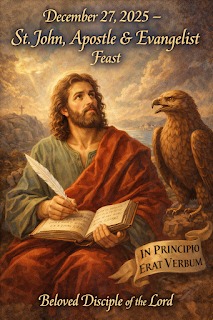
Today Mother Church celebrates the feast of Saint John the Evangelist, the beloved disciple and author of the Fourth Gospel. Before following Jesus, John was a disciple of John the Baptist. He was the brother of James, and together they were known as the sons of Zebedee—or, as Jesus called them, the Sons of Thunder. When Christ called them, they immediately left their father and the family boat to follow Him wholeheartedly.
John’s personality appears vividly in the Gospels. He is the one who once asked Jesus whether he could call down fire from heaven on the Samaritans who refused to welcome them. At the Last Supper, he reclined close to Jesus’ heart, listening intently to His words. He is also the disciple to whom Jesus entrusted His own Mother at the foot of the Cross. Truly, he was the disciple whom Jesus loved.
The First Reading
In the first reading, writing to the Johannine community, St. John underscores his personal experience of the resurrection at the empty tomb as an act of faith (Jn 20:2-8). This experience compels him to write with conviction: “What we have seen and heard we proclaim to you also, so that you also may have fellowship with us; and indeed our fellowship is with the Father and with His Son, Jesus Christ” (1 Jn 1:1-3).
In these verses, John emphasizes that he is testifying only to what he personally experienced: “What was from the beginning, what we have heard, what we have seen with our eyes, what we have looked upon and handled with our hands, concerning the Word of Life” (1 Jn 1:1). John, who speaks extensively about the Word (Jn 1:1-4), had already written in the beginning of his Gospel: “In Him was life, and the life was the light of men” (Jn 1:4).
Today’s first reading presents Christ as the “Word of Life”, showing that divine life was manifested in Him (1 Jn 1:1-2). John sees Christ, the incarnate Word, as both Light (Jn 8:12) and Life (Jn 6:35). Thus, John not only believed in the resurrection, but he also proclaimed this great mystery with faith, inviting all to understand and believe in the risen Lord: “And these things we write, so that our joy may be made complete” (1 Jn 1:4).
The Gospel Reading
Today’s Gospel reading presents the resurrection event in detail (Jn 20:2-8). Mary Magdalene comes early to the tomb and realizes that the stone has been removed and that Jesus’ body is not there. She then returns to Peter and the “other disciple whom Jesus loved” and says, “They have taken away the Lord out of the tomb, and we do not know where they have laid Him” (Jn 20:2).
In this Gospel, John is referred to simply as the “other disciple” five times. He specifically identifies himself as the “other disciple whom Jesus loved” (Jn 20:2a). Indeed, St. John was the beloved disciple—a title that speaks of a profound intimacy and friendship with the Lord. Upon hearing Mary Magdalene’s message about the empty tomb, John runs ahead—not out of pride, but out of love. Having lived closely with Jesus, he already believed in the promise of the resurrection.
The Gospel also highlights John’s humility and respect for Peter. Although he is young and reaches the tomb first, he waits patiently outside until Peter arrives (Jn 20:5b). But when he enters the tomb, the text tells us that he saw the burial cloths and believed: “So the other disciple who reached the tomb first also went in; he saw and believed” (Jn 20:8). This moment echoes an earlier scene in the Gospel: when John the Baptist pointed out Jesus, saying, “Behold the Lamb of God” (Jn 1:36). John followed Jesus, heard the invitation “Come and see,” and stayed with Him that entire day (Jn 1:39). The Gospel discreetly yet clearly identifies John as this “other disciple”—a humble, attentive seeker whose faith was grounded in truly seeing and recognizing the Lord.
Today’s Gospel identifies St. John as an apostle of faith and a firm believer in the resurrection of the Lord. He later proclaims this truth in his Gospel: “I am the resurrection and the life; he who believes in Me shall live, even though he dies” (Jn 11:25). His faith did not depend on seeing the risen Christ physically, but on recognizing the signs and remembering the words of Jesus.
The Gospel of John
The Gospel of John is a theological masterpiece that elevates our understanding of Jesus Christ as the Eternal Word. In the majestic opening of the Gospel, John proclaims: “And the Word became flesh and lived among us, and we have seen his glory” (Jn 1:14). John emphasizes firsthand experience—he writes what he has heard, seen, and touched. This is echoed in today’s first reading: “What we have heard, what we have seen with our eyes, what we have looked at and touched with our hands… we declare to you” (1 Jn 1:1). Faith, for John, is rooted in the lived, tangible encounter with the Incarnate Word.
Theological Importance of the Gospel of John
The Gospel of John holds a unique and profound place among the four Gospels. Unlike the Synoptic Gospels, John begins not with the birth of Jesus in Bethlehem, but with eternity itself: “In the beginning was the Word, and the Word was with God, and the Word was God” (Jn 1:1). This opening verse reveals Jesus as the eternal Son, the image of the invisible God, through whom all things were created (Jn 1:3). John emphasizes that Jesus is the source of life and light: “In him was life, and that life was the light of all mankind” (Jn 1:4).
The Gospel contains seven profound “I AM” statements, each unveiling a different dimension of Christ’s divine identity:
John also presents the signs (miracles) of Jesus as revelations of His glory, meant to deepen faith rather than merely impress: turning water into wine at Cana (Jn 2:1–11), healing the blind man (Jn 9:1–7), and raising Lazarus from the dead (Jn 11:1–44) are but a few examples. Through these signs, John invites the reader to believe that Jesus is the Christ, the Son of God, and that in believing, we may have life in His name (Jn 20:31).
Above all, the Gospel of John teaches that belief in Christ is not merely intellectual assent, but the source of eternal life, already accessible in the present: “I give them eternal life, and they shall never perish; no one will snatch them out of my hand” (Jn 10:28). John’s Gospel is thus not only a historical narrative but a profound theological work, drawing every disciple into deeper communion with Christ, the Word made flesh.
Points for Personal Reflection
What exactly did John see that made him believe so fully? He did not see the body of Jesus. Instead, he saw the empty tomb and the burial cloths—simple signs that pointed to the truth of the resurrection. He remembered the words of Jesus, “On the third day, the Son of Man will rise again.” And he believed.
John teaches us that the Giver of Life cannot remain in the tomb. His testimony forms the foundation of our Christian faith: Christ has truly risen! The greatest joy for St. John, St. Peter, and St. Mary Magdalene was the encounter with the Risen Lord—this encounter transformed them into courageous proclaimers of the Good News.
Dear friends, can we, like St. John the Evangelist, believe wholeheartedly in Jesus, who died and rose again for our salvation? If we open our hearts to this truth, our lives too will become a proclamation of hope, joy, and resurrection to others.
May St. John the Evangelist intercede for us, that we may remain close to the Heart of Jesus and become witnesses of His light and life.
© 2026 CATHOLIC CONNECT POWERED BY ATCONLINE LLP