
English
Mass Readings -
Isaiah 50:4-7, Psalm 22, Philippians 2:6-11, Matthew 26:14–27:66
Key Verse to Meditate -
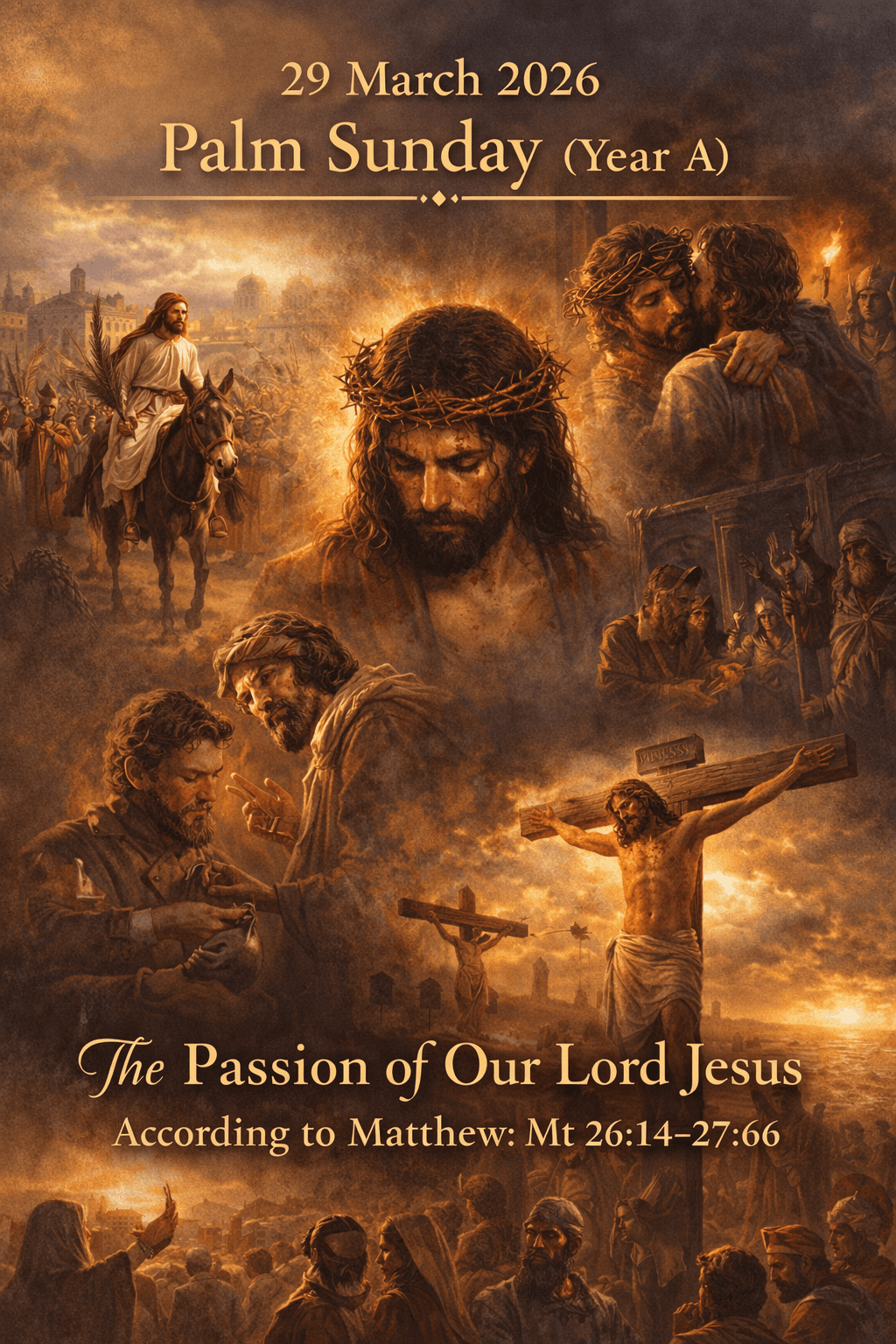
The Passion of the Lord according to Matthew.
Dear Brothers and Sisters in the Lord,
Today we begin the Holy Week with the celebration of the Palm Sunday. Palm Sunday marks Jesus’ triumphal entry into the city of Jerusalem. It was not triumphal in the total sense, because, humanly speaking, at the end of the week, Jesus will be killed. But triumphal in the divine sense, because of the fulfilment of the prophecies of old, about the death and the resurrection of our Saviour. Jesus’ final hour of glory and victory has arrived. Jesus’ glory and victory lay in his self-giving and shedding of blood on the Cross for the salvation of the world. Only Jesus in the history of the world, entered gloriously into his death and would rise also gloriously defeating death and the powers of human wickedness and plotting of power and wealth.
The Passion Narrative in the Gospel of Matthew -
The Passion Narrative in the Gospel of Matthew (Matthew 26:14–27:66) is the dramatic climax of the Gospel, where the mission of Jesus reaches its fulfilment through His suffering, death, and burial. Matthew presents the Passion not merely as a tragic end but as the fulfilment of God’s salvific plan foretold in the Scriptures. Throughout the narrative, Matthew repeatedly highlights how the events of Jesus’ suffering occur “in accordance with the Scriptures.”
In Matthew’s account, Jesus appears as the obedient Son of God and the suffering Messiah who freely accepts the will of the Father. Even in the midst of betrayal, injustice, and humiliation, Jesus remains dignified and faithful to His mission. The evangelist also emphasizes the failure of the disciples, the blindness of the religious authorities, and the irony that those who condemn Jesus unknowingly proclaim His kingship. The Passion narrative therefore invites believers not only to contemplate the suffering of Christ but also to recognize in it the mystery of redemption and divine love.
Matthew’s Passion narrative reveals that the suffering of Jesus is not a defeat but the path to salvation. Every moment—from betrayal to burial—unfolds according to God’s plan. For us the disciples of the Lord, especially during the Holy Week, this narrative invites reflection on the cost of redemption, the depth of Christ’s love, and the call to faithful discipleship even in the face of suffering.
The Outline of the Passion Narrative (Matthew 26:14–27:66)
In the Passion narrative of the Gospel of Matthew (Matthew 26:14–27:66), the events leading to the death of Jesus unfold in a dramatic sequence. The story begins with the betrayal of Jesus by Judas Iscariot (26:14–16), who agrees to hand Him over for thirty pieces of silver. Jesus celebrates the Passover with His disciples (26:17–19) and institutes the Eucharist at the Last Supper (26:20–29), while also predicting the betrayal and Peter the Apostle’s denial (26:30–35). In the Garden of Gethsemane (26:36–46) Jesus prays in anguish but submits to the will of the Father before being arrested (26:47–56). He is then tried before the Jewish authorities and later brought before the Roman governor Pontius Pilate (27:1–14). Though innocent, Jesus is condemned when the crowd chooses Barabbas instead of Him (27:15–26). After being mocked and scourged by the soldiers (27:27–31), Jesus is crucified at Golgotha, (27:32–44) where He suffers and dies (27:45–56). At His death the temple veil is torn, the earth trembles, and a Roman centurion recognizes Him as the Son of God. Finally, the body of Jesus is taken down and buried in the tomb of Joseph of Arimathea (27:57–61), while guards are placed at the tomb, setting the stage for the events of the Resurrection (27:62–66).
Jesus: A Man Condemned to Die on the Cross
Palm Sunday presents Jesus to us as a man condemned to die on the Cross for you and for me. At the same time, it commemorates His solemn entry into Jerusalem, where He was welcomed and proclaimed as King and Messiah. The Church invites us today to contemplate the beginning of the celebration of the Paschal Mystery—the passion, death, and resurrection of Christ. In the Passion narrative, Jesus stands before us as a suffering human person, seemingly abandoned by everyone.
In the Gospel we hear the poignant cry of Jesus on the Cross:
“And about three o’clock Jesus cried with a loud voice, ‘Eli, Eli, lema sabachthani?’ that is, ‘My God, my God, why have you forsaken me?’” (Matthew 27:46; Psalm 22:2). These words reveal the depth of the suffering Jesus experienced. It is the cry of a human heart that feels the weight of abandonment and helplessness. Yet this cry does not mean that God had truly forsaken His beloved Son. Rather, in His humanity Jesus experienced the full burden of suffering caused by the evil plots of the religious leaders and the rejection of those who refused to accept Him. In that painful moment, He entered completely into the depths of human suffering.
“Not What I Want, but What You Want”
The bystanders misunderstood His words and mocked Him, saying, “Let us see whether Elijah will come to save him.” Yet Jesus’ entire life was a prayerful surrender to the will of the Father. In the Garden of Gethsemane, facing the agony of the Cross, He prayed with deep anguish:
“My Father, if it is possible, let this cup pass from me; yet not what I want but what you want” (Matthew 26:39).
And again He prayed:
“My Father, if this cannot pass unless I drink it, your will be done” (Matthew 26:42).
In these moments we see the obedience of the Son of God. Even in the face of suffering and death, Jesus remained faithful to the Father’s plan of salvation. His surrender teaches us that true love is expressed in trust and obedience to God’s will.
The Betrayal and the Denial
The suffering of Jesus was deepened by the betrayal and abandonment of those closest to Him. At the Last Supper, He foretold the betrayal by one of His disciples:
“Truly I tell you, one of you will betray me” (Matthew 26:21).
He also warned that all the disciples would abandon Him that very night:
“I will strike the shepherd, and the sheep of the flock will be scattered” (Matthew 26:31).
Even Peter, the rock on whom the future Church would be built, confidently declared his loyalty: “Though all become deserters because of you, I will never desert you.” But Jesus foretold that before the cock crowed, Peter would deny Him three times (Matthew 26:33–34). In the hour of trial, Jesus stood alone—betrayed by one disciple and denied by another.
The King Who Serves
In the Gospel according to Gospel of John, we find the unique episode of Jesus washing the feet of His disciples (John 13:1–17). Jesus knew that the very disciples whose feet He washed would soon abandon Him. Yet He humbled Himself and served them with love:
“Then he poured water into a basin and began to wash the disciples’ feet” (John 13:5).
Even knowing their weakness, He loved them to the end.
This reveals the true nature of Christ’s kingship. Jesus is a king who surprises us—a humble king whom we are still learning to know, to love, and to contemplate. He is a king who kneels to wash the feet of His disciples. He enters Jerusalem not in a royal chariot but on a donkey, fulfilling the prophecy of Book of Zechariah (Zechariah 9:9). He does not seek earthly glory but seeks to win the hearts of sinners through humility, poverty, and patience. Even as Judas prepares to betray Him and Peter prepares to deny Him, Jesus gives Himself completely in the broken bread and the chalice of the new covenant.
Jesus: The Abandoned King
At Golgotha, Jesus was stripped of His garments and left hanging on the Cross. Here we see a king without a throne, without a sceptre—naked, vulnerable, and seemingly powerless. Yet this is the paradox of the Cross. When Peter tried to defend Him in the garden, Jesus reminded him that God could send legions of angels to protect Him. But Jesus chose instead to fulfil the will of the Father, as the psalmist proclaims:
“Here I am; I have come to do your will” (Psalm 40:7–9).
On the Cross, an inscription declared:
“This is Jesus, the King of the Jews.” Indeed, He is a king—but not the kind of king people expected. His kingship is revealed not in power but in sacrifice.
Points for Personal Reflection
Dear friends, the Palm Sunday readings summarize the whole life and mission of Jesus. Today we move from the joy of welcoming Him with palms to the sorrow of His suffering. We journey from praise to silence, from celebration to the shadow of the Cross. Yet the story is not finished. We must wait until Easter to see the final victory of life over death.
The Cross reveals one of the most profound mysteries of our faith: Jesus shares the abandonment, loneliness, suffering, and death experienced by humanity.
He does not save us by avoiding suffering, but by entering into it and transforming it with His love. In the weakness of the Cross, we discover the greatest power—the power of God’s saving love.
As we begin Holy Week, let us walk with Jesus from the joy of the palms to the silence of the Cross. May we not only acclaim Him with our lips but also follow Him with faithful hearts.
Conclusion
As we celebrate the Passion of Christ on this Palm Sunday, we are invited to examine our own hearts.
1. What attitude do I carry home today?
2. Does the suffering of Jesus truly touch my life?
3. How does the Passion deepen my love and faith in Christ?
Like the Roman centurion who stood at the foot of the Cross and exclaimed, “Truly this man was God’s Son!” (Matthew 27:54), may we also recognize Jesus as our Savior.
Let us welcome Jesus not merely with palm branches but with humble and contrite hearts. Let us raise the spiritual palms of our souls and proclaim with faith:
“Blessed is he who comes in the name of the Lord!”
© 2026 CATHOLIC CONNECT POWERED BY ATCONLINE LLP