
English
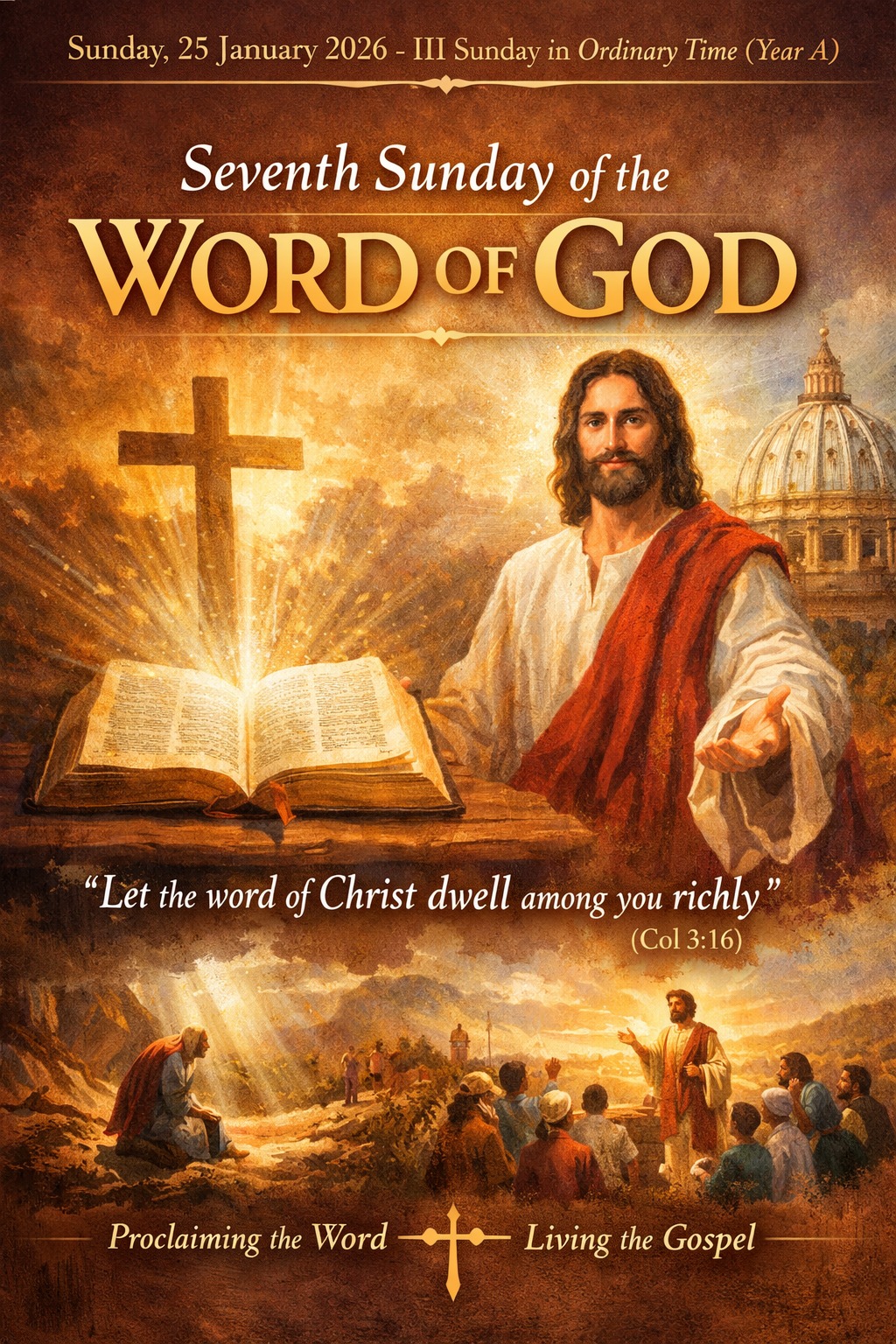
Theme: “The Word of Christ Dwells Among You” (Col 3:16)
Key Verse to Meditate: And He said to them, "Follow Me, and I will make you fishers of men" (Mat 4:19).
My dear brothers and sisters in the Lord,
This Sunday, which is observed as the Seventh Sunday of the Word of God, as instituted by Pope Francis, comes with the theme, “The word of Christ dwells among you” (Col 3:16). It is particularly significant that this year the celebration of the Sunday of the Word of God coincides with the celebration of the Conversion of Saint Paul, the day that concludes the Week of Prayer for Christian Unity. When we say “Let the word of Christ richly dwell within you (Col 3:16) what we mean is that the divine word—the word both about the Messiah and of the Messiah —is a indirect (periphrastic) way of speaking about the living presence of God himself. The Word that Christ addressed to Paul on the road to Damascus struck his heart so deeply that it made him the great evangelizer we know. The Church is called to “hold fast to the word of life.” Today it is up to us to ensure that the same Word reaches the ends of the earth, so as to transform the life of all peoples by dwelling among us.
The Gospel Reading
The Liturgy of the Word on this Third Sunday in Ordinary Time presents the call story of two pairs of brothers: Simon and Andrew, and James and John, the sons of Zebedee. After the arrest of John the Baptist, Jesus begins his mission of preaching and healing. Galilee becomes the locus of Jesus’ ministry of proclamation and healing. Just as John the Baptist proclaimed, Jesus too begins preaching the Good News, saying, “Repent, for the kingdom of heaven has come near” (Mt 4:17). For the evangelist Matthew, drawing imagery from the prophet Isaiah, Jesus indeed becomes the light for the whole region: “The people who walked in darkness have seen a great light; those who lived in a land of deep darkness—on them light has shined” (Is 9:1–2).
Jesus, as the Light of the world, brings God’s presence and forgiveness to people who had never experienced these realities before. He could have chosen to live elsewhere, in more important or prestigious places, but instead he chose to dwell among those who were considered socially inferior and living in sinful conditions. Jesus is indeed our light—a light for our lives and for our souls.
The second part of the Gospel speaks about the vocation of the first disciples of Christ: Simon and Andrew, and the two brothers James and John, the sons of Zebedee. We are at the beginning of Jesus’ ministry, and he begins to gather his future disciples. The call of the first disciples is recorded in all the Synoptic Gospels, though Luke presents a more elaborate account of Peter’s call through the miracle of the great catch of fish (Lk 5:1–11; cf. Mk 1:16–20). It is striking to note the common details in the call stories of these two pairs of brothers. Jesus calls them, and without any opposition or hesitation, they leave everything and follow him. They were fishermen, and since Jesus lived near the shores of Galilee, it was fitting that he called these fishermen with the invitation: “Follow me, and I will make you fish for people” (Mt 4:19).
We often wonder about their immediate response—without compromise, without too many questions—and their sudden abandonment of their work to follow Jesus. Perhaps the key to understanding this lies in Jesus’ preaching. It was the Word of God proclaimed by Jesus that attracted these men. Their following of Jesus was a direct response to his preaching: “Repent, for the kingdom of heaven has come near.” They were deeply moved by both the person and the message of Christ. There was something profoundly inspiring and compelling about Jesus and his call to these seemingly insignificant fishermen. Though they would later fail Jesus, they would never lack the experience of living with him—listening to his preaching and witnessing his miracles.
Their call involved a total change of life, a total change of profession, and a total reorientation of their purpose. It was a convinced response that resulted in decisive action: leaving everything to follow him immediately and unconditionally (Lk 5:11. The fishermen of Galilee understood that the kingdom of God was not merely near but present before them in the person of Jesus. Therefore, their resolute response was fully justified. In time, the disciples would realise that Jesus called them to preach and continue his mission. St. Paul, too, was deeply convinced of this immense task of proclaiming the Word of God, as we hear in today’s second reading: “For Christ did not send me to baptize but to proclaim the gospel, and not with eloquent wisdom, so that the cross of Christ might not be emptied of its power” (1 Cor 1:17).
Reflection on the Theme of The Sunday of the Word of God
Saint Paul’s exhortation to the Colossians, ‘Let the word of Christ dwell among you richly’ (Col 3:16), is the theme of this year’s Sunday of the Word of God. This invitation is not a mere moral appeal to read the Bible more often. It is an invitation to a new way of Christian existence. Paul does not ask us simply to listen to the Word, nor merely to study it, but to allow it to dwell, to take up residence within us, shaping our thoughts, purifying our desires, and transforming our lives into a credible witness of Christ.
To let the Word dwell means to allow Christ himself to live and speak in us. As the Second Vatican Council teaches, “In the sacred books, the Father who is in heaven meets his children with great love and speaks with them” (DV, 21). The Word of God is not information about God; it is God communicating himself. Every authentic renewal of the Church, therefore, is born from docile and loving listening to this living Word. In a society of noise, silence is a prophecy; it is a prophecy of the future world. When we create silence, God creates us. In our times, we need to imitate Mary in order to resist the dictatorship of noise. Thus, silence becomes the womb of the Word of God (cf. Jn 1:14). Mary's example of the silent reception of God’s Word enables the Church better to appreciate the value of silence.
The Primacy of the Word of God
The Church today is called anew to rediscover the primacy of the Word of God. Vatican II reminds us that “the Church has always venerated the divine Scriptures as she venerated the Body of the Lord” (DV, 21). The Word nourishes faith just as the Eucharist nourishes life. Without the Word, Christian life becomes fragile, scattered, and inconsistent. Jesus himself tells us that what fills the heart inevitably shapes life: “From the fullness of the heart the mouth speaks” (Mt 12:34).
Proclamation of the Word of God and Mission
Proclamation of the word of God flows from the contemplation of it. Only a heart inhabited by the Word like that of the blessed virgin Mary can become a missionary heart. Pope Francis echoes this truth when he insists that “the Word of God is not a beautiful collection of books, but a living word that calls, questions, and sends us” (Aperuit Illis, 4). A Church that listens is a Church that evangelizes; a Church that neglects the Word loses its soul. The Word that dwells among us must become the Word proclaimed through us. In this proclamation, God accompanies us as Jesus’ final promise seals this truth forever: “I am with you always, until the end of the age” (Mt 28:20). The Word of God is a promise in which the Promiser never withdraws.
The Word That Converts and Unites
It is deeply symbolic that the Sunday of the Word of God coincides with the Conversion of Saint Paul and the conclusion of the Week of Prayer for Christian Unity. The Word spoken by Christ on the road to Damascus struck Paul’s heart so powerfully that it transformed him into an apostle to the nations. The same Word continues to be spoken today, capable of converting hearts and building unity among believers. As Jesus promised: “You will be my witnesses to the ends of the earth” (Acts 1:8), we too shall become ministers of the Word, if we let the word of Gid dwell amidst us richly.
The Word as the Source of Hope
Perhaps no one understood the power of God’s Word better than the Roman centurion who said, “Only say the word, and my servant will be healed” (Mt 8:8). One word from Christ was enough to awaken unshakable hope. Likewise, Peter’s confession—“Lord, to whom shall we go? You have the words of eternal life” (Jn 6:68)—reveals that hope is not anchored in ideas, but in a person. Pope Benedict XVI helps us understand this profoundly when he writes that Christian hope is not optimism about the future but trust in a presence (Spe Salvi, 2). The Word of God gives hope because it is always bound to the One who speaks it. Christ does not merely promise something; he promises himself. Christ is our only hope and the Word cannot be separated from Christ himself.
The Word Made Flesh and Present
The ultimate foundation of our hope is the mystery of the Incarnation: “The Word became flesh and made his dwelling among us” (Jn 1:14). From creation—where God creates by speaking—to the Cross—where the Word gives himself in silence—God’s Word is inseparable from his presence. As the Psalmist cries, “If you are silent, I shall be like those who go down to the pit” (Ps 28:1). Humanity lives because God continues to speak.
He Who Has Ears, Let Him Hear
The Christian life is fundamentally shaped by the Word of God, not merely as text, but as the living voice of God speaking into human history. Hebrews 4:12 reminds us, “The word of God is living and active, sharper than any two-edged sword…” This Word is not a static message, but a dynamic encounter — and it demands a response, primarily through hearing.
In both Old and New Testaments, the command to hear God’s word is central. “Hear, O Israel: The Lord is our God, the Lord alone…” (Deuteronomy 6:4). This command (Shema Yisrael) becomes the spiritual foundation of the people of God. In the New Covenant, this listening becomes even more personal: “This is my beloved Son; listen to Him!” (Mark 9:7).
Faith Comes from Hearing: Romans 10:17 says, “So faith comes from hearing, and hearing through the word of Christ.” This underscores the sacramental nature of hearing in the New Testament. Salvation enters the human heart not first by seeing, touching, or even reading — but by hearing. Hearing is the gateway of faith.
A Church That Lives by Listening
As we celebrate the word of God Sunday, the universal Church is called to respond to his God ever speaks in and through His words is the gift and the art of listening. Dear brothers and sisters, we can survive without listening to the Word, but we cannot truly live. A life not shaped by the Word of God becomes fragmented, anxious, and empty. But a life that listens becomes communion, friendship, and hope (Lk 1:38).
Takeaway Lessons from Today’s Liturgy
From the Liturgy of Today
At the heart of discipleship is an encounter with Jesus—an encounter that is life-changing and often initiated by Jesus himself. This encounter frequently culminates in a person leaving everything behind and following Jesus. In other words, an encounter with Jesus that leads to discipleship implies losing one’s old life and beginning to live a holy life for a holy God.
Such an encounter also means that one’s life is re-oriented from the many things, desires, and wishes that preceded the encounter to Jesus himself. Discipleship, therefore, requires a wholehearted and single-minded response to the invitation of Jesus and a radical style of life that places Jesus at the very center of one’s being.
From Today’s Celebration of the Sunday of the Word of God
For us, the faithful of God, the Word listened to with faith is a source of spiritual life, nourishment for prayer, and light to discern God’s will in the events of daily life. As Pope Francis reminds us, “The Bible is not meant to gather dust on our shelves, but to challenge us daily” (Aperuit Illis, 3).
The Lord stands at the door of our freedom and knocks (cf. Rev 3:20). If we allow his Word to dwell within us, the Spirit will generate new life in us and among us-a life rooted not in passing certainties, but in the abiding presence of Christ himself.
Saint Gregory the Great teaches that when a person allows himself to be transformed by Scripture, he himself becomes Scripture for others. With the Sacred Scriptures daily in hand, we welcome the Word as Mary did and ponder it in our hearts, so that it may bear fruit and be proclaimed with zeal.
Secondly, the Word of God refers primarily to the power of God himself at work in transforming individuals and communities. Saint Paul’s “theology of the Word” speaks of a life-transforming energy that immediately gives rise to a new community, not merely new ideas. Paul believed in the personal presence and power of the one true God being unleashed through the Gospel and through its work in the radical transformation of human lives.
May this Word transform us from deep within. May the Word of Christ dwell richly among us, so that our lives may become a living Gospel for the world-Amen.
Personal Questions for Reflection on the Sunday of the Word of God
As we celebrate the Sunday of the Word of God, I need to ask myself:
1.Faith in the Word of God: What impact does it have on my personal life and vocation?
2.Prayer and Scripture: Have I prayed with and read the Bible sufficiently today?
3.Encounter with Christ: Have I discovered Jesus in the Scriptures?
© 2026 CATHOLIC CONNECT POWERED BY ATCONLINE LLP