
English
Key Verse to meditate: Then Joseph got up, took the child and his mother by night, and went to Egypt (Mt 2:14).
Dear Brothers and Sisters in the Lord,
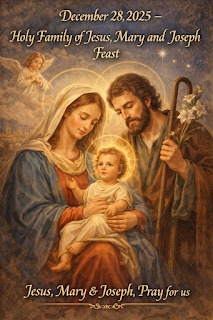
Today, we celebrate the Feast of the Holy Family, which consists of Mary, Joseph, and their holy child, Jesus. We can still picture the Holy Family through the eyes of the shepherds of Bethlehem, who, upon receiving the angel’s announcement, hurried to the manger and found “Mary and Joseph and the child lying in the manger” (Lk 2:16). The first witnesses of Christ’s birth encountered not only the Child Jesus but also a small family: mother, father, and newborn son.
God chose to be born and grow up within a human family, placing His Son in the family of Nazareth. The family of Jesus truly deserves the title “Holy Family” because it was completely committed to fulfilling God’s will. Like all families, it faced trials and challenges. We remember the “Massacre of the Innocents,” which forced Joseph and Mary to flee to Egypt (Mt 2:13-23). Yet, trusting in divine providence, they secured stability for Jesus, ensuring a peaceful childhood and a solid moral and spiritual education. As the Gospel tells us: “The child grew and became strong, filled with wisdom; and the Favor of God was upon him” (Lk 2:40). Jesus grows in wisdom, stature, and favour—a fourfold description echoing Samuel (cf. 1 Sam 2:26). In this verse, we see that the evangelist Luke safeguards both Jesus’ divinity and humanity; awareness of his mission does not negate ordinary human growth. Indeed, Mother Mary and Saint Joseph played a pivotal role in the education and formation of the God-child.
The Gospel Reading
Today’s Gospel recounts the angel’s warning to Joseph to leave for Egypt because Herod sought to kill the newborn child (Mt 2:13-15). Like Pharaoh in the Old Testament, who tried to kill Moses (Ex 2:15; 1:22), Herod reacted violently to the Magi’s non-cooperation and sought to destroy the child (Mt 2:16-18).
An angel once again appears to Joseph in a dream, instructing him to take Mary and Jesus to Egypt. Joseph is the silent believer, the only active figure in this episode, guiding and protecting both Mary and Jesus. As Matthew emphasizes, Joseph obeys the angel’s command completely: “He rose, took the child and his mother by night, and went to Egypt; and he remained there until the death of Herod” (Mt 2:14,19). Fleeing to an unknown land in the middle of the night was dangerous, yet Joseph’s faith and obedience ensured the safety of his family.
Even as a baby, Jesus faced threats to His life, echoing the story of Moses. Egypt served as a refuge for those seeking asylum in the Old Testament (1 Kgs 11:40; 2 Kgs 25:26; Jer 43:1–7). The flight of the Holy Family fulfills the prophecy: “Out of Egypt I called my son” (Hos 11:1). This emphasizes Jesus’ role as the Messiah and King. The title “Son” also aligns with messianic references in scripture, where Jewish kings were often called sons (2 Sam 7:14; 1 Chr 17:13; Ps 2:7; 89:26–27).
As the obedient Israelite, Jesus rightfully deserves to be called the “Son of God” (Exod 4:22-23). Herod’s massacre of the innocents fulfills the prophecy in Jeremiah 31:15, symbolizing Rachel mourning for the lost children of Israel. These innocent children, martyred because of Herod’s fear, are in fact the first martyrs for Christ. Their lives were in God, and God rescued them from the violence of the world.
Herod’s actions also reflect the destructive power of fear—the fear of losing power, being betrayed, or being overthrown. In our own lives, fear can lead to anxiety, anger, resentment, or even harm toward others. Jesus came to redeem us from such fear and to make us courageous children of God. Sin and fear can rule our senses, but through Christ, we are freed. May the celebration of the Savior’s birth remove every form of fear from our lives, filling us instead with joy and love.
Joseph: The Forgotten Hero
In today’s Gospel, Matthew focuses on Joseph, the righteous man and obedient servant, who carries the mission while Mary carries the mystery. God speaks to Joseph through dreams. The power of dreams in the episodes connected with Joseph lies in the fact that they are God’s secret strategy—intimate channels through which Joseph receives angelic commands.
Joseph in Matthew’s Gospel closely mirrors Joseph in the Book of Genesis—the dreamer who saved his family by bringing them to Egypt (Gen 37–47). Through these dreams, we witness the privacy of divine guidance: dreams are deeply personal and demand absolute faith and trust. Joseph’s obedience to God’s private voice becomes instrumental in safeguarding the Messiah.
The Flight into Egypt
In the episode of the Flight into Egypt, we see Jesus as the New Israel. In Israel’s earlier history, Egypt was the place of both slavery and liberation; therefore, it was not a random destination. By going to Egypt, Jesus re-enacts and perfects Israel’s story. He is the true Son called out of Egypt (Hos 11:1). The subsequent movement back to Nazareth, again directed through a dream, diverts the Holy Family to Galilee—a place of obscurity and even contempt. Returning to Nazareth fulfils the prophecy: “He shall be called a Nazarene.”
Joseph the Dreamer
The Gospel presentation of Joseph during this Advent season offers him as a model of listening, protection, and faithful obedience. He is a dreamer to whom God’s plans are revealed, and he becomes a striking example of a man who listens attentively to God and acts promptly, even when doing so challenges his own comfort and personal plans.
In Matthew 1:24 we read: “When Joseph awoke from sleep, he did as the angel of the Lord commanded him; he took Mary as his wife.” Again, when the angel of the Lord appeared to him in a dream, instructing him to take the child and his mother and flee to Egypt, we read in Matthew 2:14: “Then Joseph got up, took the child and his mother by night, and went to Egypt.” After the death of Herod, when the angel of the Lord appeared to him once more in a dream and asked him to return to the land of Israel, Matthew 2:21 records: “Then Joseph got up, took the child and his mother, and went to the land of Israel.”
Dear friends, Saint Joseph’s life teaches us that obedience in ordinary and unseen moments becomes a powerful channel through which God’s plan unfolds. His life stands as a silent yet profound witness to divine providence. His actions reveal total surrender to God’s will, reminding us that hope often works through humility, discretion, and quiet faithfulness. Above all, Joseph emerges as a perfect model of courageous trust. He steps into the unknown, confident that God accompanies him even through dark and uncertain moments. His life teaches us to embrace God’s plan, even when the path ahead is unclear.
Points for Reflection
1) Obedience and Faith: Joseph and Mary show us the importance of trusting God’s will and obeying His commands, even when circumstances are difficult or uncertain.
2) Courage in Trials: The Holy Family faced danger, exile, and uncertainty, yet remained faithful. Our families, too, face trials, and God calls us to trust Him in every situation.
3) Family as a School of Virtue: The Holy Family is a model for all families. Parents are called to nurture their children in faith and virtue, and children are called to honour and respect their parents (Sir 3:12).
4) Fear vs. Trust: Like Herod, fear can lead to destructive behaviour. Jesus invites us to live courageously in God’s love, free from fear and anxiety.
Conclusion
As we celebrate the Feast of the Holy Family, we are invited to imitate their example. Are we, as parents, obedient to God and committed to the spiritual growth of our children? Are we, as children, honouring and caring for our parents, especially in their old age or sickness? Every Christian family can reflect the Holy Family of Nazareth when love, obedience, and faith guide our lives.
St. John reminds us that we are all God’s children now (1 Jn 3:1-2). If we truly live this reality, every Christian home can become a miniature Holy Family on earth—a place of love, faith, courage, and witness to God’s plan.
© 2026 CATHOLIC CONNECT POWERED BY ATCONLINE LLP