
English
Key Verse to Meditate: “For whoever does the will of my Father in heaven is my brother and sister and mother” (Mt 12:50).
Dear Brothers and Sisters in the Lord,
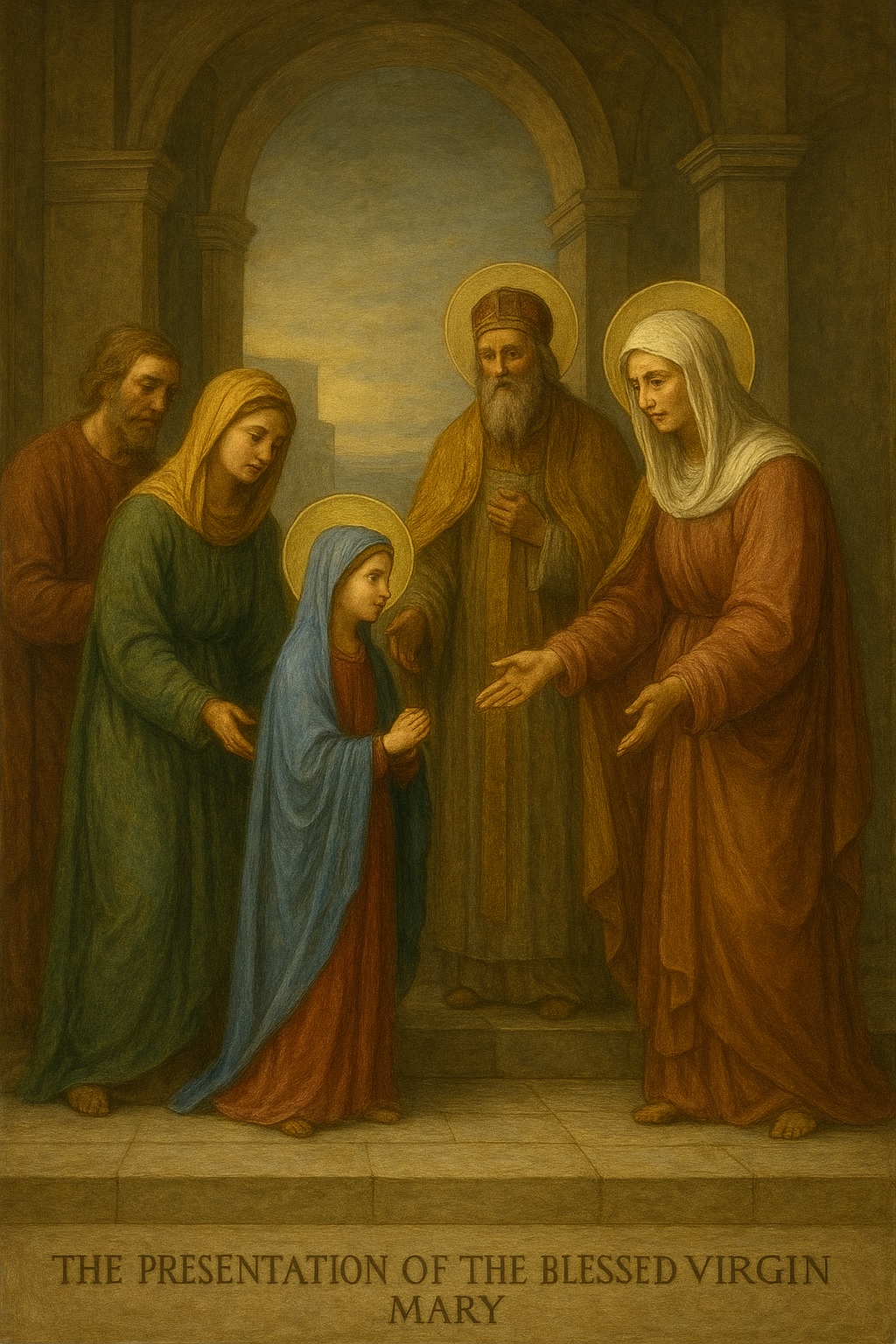
Today, the Church celebrates the memory of the Presentation of the Blessed Virgin Mary in the Temple. Although this feast has no direct biblical basis in the Gospels, tradition traces its origin to the apocryphal Protoevangelium of James. The feast also commemorates the dedication of the Basilica of Saint Mary the New, built in 543 by the Byzantines under Emperor Justinian I near the site of the ruined Temple in Jerusalem, which was later destroyed by the Persians. In the Eastern Rite, this feast is known as “The Entry of the Most Holy Theotokos into the Temple.”
Mary’s presentation in the Temple symbolizes her total dedication to God. Her parents, Joachim and Anne, who had been childless, fulfilled a vow by offering their daughter to the Lord in thanksgiving for His favour. Tradition holds that Mary, as a little girl of about three, was presented in the Temple and remained there—likely until the age of twelve—to receive instruction in the Torah. Though these details are not found in Scripture, they have profoundly influenced the Church, inspiring religious communities and the faithful to offer themselves wholly to God, following the example of Mary, who would later receive the Annunciation. Through this offering, Mary was being prepared to become the Temple of the Holy Spirit and the Ark of the Covenant, receiving God into her heart and life with purity and obedience. This feast, celebrated near the beginning of the Advent season, gently prepares the Church to enter into the spirit of Advent and the joyful anticipation of Christmas—the celebration of the coming of our Lord, Jesus Christ.
The True Family of Jesus
All the Synoptic Gospels speak about the true kindred of Jesus (Mt 12:46-50; Mk 3:31-35; Lk 8:19-21). Matthew intentionally uses phrases such as “his mother,” “your mother,” and “my mother” to emphasize to his audience that the one approaching Jesus is indeed his own mother, Mary. Through these words, he highlights the profound distinction between biological ties and the deeper spiritual kinship that Jesus establishes with those who do the will of God.
In today’s Gospel passage from Matthew, we encounter a moment when Jesus’ mother and brothers came to speak with Him. Yet, the crowd surrounding Him made it difficult for them to reach Him, reminding us that sometimes the presence of others or the busyness of life can obscure our encounter with Christ. When informed, Jesus asked, “Who is my mother, and who are my brothers?” Then, pointing to His disciples, He said, “Here are my mother and my brothers! For whoever does the will of my Father in heaven is my brother and sister and mother” (Mt 12:49b–50). Jesus teaches us that our true kinship with Him is not defined by blood but by obedience to God’s will. By listening to and acting upon God’s Word, we enter the family of Christ—just as Mary did. She is the perfect model of someone who not only listened to God’s Word but also lived in complete conformity with His will.
We read in Acts, “All these devoted themselves with one accord to prayer, together with certain women, including Mary the mother of Jesus, and with His brothers” (Acts 1:14). Mary’s role was central not only in the infancy narratives but throughout Jesus’ ministry. While His brothers and sisters shared His family life, they did not share His unique relationship with God the Father, nor was Joseph mentioned here, reserving the role of father solely for God (cf. Mt 23:9). In the Kingdom of God, however, all who do the Father’s will become true members of Jesus’ family.
Doing the Will of God
The core message of today’s Gospel is that those who do God’s will are “everything” to Jesus: “Here are my mother and my brothers! For whoever does the will of my Father in heaven is my brother and sister and mother” (Mt 12:49–50). To do God’s will means prioritizing His plan over our family, possessions, or personal desires. Jesus, even as a child in the Temple, emphasized His commitment to the Father: “Did you not know that I must be in my Father’s house?” (Lk 2:49). He later affirmed, “Whoever loves father or mother more than me is not worthy of me” (Mt 10:37), underscoring that obedience to God transcends all else.
Jesus’ mission was entirely aligned with the Father’s will:
Obedient Disciple
Through obedience and discipleship, we too can become members of Christ’s family. One may even become “mother” to Christ by fostering His presence in the hearts of others. At the foot of the Cross, Jesus entrusted Mary to St. John: “Woman, here is your son… Here is your mother” (Jn 19:26–27). In this way, we share in Mary’s maternal role by embracing and guiding others in faith.
Points for Personal Reflection:
Conclusion
Mary exemplified what St. Paul later described as the ideal of Christian life: “I appeal to you therefore, brothers and sisters, by the mercies of God, to present your bodies as a living sacrifice, holy and acceptable to God, which is your spiritual worship” (Rom 12:1). Though the offering of the child Mary is not historically documented, her presentation, followed by her “yes” at the Annunciation and her fidelity at Calvary, shows us a life completely surrendered to the grace and the Holy Spirit of God.
On this feast of the Presentation of the Blessed Virgin Mary, we are invited to imitate her total dedication and obedience to God. Just as she became the dwelling place of the Holy Spirit and the model of discipleship, we too are called to offer our lives completely to God. By listening, obeying, and sharing Christ with others, we enter His family and participate in His redemptive mission. May Mary inspire us to say “yes” to God’s will daily, so that we, like her, may become instruments of God’s love in the world.
© 2026 CATHOLIC CONNECT POWERED BY ATCONLINE LLP