
English
Mass Readings -
Ezekiel 37:12-14, Psalm 130, Romans 8:8-11, John 11:1-45
Key Verse to Meditate-
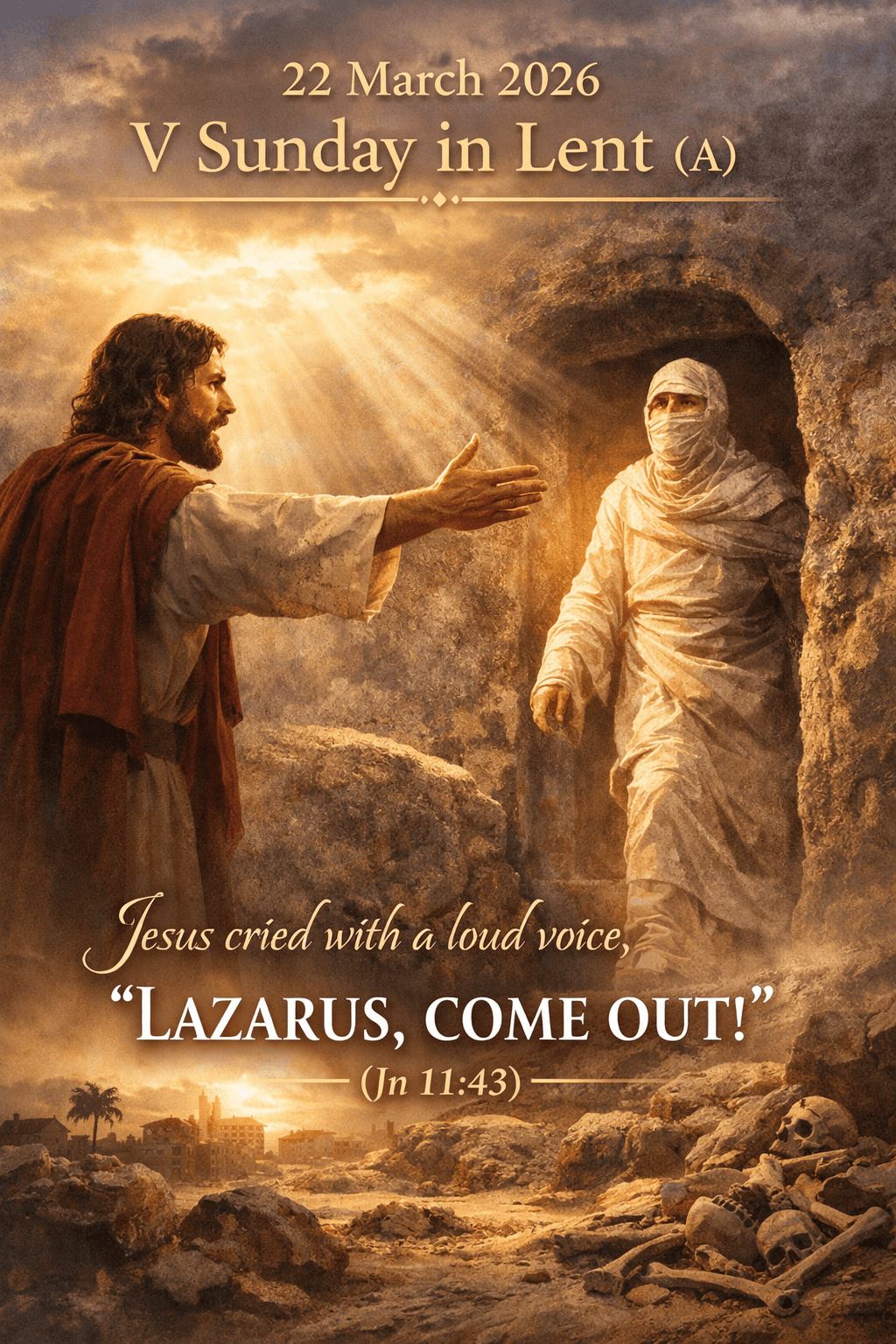
When he had said this, he cried with a loud voice, "Lazarus, come out!" (John 11:43).
Dear Brothers and Sisters in the Lord,
The fifth Sunday in Lent, the Word of God invites us to move from the life of the flesh to the life of the Spirit. The three readings remind us that God is the Lord of life. He opens the graves of despair, calls us out of the tomb of sin, and fills us with His Spirit. During this season of Lent, we are invited to hear the voice of Christ calling us, just as he called Lazarus, to leave behind the darkness of sin and rise to a new life of grace in Him. Today’s Gospel beautifully connects with the first reading from Ezekiel, where God promises the exiled people:
“I will open your graves and bring you up from your graves, O my people” (Ezekiel 37:12–14).
What God promised through the prophet becomes visible in the action of Jesus, who calls Lazarus out of the tomb.
The First Reading – Ezekiel and the Vision of Dry Bones
The first reading is taken from the prophet Ezekiel, whose name means “God strengthens” (Ezekiel 1:3; 24:24). He stands among the great prophets of Israel, alongside Isaiah and Jeremiah, and in the prophetic tradition of Elijah and Elisha. Ezekiel continues the prophetic mission after Jeremiah and inherits a rich legacy of classical prophecy. He was a prophet of the exilic period (593–570 BCE) and ministered during one of the darkest and most decisive moments in Israel’s history, particularly during the reign of King Jehoiachin (2 Kings 24:14). The catastrophic event that shaped his ministry was the fall of Jerusalem in 587 BCE, when the people of Judah were taken into exile in Babylon.
Part of today’s reading comes from the famous vision of the valley of dry bones (Ezekiel 37), which speaks powerfully about the restoration of the people of Israel after the exile. In Ezekiel 37:1–14, the prophet sees a vision of lifeless bones scattered across a valley. God gathers the bones together, binds them with sinews, covers them with flesh and skin, and finally breathes His spirit into them so that they come back to life. This vision is not primarily about personal resurrection but about the national restoration and revival of Israel, a people who felt completely destroyed and without hope. The following verses (Ezekiel 37:15–28) speak about the reunion of the northern and southern kingdoms, showing that in God’s plan Israel and Judah will once again become one people (37:15–22).
In the interpretation of the vision (vv.11–14), the bones represent the house of Israel. The people cry out in despair with a triple lament:
“Our bones are dried up, our hope is lost, and we are cut off completely” (v.11).
God responds to each of these cries with a promise of hope:
1. “Our bones are dry” — “I will open your graves” (v.12).
2. “Our hope is gone” — “I will raise you from your graves” (v.13).
3. “We are done for” — “I will bring you back to your land and put my Spirit within you” (v.14).
The phrase “I will raise you up” in verse 12 literally means “I will make you go up.” This expression echoes the language of the Exodus, where God leads His people up from Egypt to the Promised Land (Exodus 1:10; 13:18). Thus, the prophet announces a New Exodus (cf. Ezekiel 20:32–34). The life-giving spirit mentioned in verse 14 is the Spirit of the Lord Himself (cf. Ezekiel 36:27), pointing toward the promise of a New Covenant, similar to what the prophet Jeremiah proclaims in Jeremiah 31:31–34, though expressed in different words.
The Second Reading – Life in the Spirit (Romans 8:8–11)
In the second reading, St. Paul, writing to the Romans, reminds the Christian community that “those who are in the flesh cannot please God” (Romans 8:8). Here the word flesh does not simply refer to the human body but to a way of life dominated by selfishness and self-centred desires. It describes those whose lives are guided by their fallen human nature, whose ambitions and decisions revolve only around themselves. Such a life ultimately leads away from God and ends in spiritual destruction. Those who allow their lives to be ruled by this fallen nature become hostile to God and resistant to His will (cf. Romans 12:2; 14:18; 1 Corinthians 7:32; 2 Corinthians 5:9; Ephesians 5:10; Colossians 3:20).
However, St. Paul reminds the Roman Christians that their lives are not meant to be governed by the flesh but by the Spirit of God. Through faith in Christ, justification, and baptism, they have entered into a new way of life. They no longer belong to the realm of the flesh but to the realm of the Spirit (cf. 1 Corinthians 3:16). Paul strongly emphasizes that belonging to Christ necessarily means possessing the Spirit, because every Christian is indwelt by the Spirit of God.
Paul then speaks about the indwelling presence of the Spirit and of Christ. After stating that the Spirit dwells within believers (v.9), he goes on to say that Christ himself is in them (v.10). This shows the deep connection between Christ and the Spirit. In fact, Paul closely identifies the Spirit with the risen and glorified Christ (cf. Romans 8:9; 2 Corinthians 3:17). Through the indwelling of the Spirit, Christ himself lives within believers. Thus, the presence of the Spirit is the way in which Christ continues to dwell in the hearts of his followers.
In verse 11, Paul addresses an important question. Even though Christ dwells in believers through the Spirit, they still experience physical death because of the reality of sin in the world. Yet Paul offers a powerful assurance of hope:
“If the Spirit of Him who raised Jesus from the dead dwells in you, He who raised Christ Jesus from the dead will also give life to your mortal bodies through His Spirit who dwells in you” (Romans 8:11).
The Spirit who raised Jesus from the dead now lives in believers and becomes the guarantee of their future resurrection. In this way, Paul highlights the close connection between the resurrection of Christ and the resurrection of Christians (cf. 1 Corinthians 6:14; 15:20, 23; 2 Corinthians 4:14; Philippians 3:21; 1 Thessalonians 4:14). Christ was raised as the head of a new humanity, and those who belong to him will also share in his resurrection. What Ezekiel proclaimed as a prophetic vision becomes a visible reality in the action of Christ, and St. Paul assures us that the same life-giving Spirit that raised Jesus will also raise us.
The Gospel – The Raising of Lazarus (John 11:1–45)
The Gospel passage presents the powerful story of the raising of Lazarus, one of the great “signs” narrated by St. John. Through these signs, John reveals the true identity of Jesus. In this event, Jesus is shown as the victor over death, and the narrative reaches its climax when Jesus declares:
“I am the resurrection and the life. Whoever believes in me, even though he dies, will live; and everyone who lives and believes in me will never die” (John 11:25–26).
The belief that God has power over death already appears in the later writings of the Old Testament. In the first reading of today, we see how prophet Ezekiel speaks of the vision of the dry bones, symbolizing the restoration of Israel after the catastrophe of exile (Ezekiel 37:1–14). Isaiah proclaims that God will one day destroy death forever and wipe away the tears from every face (Isaiah 25:8). The Book of Daniel also announces that many who sleep in the dust of the earth shall awake, some to everlasting life and others to shame (Daniel 12:2). Yet the Gospel goes beyond these future hopes. In Jesus, the resurrection is not only a promise for the future but a present reality, because He himself is “the resurrection and the life” (John 11:25). Whoever believes in Him already shares in the life that death cannot destroy.
Lazarus as the Image of the Sinner would stay in their home. The evangelist tells us that the sisters sent word to Jesus: “Lord, he whom you love is ill.” Surprisingly, Jesus does not go immediately but remains where he is for two more days. As Easter approaches, the Church invites us to meditate on this great sign, which also foreshadows the resurrection of Jesus himself. The Gospel tells us that Lazarus of Bethany, the brother of Martha and Mary, was seriously ill. Jesus loved this family dearly, and whenever he was in Jerusalem he days. He explains that the illness will not end in death but will serve to reveal the glory of God, so that through it the Son of God may be glorified.
After this delay, Jesus decides to return to Judea. The disciples are concerned because the authorities had recently tried to stone him, but Jesus replies that he must accomplish the work entrusted to him by the Father while there is still time. He then tells them:
“Our friend Lazarus has fallen asleep, but I am going to awaken him” (John 11:11).
When the disciples misunderstand his words, Jesus speaks plainly: “Lazarus is dead; and for your sake I am glad I was not there, so that you may believe. But let us go to him.” Many of the Church Fathers saw Lazarus as a symbol of the human person trapped in sin. John Chrysostom preached that Jesus delayed his coming so that the miracle would be unmistakable: “He allowed death to come, so that the resurrection might be more clearly seen.” In another reflection, St. Augustine interpreted the four days Lazarus spent in the tomb as a symbol of how sin can become deeply rooted in human life. Yet even when Lazarus had already begun to decay, the voice of Christ still reached him. No matter how long we have remained in spiritual darkness, the call of Christ can still bring us back to life.
Faith before the Miracle
When Jesus arrives at Bethany, Lazarus has already been in the tomb for four days. Martha goes out to meet him and says with deep faith and sorrow: “Lord, if you had been here, my brother would not have died. But even now I know that whatever you ask of God, God will give you.” Martha expresses her belief in the future resurrection of the dead. Jesus then leads her to a deeper understanding by revealing his identity:
“I am the resurrection and the life” (John 11:25).
Jesus spoke these words to Martha before raising Lazarus from the dead, promising that those who believe in him will live even if they die. When he asks, “Do you believe this?” Martha makes a profound confession of faith:
“Yes, Lord, I believe that you are the Christ, the Son of God, the one who is coming into the world” (John 11:27).
Benedict XVI reflected in a Lenten Angelus message: “Jesus does not simply give life; He himself is the Resurrection and the Life.” The miracle is not only about Lazarus. It is about revealing who Jesus truly is. Faith in Christ already gives us a share in eternal life.
The Tears of Jesus: God’s Compassion for Human Suffering
Soon Mary also comes to Jesus and falls at his feet weeping: “Lord, if you had been here, my brother would not have died.” Seeing her sorrow and the grief of the crowd, Jesus is deeply moved and bursts into tears: Jesus Wept (John 11:35). This is the shortest verse in the Bible. This touching moment shows the humanity of Jesus. He shares in the pain of those who mourn, and his tears reveal the depth of his love for Lazarus. Those present remark: “See how he loved him!”
One of the most touching moments in the Gospel is the short but profound verse: “Jesus wept” (John 11:35). Augustine of Hippo reflected on this scene in his sermons: “Jesus wept as a man, but raised Lazarus as God.”
St. Augustine explains that the tears of Jesus reveal his true humanity. Christ is not distant from our suffering; he shares in our pain and sorrow. Yet the same Jesus who weeps also commands death itself. For Lent, this reminds us that Christ enters into the sorrow of our broken lives. He sees our struggles, our sins, and our fears—but he does not leave us there. His compassion always leads toward new life.
“Lazarus, Come Out!” – The Voice that Breaks the Tomb
Still deeply moved, Jesus goes to the tomb and asks that the stone be removed. Looking up to heaven, he prays to the Father, giving thanks for being heard. His prayer is spoken aloud so that those around him may believe that he has been sent by the Father. Then Jesus cries out in a loud voice: “Lazarus, come out!” The dead man comes out, his hands and feet bound with burial cloths and his face wrapped in a cloth. Lazarus, who had been dead and buried, emerges from the tomb, and this miracle becomes a sign that points toward the resurrection of Jesus himself.
Points for Personal reflection
The Gospel of the raising of Lazarus (John 11:1–45) is one of the most powerful passages for reflection during Lent, because it reveals Jesus as the Lord of life, the one who calls humanity out of the tomb of sin and death. The Church Fathers and recent Popes have often meditated on this miracle as a symbol of spiritual resurrection.
The raising of Lazarus speaks directly to our Lenten journey.
1. Like the dry bones in Ezekiel, our faith can sometimes become lifeless.
2. Like Lazarus in the tomb, we may feel trapped in sin, discouragement, or spiritual fatigue.
3. But like the Romans in Paul’s letter, we are reminded that the Spirit who raised Jesus from the dead lives in us (Romans 8:11).
Pope Francis once explained in a homily that Lazarus represents every person who feels spiritually dead: “Sometimes our life resembles a tomb: everything is dark, and around us there is only sadness. But Christ’s voice calls us out.”
Lent is therefore the time when we allow Christ to stand before the tomb of our hearts and call us by name: “Come out!” Just as God breathes life into the dry bones in Ezekiel, Jesus now calls Lazarus out of the grave. His voice invites us to leave behind sin, despair, and indifference, and to walk again in the new life of grace that leads us toward the joy of Easter.
Conclusion
Like the dry bones in Ezekiel’s vision and like Lazarus in the tomb, our hearts can sometimes become lifeless because of sin, discouragement, or spiritual indifference. Yet God’s Spirit can breathe new life into us, and the voice of Christ continues to call us out of the tombs of sin so that we may rise and walk in the new life of grace. Just as the Lord brought life to the dry bones and called Lazarus out of the tomb, He can also raise us from the graves of sin, despair, and spiritual death. When we listen to His voice and allow His Spirit to enter our lives, we too experience the new life that God alone can give.
© 2026 CATHOLIC CONNECT POWERED BY ATCONLINE LLP