
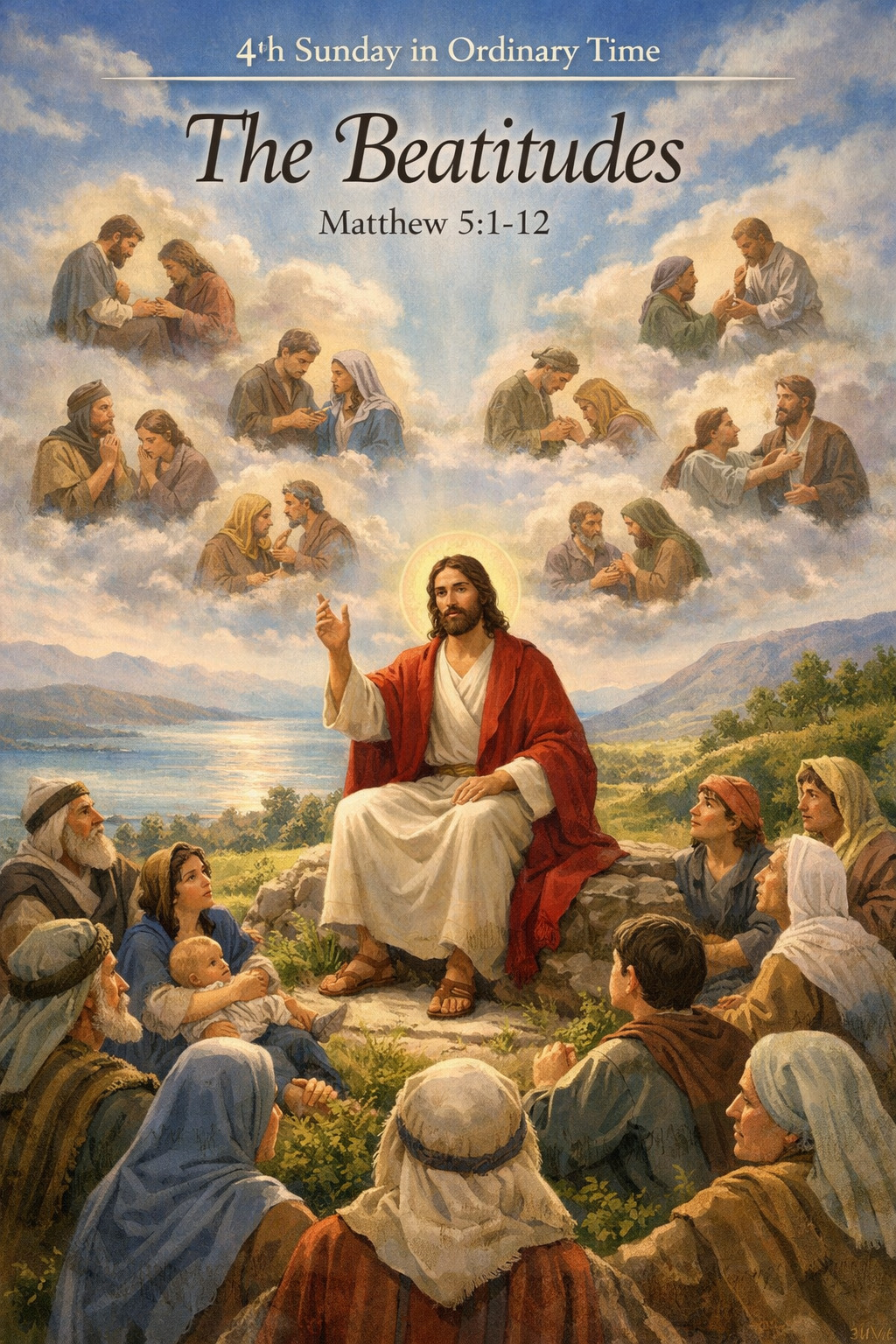
Zeph 2:3; 3:12-13 Ps 146 1 Cor 1:26-31 Mt 5:1-12
English
Key Verse to Meditate: "Blessed are the poor in spirit, for theirs is the kingdom of heaven (Mt 5:3).
Dear Brothers and Sisters in Christ,
The Word of God this Sunday invites us to reflect deeply on who truly belongs to God’s people and how God accomplishes His saving work in the world. The first and second readings today both converge on a powerful and challenging theme: God chooses the humble, the poor, and the seemingly insignificant to reveal His glory.
The Gospel reading presents the Beatitudes to us—a programme of Christian ethics and a way of life of discipleship. It is a beautiful programme of spiritual life. The Sermon on the Mount begins with the Beatitudes, and it is truly a sermon for life. This passage has touched the lives of countless people. The Fathers of the Church unanimously affirm that the Beatitudes are first fulfilled in Christ. Vatican II confirms that the Church is called to make this Beatitude-shaped Christ visible in the world. Today’s liturgy invites us to practise humility and to focus on Christ, the wisdom of God, by living the Beatitudes.
First Reading: A Humble and Lowly People: The Promise of Zephaniah
The first reading taken from prophet Zephaniah speaks to a people threatened by judgment, corruption, and self-sufficiency. In this context, he offers a message of hope—not to the proud or powerful, but to the humble: “Seek the Lord, all you humble of the land… seek righteousness, seek humility” (Zep 2:3). Later, the prophet announces God’s saving promise: “I will leave in your midst a people humble and lowly… they shall seek refuge in the name of the Lord” (Zep 3:12). Hope an promise come together from the Lord. Here, humility is considered not as weakness but a spiritual attitude of trust and dependence on God. The “remnant” of Israel that God preserves is characterized not by wealth, power, or prestige, but by truthfulness, simplicity, and fidelity. They “do no wrong and speak no lies” because their security is not in themselves, but in the Lord. The first reading proposes a unique Gospel logic: God’s kingdom grows not through domination, but through surrender; not through pride, but through humility.
Second Reading: God’s Choice: The Foolish and the Weak
Saint Paul, in his first letter to the Corinthians, reminds the community to consider their own vocation: “Consider your own call, brothers and sisters: not many of you were wise by human standards, not many were powerful…” (1 Cor 1:26). Here, Paul is not humiliating the community; rather, he is revealing God’s saving strategy. Beautiful message of Paul in today’s second reading is that God deliberately chooses what the world considers weak and foolish in order to expose the emptiness of human pride: “God chose what is weak in the world to shame the strong… so that no one might boast before God” (1 Cor 1:27, 29).This overturning of human values reaches its climax in Christ crucified—the greatest “foolishness” in the eyes of the world, yet the supreme wisdom of God.
Christ: Our Wisdom, Righteousness, and Redemption
In the second reading Saint Paul further moves forward and centers everything on Christ: “He is the source of your life in Christ Jesus, who became for us wisdom from God, as well as righteousness, sanctification, and redemption” (1 Cor 1:30). What we cannot achieve by our own merit, intelligence, or strength is freely given by God in Christ. Therefore, Christian life is not about self-exaltation but about grace-filled dependence. Finally Paul concludes with a powerful reminder drawn from Scripture: “Let the one who boasts, boast in the Lord” (1 Cor 1:31).
The Gospel Reading
Today’s Gospel passage is taken from the Sermon on the Mount in the Gospel according to St. Matthew (cf. the Sermon on the Plain, Lk 6:22–26; for the eschatological woes, see Deut 27:15–28; Is 5:8–23; Mk 13:17; Rev 8:13; 9:12; 11:14; 12:12; 18:10). Scholars such as Schweizer, Gundry, Guelich, and Meier suggest that the Matthean Beatitudes may be divided into two sets of four, reflecting first the passive condition of the disciples and then their active response, which ultimately leads to persecution.
The first four Beatitudes are: “Blessed are the poor in spirit,” “Blessed are those who mourn,” “Blessed are the meek,” and “Blessed are those who hunger and thirst for righteousness.”
The second four Beatitudes are: “Blessed are the merciful,” “Blessed are the pure in heart,” “Blessed are the peacemakers,” and “Blessed are those who are persecuted for righteousness’ sake.”
Interestingly, it is observed that both Beatitudes 1–4 and Beatitudes 5–8 each contain thirty-six words. Because of this structural symmetry, Beatitudes in verses 11–12 are sometimes excluded from the total count and treated as a transition to the following section. The principal Greek adjective μακάριοι (makarioi, “blessed”) denotes being fortunate or happy, particularly in the sense of being a privileged recipient of divine favour (cf. Mt 11:6; 13:16; Lk 11:27; 23:29; Jn 13:17; Jas 1:25; 1 Pt 3:14). Since the term makarios appears nine times, some scholars identify nine Beatitudes.
The word “Beatitude” literally means happiness or blessedness. The Old Testament also contains Beatitudes or blessings, expressed through key Hebrew terms such as ’ashrê and bārûk. The Old Testament makarios formulas first appear in Wisdom literature (Job 5:17; Ps 1:1–2; 2:12; 41:1; 119:1; Prov 3:13; Wis 3:13–14) and later in apocalyptic writings (Dan 12:12; Tob 13:14). In the New Testament, makarios occurs fifty times: thirteen in Matthew, fifteen in Luke, two in John, two in Acts, seven in the Pauline corpus, two in James, two in 1 Peter, and seven in Revelation.
Blessed Are the Meek and Those Who Hunger and Thirst for Righteousness (Mt 5:5–6)
Jesus goes on to proclaim: “Blessed are the meek, for they shall inherit the earth” (Mt 5:5). Meekness is not weakness; rather, it is power disciplined by love. True strength is found in gentle self-control, not in domination. Jesus Himself describes His own heart as “meek and humble” (Mt 11:29). For the Fathers of the Church, meekness reflects the very character of Christ. St. Augustine insists that meekness restrains anger and violence, thereby creating space for peace.
Jesus then adds, “Blessed are those who hunger and thirst for righteousness, for they shall be satisfied” (Mt 5:6). St. Jerome explains that righteousness is not mere legal observance but a passionate longing for God’s justice and holiness. Those who hunger and thirst for righteousness find nourishment and strength in the Word of God and in the consolation of the Holy Spirit. Here, “righteousness” includes both personal holiness and social justice.
A meaningful life, therefore, is driven by a deep desire for God’s will and justice. When one entrusts one’s life to Jesus, one discovers true joy and freedom. God transforms sorrow into hope, and the disciple learns that lasting happiness flows from seeking the Kingdom of God above all else.
Blessed Are the Merciful (Mt 5:7)
Mercy is the face of God. Jesus consistently showed mercy toward sinners, outcasts, and the poor. Mercy opens the door to healing relationships and divine forgiveness. It is compassion in action—extended to the weak, the sinner, and even the enemy. Jesus directly links mercy with the way God will treat us: “If you forgive others… your heavenly Father will also forgive you” (cf. Mt 6:14–15). Our discipleship becomes truly humane and redemptive when forgiveness outweighs judgment. This Beatitude teaches us that we receive from God what we are willing to give to others. St. Cyprian reminds us that we cannot ask for God’s mercy while refusing mercy to our neighbour. Mercy, therefore, is not optional; it is the measure by which God judges the authenticity of our discipleship.
Blessed Are the Pure in Heart (Mt 5:8)
The sixth Beatitude highlights the necessity of inner purification: “Blessed are the pure in heart, for they shall see God” (Mt 5:8). The expression “pure in heart” echoes Psalm 24:3–4: “Who shall ascend the hill of the Lord? … Those who have clean hands and a pure heart.” In the biblical tradition, the heart (lēb) represents the true self: the seat of emotions (cf. Deut 28:47; Prov 27:11; Is 35:4; Acts 14:17), the seat of intellect and decision-making (cf. Gen 27:41; Judg 5:16), and the interior space where one encounters God (cf. Ps 27:8; Eph 3:17). For the Fathers of the Church, purity of heart signifies undivided love. St. Gregory of Nyssa teaches that only a purified heart can perceive the presence of God.
Jesus clarifies that purity is not merely external or ceremonial, but deeply interior (cf. Mt 5:27–30). Purity of heart involves integrity, freedom from duplicity, singleness of intention, and above all, a desire to please God in everything. In other words, purity of heart means to will one thing alone—the will of God—with one’s whole being. The saints are those who sought God above all else and did not worry about tomorrow, for they trusted in the promise of Jesus: “Strive first for the kingdom of God and His righteousness, and all these things will be given to you as well” (Mt 6:33). Such integrity of heart leads to the ultimate promise of this Beatitude: the beatific vision. When the heart is purified of selfish motives, life becomes transparent to God; only a transparent heart can truly perceive the divine.
Blessed Are the Peacemakers (Mt 5:9)
In the Beatitudes, Jesus declares: “Blessed are the peacemakers, for they shall be called children of God” (Mt 5:9; cf. Mt 5:45; Lk 6:35; Prov 10:10; Col 1:20). Peacemakers share in the very identity of God and are rightly called sons and daughters of the Father. The call to holiness is universal and extends to all who accept the invitation of the Heavenly Father to live a godly life. Our journey begins on earth and finds its fulfilment in heaven, where we shall finally understand who we truly are in God’s presence. The greatest fulfilment of human life is the beatific vision—to see God as He is and to realise that it is the same Lord who loved us from the beginning, who came down to meet us, and who loves us to the end. In harmony with this Beatitude, Vatican II, in Gaudium et Spes (78), teaches: “Peace is not merely the absence of war… it is the fruit of justice and love.” Thus, to be a peacemaker is to participate in God’s own reconciling work in the world.
Blessed are those who have been Persecuted (Mt 5:10)
The disciples of Christ are those who are persecuted for the sake of God and for the sake of the Kingdom. This is because the values of the Kingdom by which they choose to live in this world are different from the values of those who seek to make their earthly life absolute and eternal. Those who are persecuted for the sake of Christ, however, will be rewarded in heaven for their faithful witness and perseverance in faith amid difficulties and struggles: "Blessed are those who are persecuted for righteousness' sake, for theirs is the kingdom of heaven. "Blessed are you when people revile you and persecute you and utter all kinds of evil against you falsely on my account. Rejoice and be glad, for your reward is great in heaven, for in the same way they persecuted the prophets who were before you (Mt 5:11-12). In Lk 6:22 persecution takes four forms: the disciples are hated, excluded, reviled, and their name is cast out as evil. In Mt 5:11 they are only three forms: the disciples are reviled, persecuted and spoken against. This verse and the next (Mt 5:11-12) constitute the ninth and concluding beatitude. Joy flows from knowing that God sees, remembers, and rewards faithfulness. Life is larger than the present moment; hope gives courage to endure. Eternal hope transforms present suffering into joyful witness.
Points for Personal Reflection
In the gospel of today, Jesus gives us a ‘key’ or a mantra for a happy life. Meditating on these beatitudes, we realise that a true disciple of Christ is a one who is poor in spirit, one who mourns without comfort, one who is meek and one who hunger and thirst for righteousness. We too are called to be pure in heart, merciful to others and remain as peace makers. It takes courage to believe that God can give us all that can lead to true happiness in life. The Beatitudes, therefore, are not ideals for a few but the normal path of Christian holiness.
No one like to or possibly find happiness in poverty, hunger, mourning, and persecution? And yet Jesus challenges every one of us in following these beatitudes. Life’s supreme goal Jesus tells us that it is God. As St. Augustine confessed, ‘our hearts are made for God and the restless until they rest in Him.’ It is also possible only with the life of holiness, the destined goal for which we are all created. St. Teresa of Avila would say, ‘let nothing disturb you (Jn 14:1). Whoever has God lacks nothing – God alone suffices’. Without holiness, it is impossible to see God as affirmed by St. Paul: Pursue peace with everyone, and the holiness without which no one will see the Lord. (Heb 12:14).
In this world, we need to depend on God for everything and for our eternal happiness. If our hearts are set on carnal pleasures than we are sadly mistaken. St Thomas Aquinas tells us that, a person deprived of Spiritual Joy, goes after carnal pleasures. We need to become poor in spirit to possess the kingdom of God. God should be sufficient for us. None of us can live without joy. But may we find that true spiritual Joy, in following Jesus Christ. This is our true reward which awaits us in Heaven.
Conclusion
Dear brothers and sisters, the beatitudes (Mt 5:1-12) are not merely moral ideals; they are Jesus’ portrait of a true disciple and a blueprint for Christian living. Vatican II presents the Beatitudes as a path of holiness for all (LG 40–42). The Beatitudes do not promise an easy life. They reveal the values of the Kingdom of God, often in sharp contrast to the values of the world. The beatitude also points to us the spiritual path which Christ want us to pursue. They embody Christ’s own words and thus become the standard or model to be imitated. The Gospels tells us that Jesus himself was meek (Mt 11:29; 21:5). Jesus mourned (Mt 26:36-46). Jesus was righteous and fulfilled all righteousness (Mt 3:15; 27:4. 19). Jesus Showed mercy (Mt 9:27; 15:22; 17:15). Jesus was persecuted (Mt 26-27). Thus, the beatitudes are illustrated and brough to life by Jesus’ actions. The Sermon on the Mount invites us to live by the values of God’s Kingdom, where true happiness is found not in power or possessions, but in humility, mercy, and righteousness. The Beatitudes call us to shape our lives according to Christ’s way, trusting that those who live for God will be truly blessed—now in hope and ultimately in fullness in His Kingdom.
© 2026 CATHOLIC CONNECT POWERED BY ATCONLINE LLP