- 09 June, 2026

June 9, 2026: Death is the one certainty that binds all human beings. Regardless of ethnicity, language, social status, or belief, every person will one day leave this world and embark on a journey into the Unseen and the Unknown. It is a journey undertaken alone, carrying with us only the consequences of our actions and the legacy of our deeds.


Perhaps it is for this reason that human beings, across cultures and civilizations, have always sought answers to life’s deepest questions. The search for truth, meaning, and the divine is not merely a religious exercise; it is an essential part of the human experience.
That is why any attempt to dictate, restrict, or prescribe how individuals pursue that search deserves careful examination.


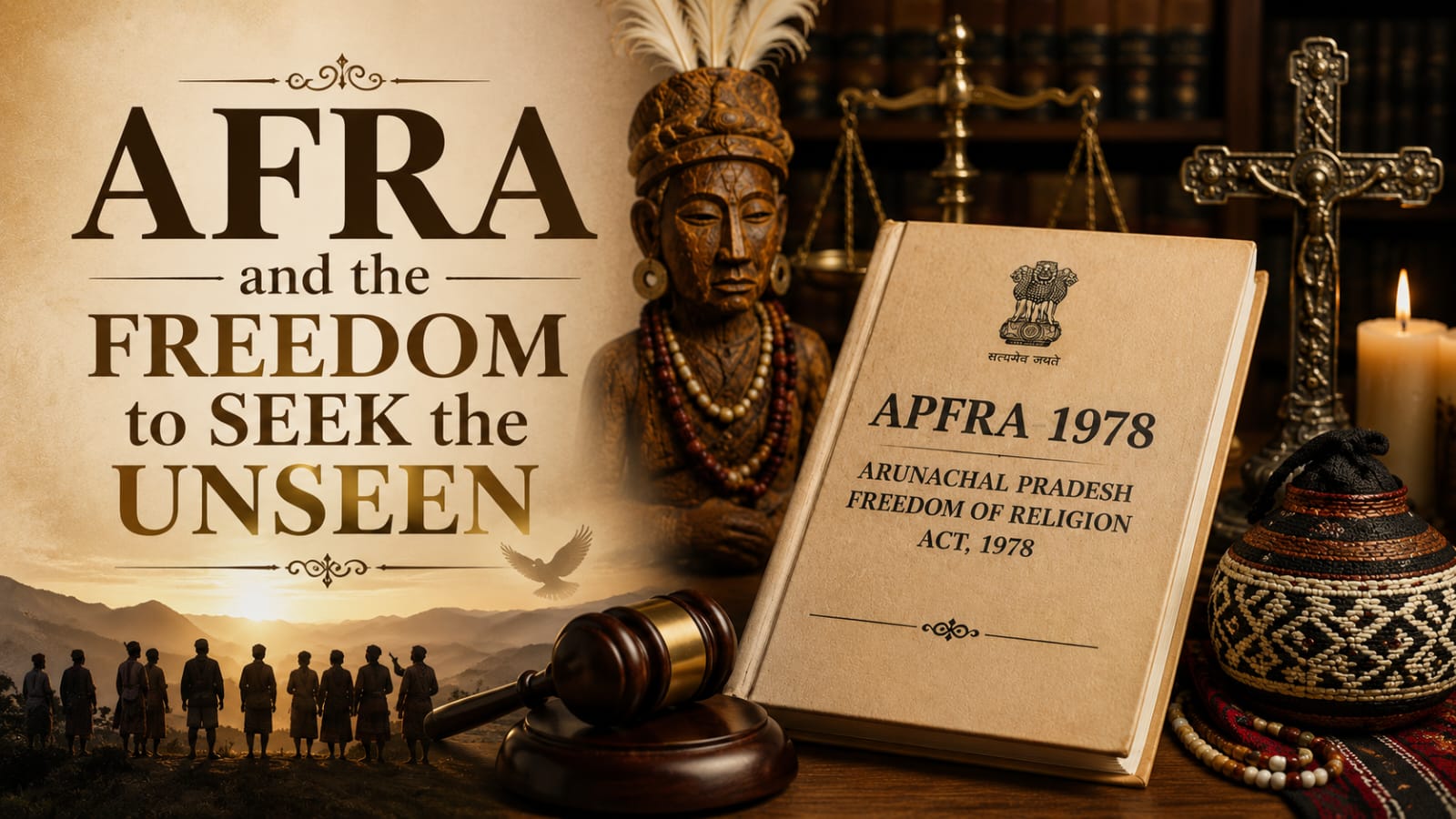
The ongoing debate surrounding the Arunachal Freedom of Religion Act (1978) (AFRA) raises questions that go far beyond the legal and political arguments currently dominating public discourse. At its core lies a fundamental issue of personal freedom: Should individuals be free to choose their spiritual path, or should the state and self-appointed custodians of culture determine that choice on their behalf?
One of the most common arguments advanced in support of such restrictions is that religion and cultural identity are inseparable. History, however, suggests otherwise.
A tribal born into a tribal family does not cease to be tribal because he or she embraces a different faith. Likewise, a non-tribal does not become tribal simply by adopting indigenous rituals. Ethnic and cultural identities are rooted in ancestry, language, customs, history, and shared experiences. They are neither erased nor created solely through religious affiliation.
Moreover, culture itself is never static. It evolves continuously, adapting to changing realities, influences, and interactions. In many ways, the history of every community is also the history of change.
Even within indigenous religious traditions, practices have evolved over time. Today, one can observe customs and expressions of worship that would have been unfamiliar to earlier generations—whether it is the use of “holy water,” praise-and-worship formats that resemble Christian gatherings, or other forms of spiritual expression that have emerged through interaction with different traditions. These developments did not destroy culture; rather, they became part of its ongoing evolution.
The more important question, therefore, is not which path a person follows, but what that path does to the person.
Does it make them more compassionate, responsible, and ethical? Does it inspire them to serve their community? Does it contribute positively to society? If the answer is yes, then on what moral basis can anyone seek to curtail that individual’s freedom to pursue the divine as they understand it?
The AFRA debate also compels us to confront some uncomfortable questions.
Why do we assume that our fellow tribesmen and women are incapable of making informed choices about their own lives?
Why do we regard another person’s spiritual journey as a threat to our own?
Why do we believe that cultural identity and religious diversity cannot coexist?
And perhaps most importantly, why should anyone be denied the freedom to seek truth in a manner they find meaningful?
For centuries, tribal communities have lived alongside one another despite differences in beliefs, customs, and practices. Coexistence—not uniformity—has been the foundation of social harmony.
Passing laws and framing regulations may be relatively easy, especially when governments enjoy political power. The more difficult task is to consider the long-term consequences of policies that risk dividing neighbour from neighbour, brother from brother, and community from community.
History repeatedly teaches that societies are strengthened not by coercion, but by freedom; not by enforced conformity, but by mutual respect.
Political battles may be won. Restrictive laws may even find their place in statute books. Yet before such victories are celebrated, one simple question remains:
At what cost?
By Fr. Felix Anthony
(CLICK HERE to follow Catholic Connect for regular Catholic News & Content)


© 2026 CATHOLIC CONNECT POWERED BY ATCONLINE LLP